

The day after Medicare’s 2027 payment rule came out, a coach brought it up on a call with me. She had read that Medicare was about to start paying for health coaching, and she wanted to know what that meant for a practice like hers. Within the week, coaches were asking versions of the same thing in public: can I bill Medicare, does this include Medicaid, and what does a session pay?
The short answer is that Medicare changed what it pays for coaching. It did not change who it pays. From January 1, 2027, there is a national rate for health coaching, and the claim still belongs to the supervising practitioner, not the coach. Here is what the final rule says, with the page numbers.
I build software for coaches; I am not a Medicare biller. Everything below is tied to the rule’s own text, nothing here is billing advice, and where the rule is silent I say so.
The short version:
| Question | Short answer | Where it comes from |
|---|---|---|
| Does Medicare pay for health coaching? | Yes, at a national rate from January 1, 2027, when a supervising practitioner bills for it and it is reasonable and necessary | CY 2027 Physician Fee Schedule final rule, 91 FR 71112 to 71116 |
| Can a coach bill Medicare herself? | No. The supervising physician or other practitioner bills | 42 CFR 410.26(b)(5), as amended at 91 FR 71689 |
| Does that practitioner have to be on site? | No. General supervision is enough | 91 FR 71114 |
| Which credentials count? | Four named pathways, in a list CMS left open | 91 FR 71115 |
| Is there a cap on sessions? | No, as long as they are reasonable and necessary | 91 FR 71116 |
| Does it change an independent, cash-pay practice? | The rule does not mention one | What the rule does not say |
The questions coaches search for, each answered in a sentence or two, are in Questions coaches ask at the end.
I first saw the numbers laid out by Cherie O’Neill, EdD, NBC-HWC, who directs the Integrative Health and Wellbeing Coaching programs at the University of Minnesota’s Earl E. Bakken Center for Spirituality & Healing. Her breakdown sent me to the rule, and every figure below was then checked against the Federal Register text.
Where you stand decides how to read this
Most of this rule is about one kind of coaching job. Find yourself in the three below and read accordingly.
You are an independent coach, and your clients pay you directly. Nothing in the rule asks anything of you. The question from the billing software post stays the same: who pays you? It is worth reading on anyway: a client on Medicare may ask whether insurance covers coaching now, and the definition of coaching that Medicare adopted is one you will recognize. The sections for you are “Patients determine their goals” and What the rule does not say.
You work for, or contract with, a practice that bills Medicare. You are the coach this rule was written around. Start with Who can bill, and who cannot and Which credentials count. The things coaches in that seat were asking in the first week are a fair list of what to find out: who supervises, what the notes need to show, how sessions are scheduled, and how the coach is paid.
You are wondering whether to move toward that kind of work. The recognition is real, and so is the structure that comes with it. The rule tells you what a practice may bill. It does not tell you what the job is like. The arithmetic, and the calculator under it, are the place to start.
What changes on January 1, 2027
Three CPT billing codes for health and well-being coaching have been in effect since January 1, 2020. Until now, each regional Medicare contractor set its own price for them. The CY 2027 Physician Fee Schedule final rule, released on November 4 and published in the Federal Register on November 9, gives them one national price from January 1, 2027.
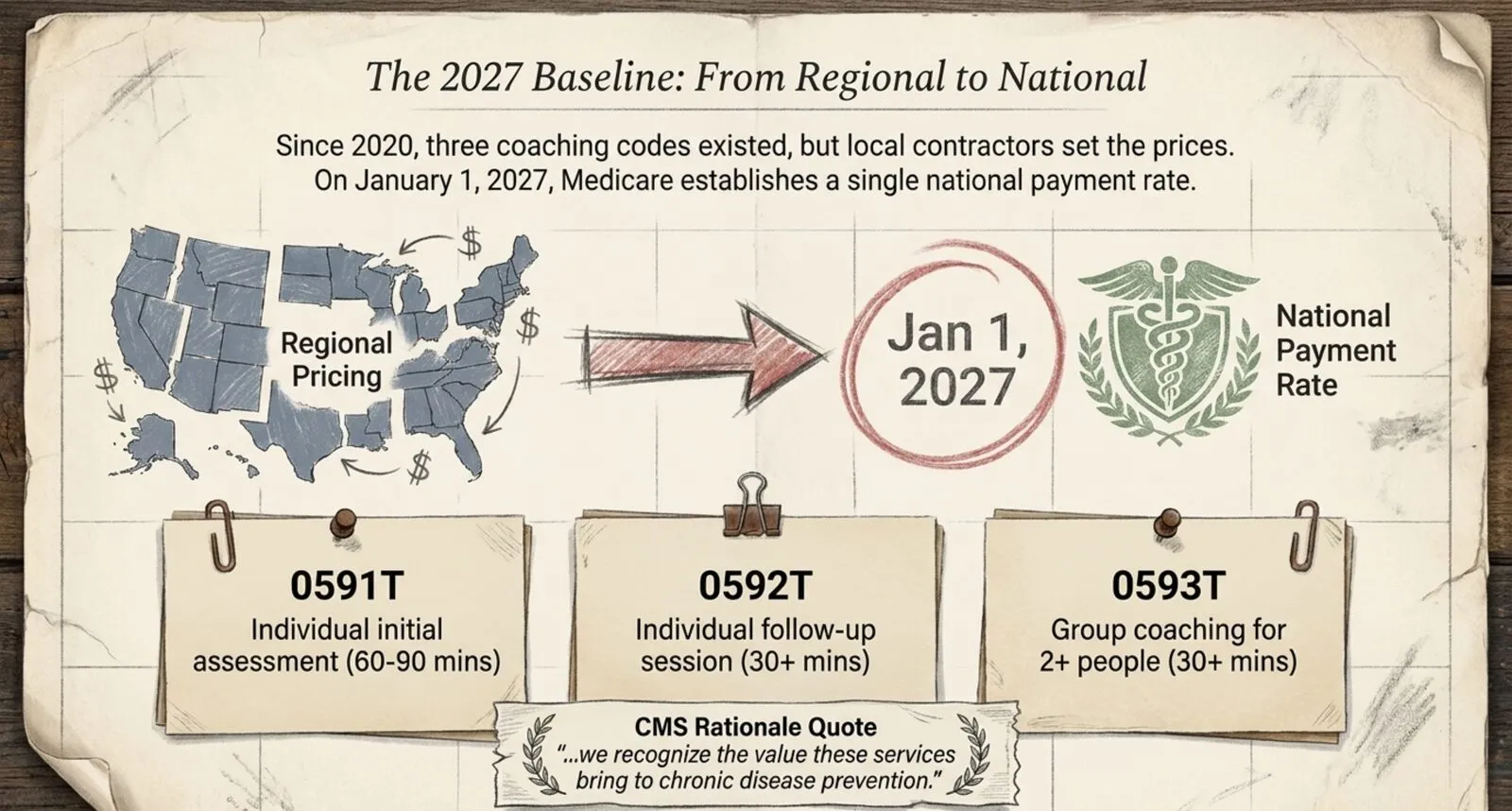
The rule runs 1,029 pages. The coaching section is five of them.
CMS gives its reason in one sentence:
“we are finalizing national pricing for health and well-being coaching, as we recognize the value these services bring to chronic disease prevention.”
The three CPT codes: 0591T, 0592T and 0593T
CMS calls the service health and well-being coaching. Most coaches say health and wellness coaching, and for these codes it is the same work.
The three codes, as CMS describes them:
| Code | What it covers |
|---|---|
| 0591T | Individual initial assessment, 60 to 90 minutes |
| 0592T | Individual follow-up session, at least 30 minutes |
| 0593T | Group coaching for two or more people, at least 30 minutes, billed once for each Medicare beneficiary in the group |
Three more things are settled in those five pages.
- No cap on sessions, with a condition and a warning: “we are not finalizing frequency limitations for these codes, as long as they are reasonable and necessary. We will monitor utilization and may re-evaluate these policies in future rulemaking.”
- Stress, sleep and behavior are in scope. “Behavioral health needs should not be precluded from being addressed by health coaches when medically necessary.”
- Telehealth stays. The codes have been on Medicare’s telehealth list since 2024, with an expiry date I come back to below.
Who can bill, and who cannot
The headline version of this news is “Medicare now pays health coaches.” The rule pays someone else for the coach’s work.
The coach is what the regulation calls auxiliary personnel: someone who furnishes a service under a practitioner’s supervision, “incident to” that practitioner’s own care. The amended regulation is plain about the claim:
“Only the supervising physician (or other practitioner) may bill Medicare for incident to services.”
Why not let a board-certified coach bill for herself? CMS answered that a year earlier, in the 2026 rule:
“health coaches do not have a Medicare benefit category and therefore cannot bill Medicare directly (a new benefit category requires statutory change)”
“Statutory change” means Congress. CMS cannot grant it in a payment rule, however many coaches ask.
The National Board for Health & Wellness Coaching says the same in its FAQ on the final rule, and heads off a common assumption about provider numbers: “Having an NPI does not automatically provide Medicare billing privileges or authorize an individual to bill Medicare independently.”
The practitioner does not have to be in the building
This is where the final rule moved, and it moved because people wrote in.
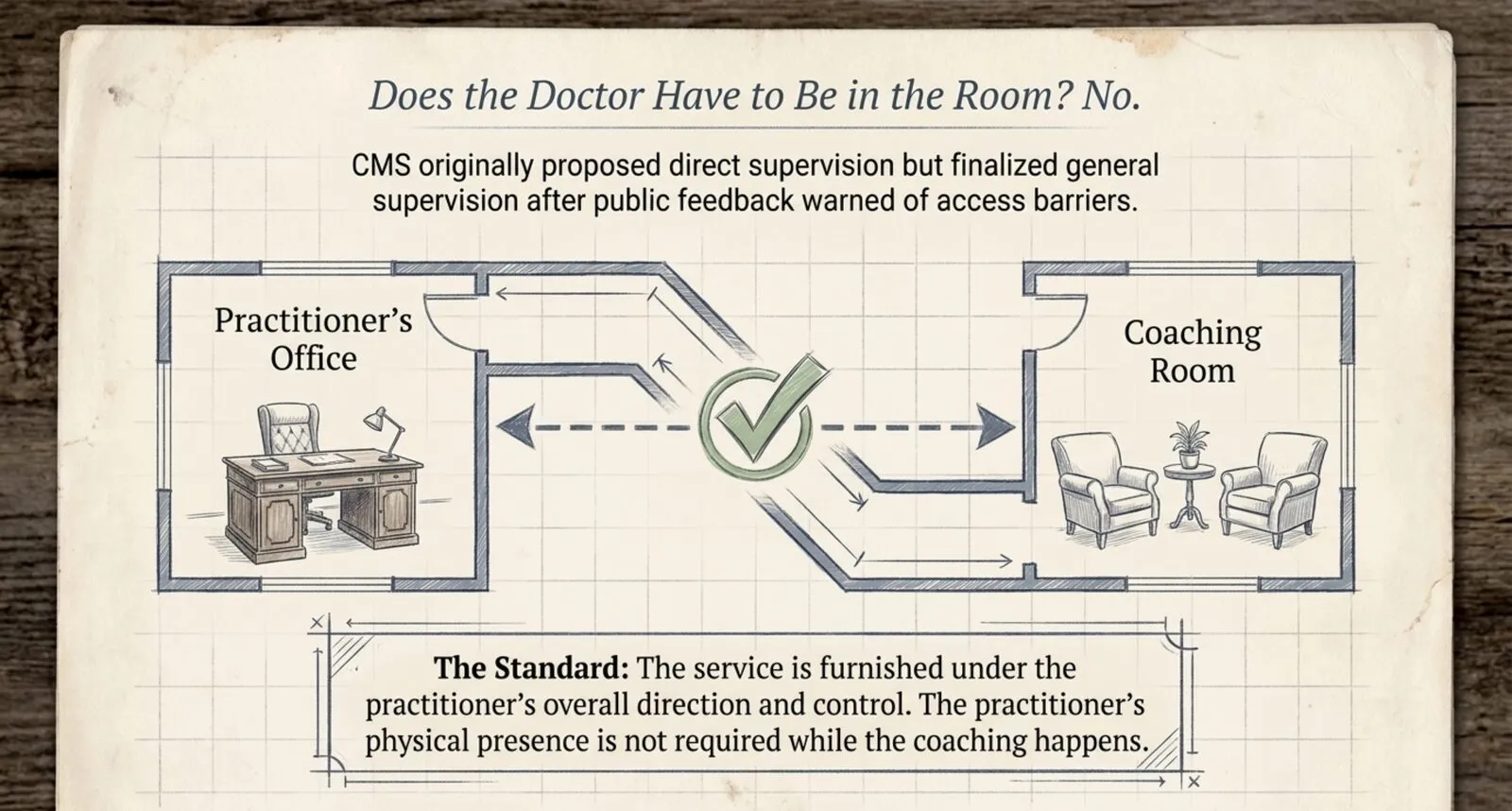
In July, CMS proposed direct supervision, which keeps the billing practitioner immediately available while the service happens. Commenters told the agency that this would “create unnecessary barriers and would impede access for populations most in need.”
CMS’s reply:
“Based on comments received, we now agree that health and well-being coaching should be performed under general supervision of the billing practitioner instead of as proposed with direct supervision.”
Under general supervision, the service is furnished under the practitioner’s overall direction and control, and the practitioner’s presence is not required while it happens.
Independent coaches and community organizations
The regulation’s definition of auxiliary personnel covers employees, leased employees and independent contractors, so an independent coach is not shut out by the wording. NBHWC’s FAQ puts it carefully: independent practitioners “may be able to participate through arrangements with eligible healthcare practices, health systems, or other organizations.” Whether a particular arrangement qualifies is a question for the practice and its billing counsel.
The rule also names community-based organizations, the not-for-profits such as area agencies on aging that often employ coaches. A coach employed by or affiliated with one “may provide health coaching services under general supervision of a physician or non-physician practitioner,” as long as the certification standard is met.
Two groups asked for more and did not get it. Nurse organizations asked CMS for “exemption from supervision requirements for licensed professionals” and for “direct billing pathways.” The final rule does not take that up, so a nurse coach works under the same general supervision as everyone else. Rural health clinics and federally qualified health centers asked to bill the codes, and CMS answered that coaching there does “not constitute a billable RHC or FQHC visit.”
Which credentials count
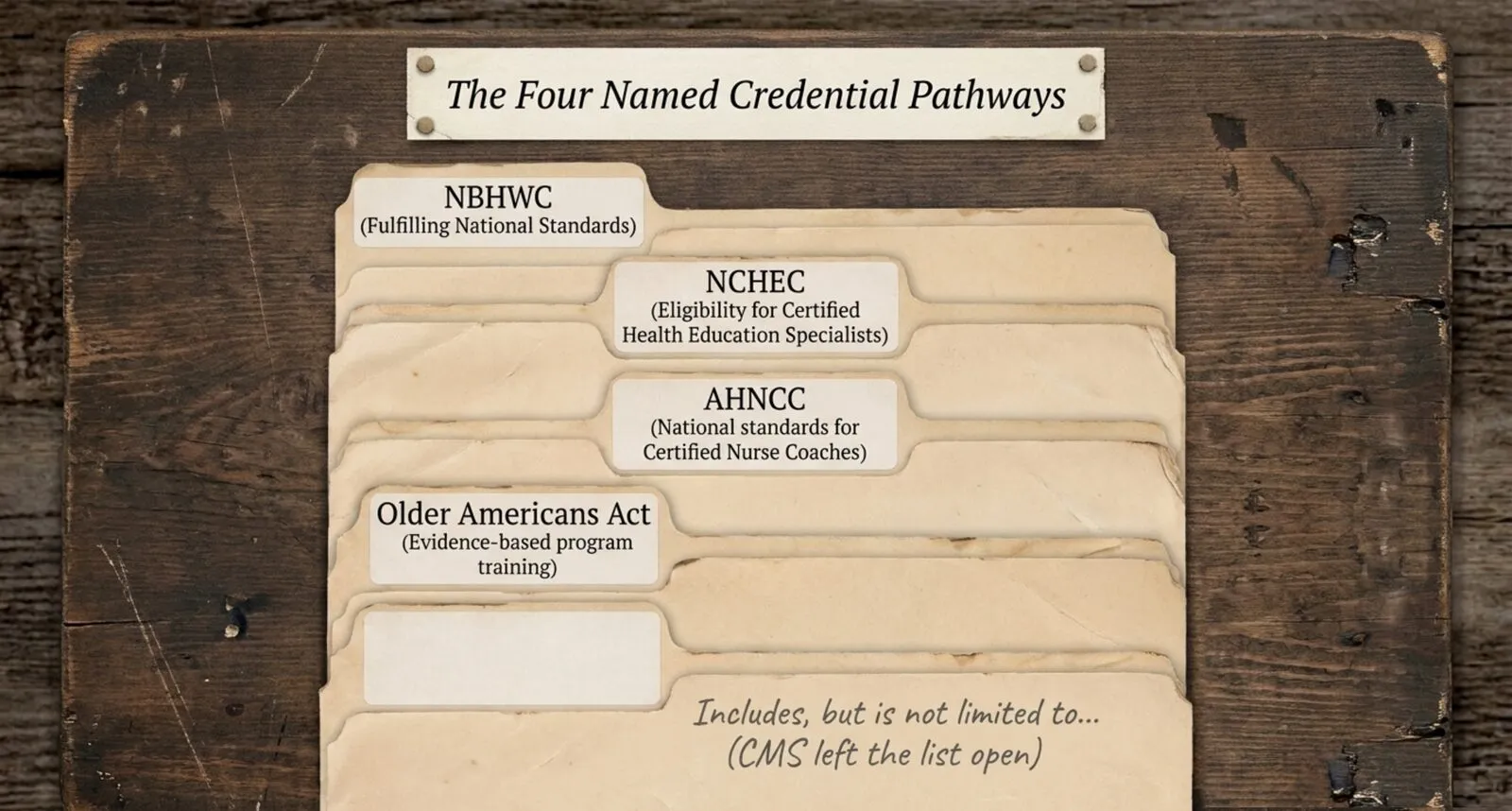
The coach must have “appropriate certification to perform the services, which includes, but is not limited to,” the following:
- fulfilling the National Board for Health and Wellness Coaching National Standards
- the National Commission for Health Education Credentialing’s eligibility for Certified Health Education Specialists
- the American Holistic Nurses Credentialing national standards for Certified Nurse Coaches
- training from the evidence-based health promotion and disease prevention programs funded under the Older Americans Act
Two details in that wording are easy to miss.
The list is open: CMS named four pathways without saying they are the only ones, and it did not say what else would count.
The phrase is “fulfilling the National Standards,” and the rule does not say that holding the NBC-HWC credential itself is required. Board certification is the clearest way to show you meet that standard. Whether a particular arrangement with a practice qualifies is a separate question.
What Medicare pays, and why that number is not your rate
CMS does not print a dollar amount for these codes anywhere in the rule. It publishes relative values and a conversion factor, and the dollars are multiplication.
CMS set two conversion factors for 2027: 32.9548 for practitioners who are qualifying participants in an alternative payment model, and 32.6286 for those who are not. The figures here use the second. With the first they come out about one percent higher.
Here is the arithmetic, using the total office-setting values in CMS’s Addendum B and the 2027 conversion factor of 32.6286:
| Code | Total relative value | Times 32.6286 |
|---|---|---|
| 0591T, initial assessment | 4.22 | $137.69 |
| 0592T, follow-up | 2.27 | $74.07 |
| 0593T, group, per beneficiary | 0.69 | $22.51 |
Read those figures with two cautions. They are national figures before Medicare adjusts for location, and for an office setting; in a hospital or other facility the values are roughly half. And CMS was still updating its files the week the rule published, so check the current file before quoting anyone a number.
The larger caution is what the figure is. “Medicare reimbursement for health coaching” sounds like money paid to a coach. It is the amount Medicare allows the practice that bills. It is not a wage, and it is not a session rate. What a coach is paid out of it is whatever she and the practice agree to, and the rule does not set that.
What could these rates mean for a practice?
Enter how many individual and group sessions happen in a month to see what a practice that bills Medicare would be allowed at the national figures. It starts with two questions about how you work, because the answer depends on where you stand. The result is the practice’s allowed amount, never a coach’s pay.
Two questions about how you work. If the rule's supervised path fits, add your session counts to see the arithmetic.
Leave a field blank if it does not apply.
Enter how many sessions a month to see the arithmetic.
This is not what a coach is paid. It is the amount Medicare allows the practice that bills. Your pay is whatever you and the practice agree to.
National figures for an office setting, before Medicare adjusts for location. Facility settings are roughly half.
CMS's 2027 relative values times 32.6286, its 2027 conversion factor for practitioners who are not qualifying participants in an alternative payment model. For those who are, the factor is 32.9548 and the amounts are about one percent higher. The rule prints no dollar amount for these codes.
Not billing advice. The billing practitioner at the practice is the person to ask.
If you set your own prices, the pricing post is the one that applies to you, and nothing in this rule changes it.
If you are weighing whether to work this way, the person to ask is the billing practitioner at the practice you would work with. They carry the claim, and they will know what their Medicare contractor expects.
“Patients determine their goals”
This is the part of the rule I keep rereading.
CMS did not write its own definition of coaching. It adopted the one already attached to the codes in the American Medical Association’s CPT language:
“Health and well-being coaching is a patient-centered approach wherein patients determine their goals, use self-discovery or active learning processes together with content education to work toward their goals, and self-monitor behaviors to increase accountability, all within the context of an interpersonal relationship with a coach.”
So the thing Medicare is paying for is, by definition, a relationship in which the patient sets the goals. At Grove we call that client-led coaching: the client owns the plan, and the coach stays close to it.
Cherie O’Neill named the tension in that better than I can:
“Medicare is paying for a relationship in which the patient sets the goals. The billing runs through clinical structures: supervision, medical necessity documentation, productivity targets. Keeping the patient’s agenda at the center is now the work of educators, employers, and coaches.”
I build software, so I tend to ask what a system counts. A billing system counts sessions, minutes, and whether a note supports “reasonable and necessary.” None of those fields asks whose goal it was. The definition does.
What that means inside a session is a coach’s call, not mine. What I can point to is where the rule leaves room. On session frequency, commenters argued that it “should be determined by clinical need and beneficiary-specific goals, rather than arbitrary caps,” and CMS kept the policy with no cap. And NBHWC’s FAQ is blunt on the boundary: “Payment does not change professional scope.”
Grove is not billing software and does not submit claims. What it keeps is the part that definition describes: a plan the client leads, the goals they set in their own words, and a session log that belongs to the coach. That is true whoever is paying.
What the rule does not say
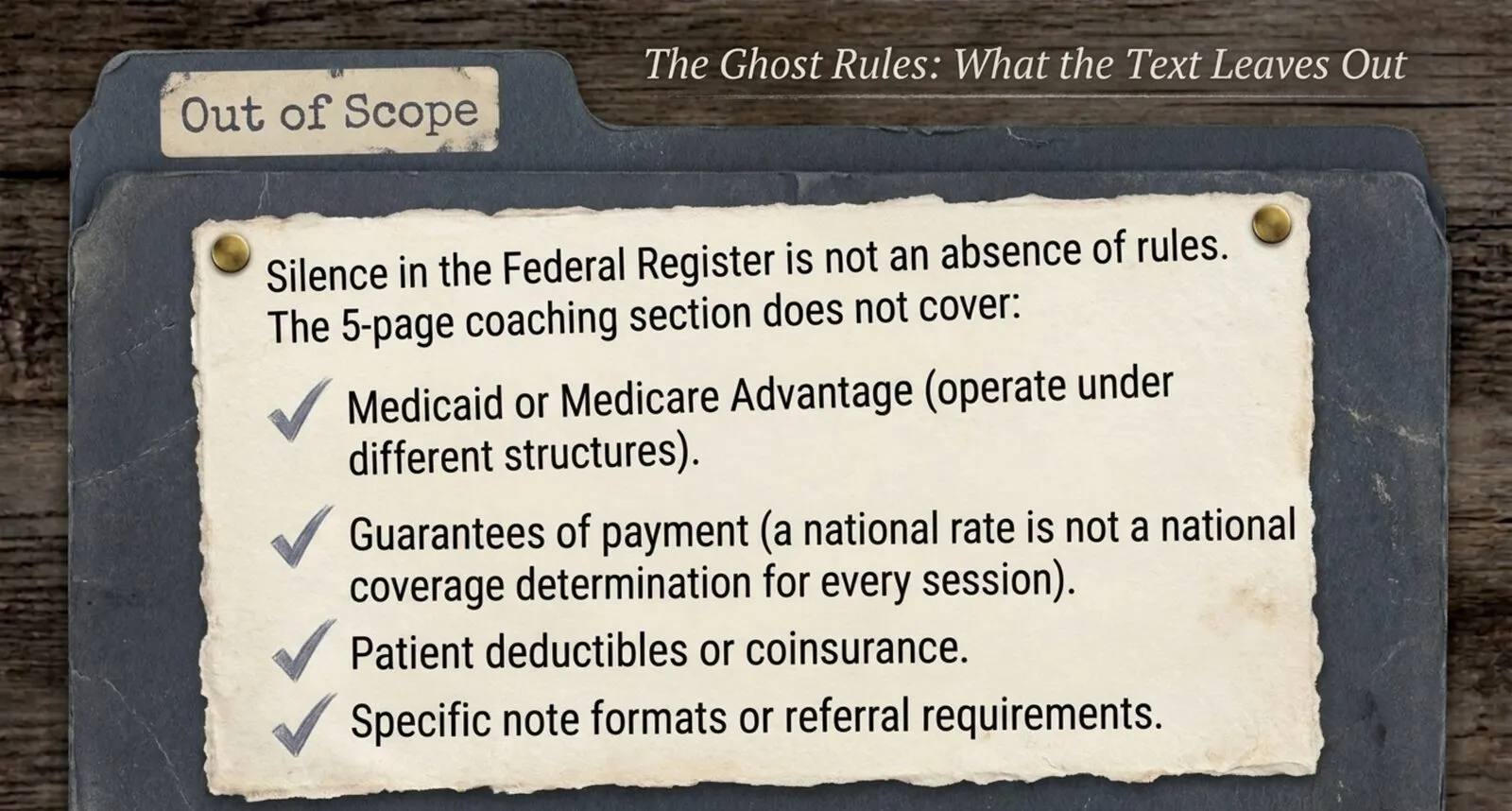
Most of the confusion I have seen since November is about things the rule never addresses. Silence in these five pages is not the absence of rules: Medicare’s general requirements for the practice that bills sit elsewhere, and they still apply.
- Whether any one session is covered. A national price is not a promise that a particular claim is paid. CMS’s own key to its payment file says an active code “does not mean that Medicare has made a national coverage determination regarding the service.”
- Medicaid and Medicare Advantage. The coaching section mentions neither. NBHWC’s FAQ: “This reimbursement pathway concerns Original Medicare physician-fee-schedule policy. Medicare Advantage and state Medicaid programs operate under different payment structures.”
- What the patient owes. The section says nothing about deductibles or coinsurance.
- Diagnoses, orders, care plans and documentation. The section sets no list of conditions, no referral requirement and no note format. The only tests it states are “reasonable and necessary” and “medically necessary.” NBHWC says it is still working through the operational details.
- Telehealth after 2027. The codes are on the telehealth list, but the flexibilities that let a Medicare patient be seen at home run through December 31, 2027, and audio-only through January 1, 2028. Both depend on Congress.
- Independent, cash-pay coaching. The section never mentions it. The rule creates a payment to a supervising practitioner, gives a coach no way to enroll, and requires nothing of any coach.
I read that last one as nothing changing for an independent practice, and I am reading silence, which is different from reading a rule. If you also hold a clinical license that Medicare recognizes, such as a registered dietitian or a nurse practitioner, your position is different, and it is worth a conversation with someone who does this for a living.
Where to ask what comes next
NBHWC has set a date to talk about the year ahead. Its 2027 Town Hall is on January 13, and the agenda is the board’s priorities for the year and what its annual survey found, with a live Q&A. The page does not promise Medicare answers, but it is a room where the question can be asked.
The part that belongs to coaches
For years the objection coaches heard from clinics was a billing question: what is the code, and who pays for it? From January there is an answer, and it arrives inside a medical practice’s claims process, with everything that implies.
What I notice is what came along with the price. CMS took the definition the field already had, the one where the patient determines the goals, and made it the description of the service it pays for. The rates may change. The rules around them may change too. The definition is the part worth holding on to: the patient determines the goals. A payment system can support that relationship, or it can quietly take it over.

Sources. The final rule (CMS-1848-F; the coaching section is 91 FR 71112 to 71116), CMS’s Addendum B, the 2026 final rule (90 FR 49480), and NBHWC’s FAQ of November 5, 2026.

Founder of Grove. Twenty years building software for skilled professionals. Currently writes mostly on Tuesdays from a small studio in Austin.
