
This summer I hired a coach. Six months, a program price in the low thousands, and when we got to the money she said the thing that closed it: you can split this into monthly payments if that helps. It did. I had the budget for the coaching and not for the lump sum, and without the plan I would have said “let me think about it” and probably never come back.
I have since heard the coach’s side of that conversation from most of the coaches I talk to while building Grove. It comes down to two questions they say their training barely touched: what do I charge, and do I sell one session at a time or a package. The advice they find afterward tends to be “charge what you’re worth.” The useful answer has numbers in it, and a structure that makes the numbers work.
The short version, if you came for the numbers. Private-practice health coaches charge a median of $100 for a one-hour session, and most land between $75 and $150. Sell the coaching as a package rather than one session at a time: eight to twelve weeks for a first package, three to six months for the main one. Quote one price for the whole program; at the median, six sessions over eight weeks is $600. Offer a payment plan with a fixed total to the client who budgets by the month. The rest of this post is why each of those holds, and where the exceptions are.
1. How much to charge per session: the two numbers coaches confuse
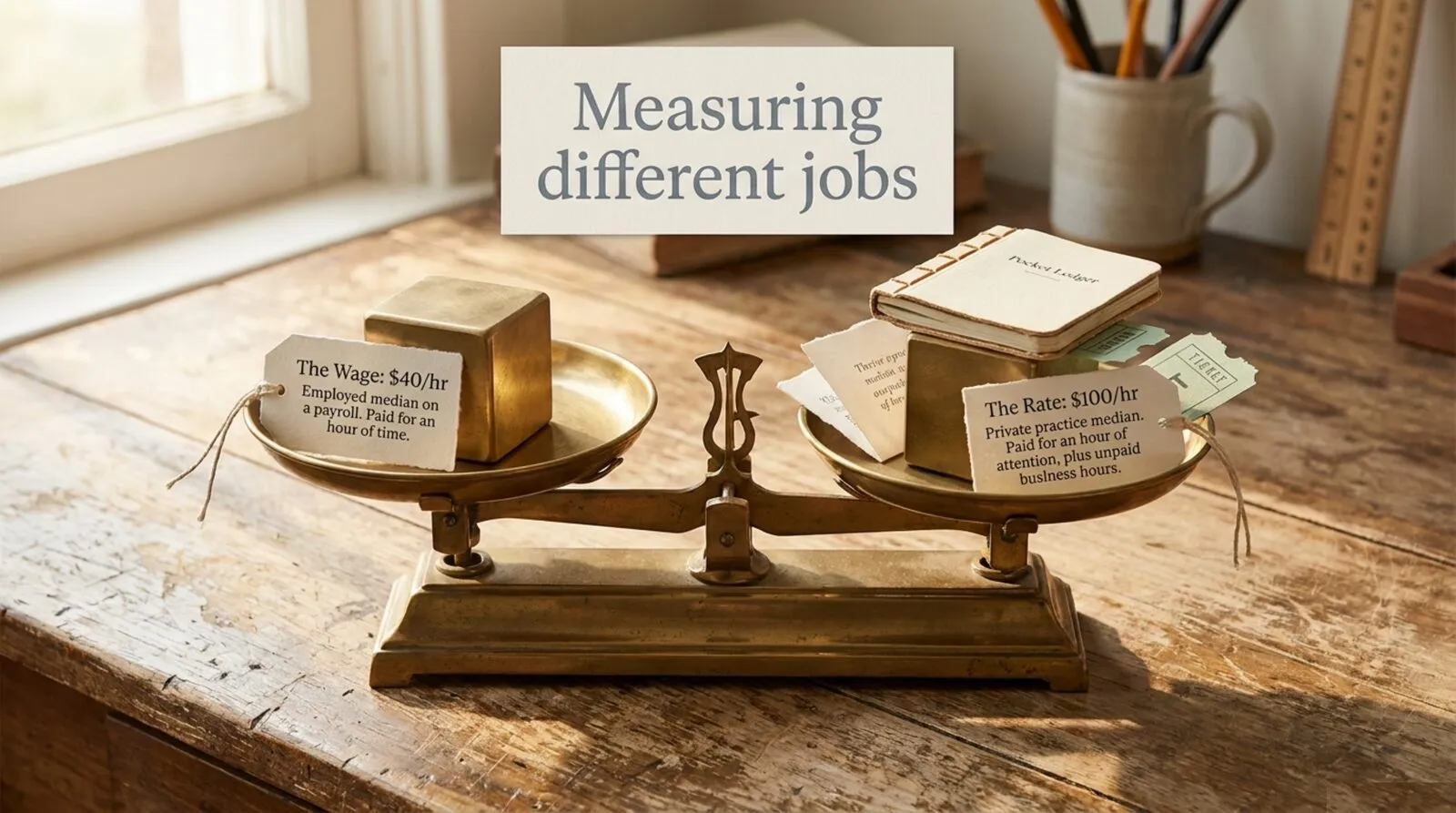
When a coach searches for what to charge, she finds two figures that seem to contradict each other. Salary aggregators say a health coach earns $25 to $40 an hour. Certification programs say a private practice bills $100 to $150 an hour. Both are real. They measure different jobs.
The National Board for Health & Wellness Coaching asked its own certified coaches in the 2025 Annual Survey. Employed coaches, the ones on a payroll at a clinic or a company, reported a median hourly wage of $40. Coaches in private practice reported charging a median of $100 for a one-hour session, with most rates between $75 and $150. I went through the whole survey in How much do health coaches make? The short version: the wage is what an employer pays for an hour of your time. The rate is what a client pays for an hour of your attention, plus every unpaid hour it took to find her.
So if you are setting a private-practice rate, the market has already published a range; start inside it. Below $75 can read as uncertainty rather than generosity to someone who has never bought coaching, and a low rate is harder to raise than a fair one. Pricing lower on purpose, for a community you have chosen to serve, is a decision and not a mistake; the survey notes that coaches working with teens, rural communities, veterans, LGBTQIA+ clients, and clients with chronic conditions or mental health needs were all less likely to earn $50,000 or more. Above $150 is a real position some coaches earn, usually with a niche and a referral stream behind it. The median did not move between 2024 and 2025, so waiting for the market to lift your rate is not a plan.
If you are brand new and charging less on purpose to get your first reps, that can make sense too. Treat it as a defined early-practice rate, not a verdict on what the work is worth: a lower rate for your first five clients, an end date decided in advance, and new clients at the full rate once those reps are behind you. Those first clients are also where you learn what people actually need between sessions, how much prep the work takes, and the words they use for what they got. Ask for honest feedback when the package ends, and, if they are willing, permission to use their words. One line to keep straight: a discount given in return for a review is a connection the FTC’s endorsement guides say has to be disclosed, and the discount cannot depend on the review being good. Price low to learn, and ask for the testimonial afterward, as a separate request.
ACE’s guidance for new coaches, What to Charge as a New Health Coach, starts from the other direction and lands in the same place. Work out the yearly income the practice needs, divide by the weeks you will work and the hours you can coach, and treat the result as a baseline rather than a price. Their worked example is $36,000 a year over 48 weeks at 15 coaching hours, which comes to $50 an hour of coaching. The gap between that baseline and the survey’s range is the rest of the job: prep, notes, follow-up, and the hours spent finding the next client. A $100 session is not greedy. It is what starts to make sense once the rest of the work is priced in.
The same arithmetic runs forward, too. A year of income is your session rate, times the sessions you hold each week, times the weeks you work. At the survey’s $100 median, ten client sessions a week across ACE’s 48 working weeks comes to $48,000, before expenses and before the unpaid hours behind every one of those sessions. Change any one of the three numbers and the year changes with it. The Ledger below runs the same math with your own numbers, unpaid hours included.
2. Packages vs. single sessions
The textbook case for single sessions is flexibility: the client commits to one hour, pays one price, nobody feels locked in. The case for packages is usually made as a revenue argument: more money up front, steadier income.
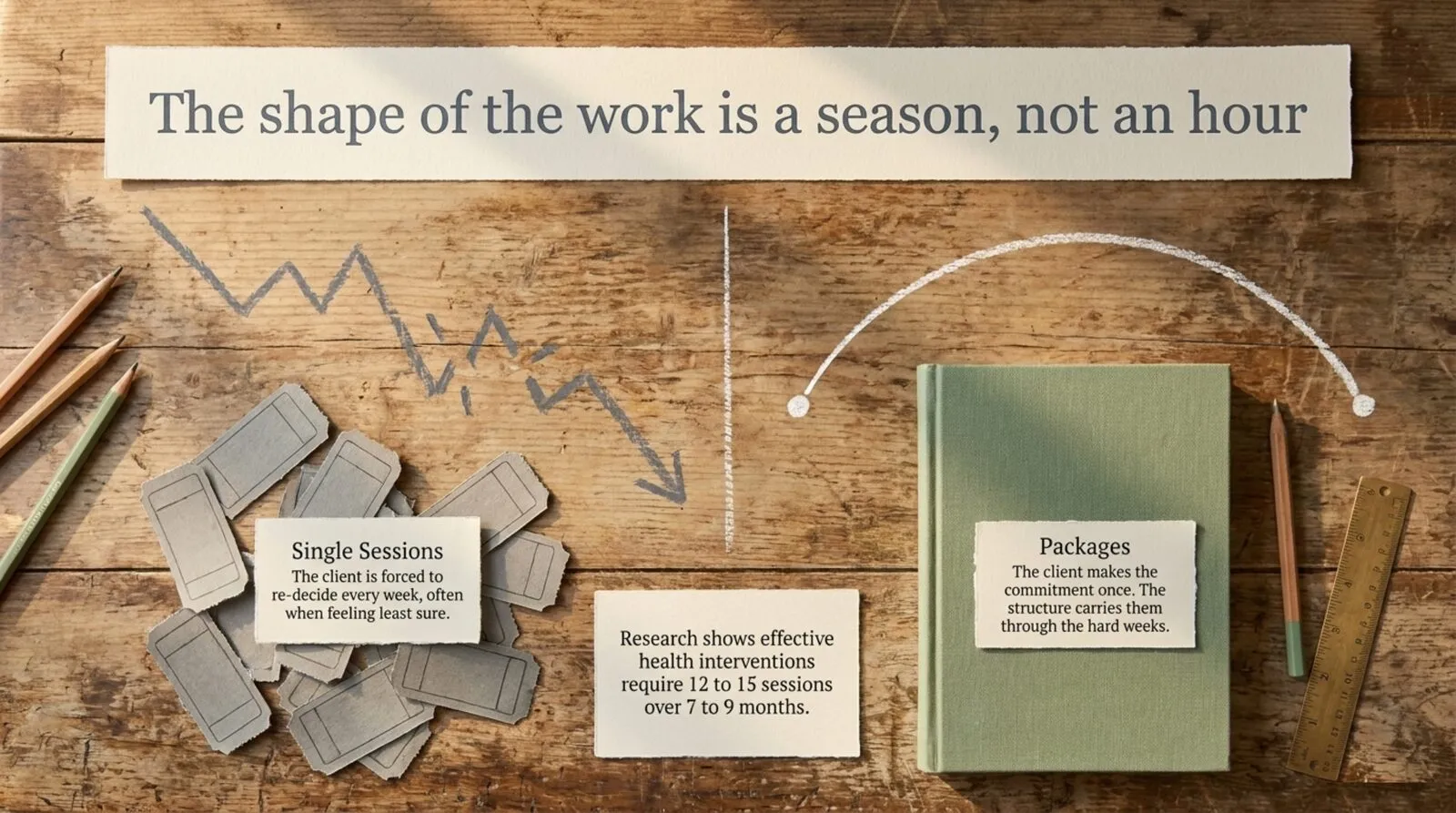
Both are true, and neither is the reason I find convincing. The reason is how long the work takes. Sforzo and colleagues reviewed 88 health coaching studies to work out how much coaching the research literature actually used for obesity and type 2 diabetes. The answer was 12 to 15 sessions of 35 to 40 minutes over seven to nine months. That research says nothing about how to bill. It does say something about the shape of the work: the intervention is a relationship over a season, not an hour and not four weeks.
Here is the interpretation I would add. On single sessions, every session is a renewal decision, and the client makes it alone, between sessions, often at the moment she feels least sure about her progress. On a package, she makes the decision once, at the start, when she is most hopeful, and the structure carries her through the weeks she would otherwise have quietly skipped. The coach is not re-earning the next hour every week. She gets to spend the week coaching. That is a behavioral argument, not a spreadsheet, and I hold it as a strong hunch rather than a proven result.
A founding coach with nearly twenty years of practice walked me through how her clients have actually paid, and every arrangement she described had a shape: a three-month program, an extension that continued the current plan, a six-month arc with the payments spread over a longer stretch to keep it reachable. The single session, in her practice, is the discovery call. Everything after it is a package of some kind.
The survey agrees from the other direction. Coaches named finding clients, not pay, as their hardest problem. If finding clients is the expensive part, a package means you do it once per season, and the weeks in between are coaching rather than re-selling.
How to structure a coaching package
Three decisions, in order.
Length. Pick a term that matches a change, not a calendar quarter. Eight to twelve weeks is long enough to see a habit start to take and short enough for a new client to say yes to; ACE’s example is an eight-week program with six sessions. Three to six months is the shape I hear most from experienced coaches. The research programs ran longer still, seven to nine months with sessions spacing out over time, so a longer package is not an indulgence. Offer the shorter one first, and the longer one when it ends.
Sessions. Decide the count and the cadence, and write both down. Weekly for the first month and every other week after is the most common rhythm I hear, and it matches the literature, where programs tended to taper as they matured. Six sessions in eight weeks, ten in twelve, twelve across six months. The exact number matters less than the client knowing it before she pays.
Between sessions. This is the part that is easiest to leave out of the price and then resent. A check-in form, a weekly message, a reply within a day, a plan the client can see: name what is in and what is not. ACE makes the same point: the value is the full scope of support, not the minutes in the session. If you offer between-session support, it belongs in the package description and in the price, because for many practices that is where a good part of the coaching happens.
Then one price. Not “$100 a session, six sessions.” One number for the program. At the survey’s median, six sessions in eight weeks is $600 and ten sessions in twelve weeks is $1,000; those are illustrations built from the median, not recommendations. A session rate invites the client to do the division and compare it to a gym membership. A program price asks whether the change is worth it. Quote the program. Keep a per-session rate for the single sessions you still offer, and let it sit a little above the rate implied inside the package, so the package is the obvious choice without a discount sticker on it.
Coaching package examples
Three shapes, priced at the survey’s $100 median so the arithmetic stays visible. They are illustrations, not recommendations; swap in your own rate and the last column moves with it.
| Package | Length | Sessions | Between sessions | Price at $100 a session |
|---|---|---|---|---|
| First package | 8 weeks | 6, weekly and then every other week | A weekly check-in and messaging | $600 |
| Core program | 12 weeks | 10 | The same, plus a written plan the client can see | $1,000 |
| Season | 6 months | 12, every other week | The same | $1,200, or six monthly payments of $200 |
Retainers, intensives, and group programs
Three other shapes show up once a practice has a core package. A retainer is what comes after a package ends: a set number of sessions a month, billed monthly, for a client who has made the change and wants to keep it. Unlike the payment plan below, a retainer is a subscription, so say how either side ends it. An intensive is one long block, a half day or a full one, priced as a program rather than by the hour, because the prep and the follow-up are most of the work.
A group program trades individual time for a lower price per person. Price the seat for the whole program, the same way you quote a package, rather than per session. Then work out the smallest group that still runs: start from what the program has to bring in for the hours it takes, sessions plus prep plus the messages in between, and divide by the seat price. As an illustration, six weekly group sessions at $300 a seat (half the $600 first package above) bring in $1,800 with six people and $2,400 with eight. If six is your floor, decide before you open sign-ups what happens when only four join: a later start date, a refund, or a move into a one-to-one package.
When you raise your rate, raise it for new clients. Existing clients keep the terms they signed until the package they signed ends. It is simpler, it is kinder, and it means the price on your booking page is always the current one.
3. Payment plan or paid up front
A payment plan is not a subscription. A subscription renews until someone stops it. A payment plan is a fixed total split into a known number of monthly payments: six months, $1,800, six payments of $300. Both sides know the total, and the arrangement ends when the last payment lands.

The reason to offer one is the reason my coach did. The plan is often the difference between yes and “let me think about it.” A $1,500 program and a $250-a-month program over six months are the same money, and they are not the same decision. For a client who budgets by the month, the second fits in a way the first never will. Coaches who print “payment plans available” on their offers are not discounting. They are meeting the client’s budget where it lives.
Two things to decide before you offer one, and to write into the agreement so you never decide them in the moment.
First, what a payment buys. The clean rule is that sessions become available as payments land: payment one of six clears, and the first portion of sessions can be booked. It keeps the plan honest for both sides. Some coaches deliberately deliver ahead of payment, a three-month program paid over six, as a trust extension to a client who needs it. That is a credit decision as much as a kindness. Make it on purpose, for a specific client, rather than as the default for everyone.
Second, what happens on a missed payment. Cards expire, accounts dip, and a failed charge in month four is not a moral event. Decide now: sessions already delivered stay delivered, sessions already booked still happen, and nothing new becomes available until the payment clears. Then the coach, not the software, reaches out. “Your card didn’t go through on the fourth payment; here is how to update it, and the next session opens up when it does” is a sentence that belongs in a coach’s voice, in a thread the client already trusts. A payment processor will retry the card and send its own receipts; that is fine. What should not happen is a client getting a collections-flavored email from a tool she never chose, about a relationship that was supposed to feel safe. Keep the money conversation human and the plan has a fair chance of surviving the missed month.
While you are writing that rule down, write the others next to it: how long the package stays valid, what happens to unused sessions, how either of you ends it early, and whether anything is refundable. The missed payment is the rule coaches think about. The expiry date is the one they regret skipping.
4. Private packages for returning clients and exceptions
The public price list should be short. Two or three packages, one single-session rate, a discovery call. That is what a stranger can read and say yes to.

Clients do not stay strangers for long, and the longer you coach, the more of them have terms of their own: the returning client who wants three sessions, not a program; the one finishing a package who wants an extension at the old rate; the one whose six months of payments you are quietly spreading across nine; the colleague you coach at a professional courtesy. None of these belong on the booking page. All of them deserve a real package, a real price, and a real agreement, rather than an informal transfer and a mental note.
The founding coach I mentioned described what she wants as both/and: straightforward public options, plus the ability to shape an offer for one person. That is the whole design. The public page is for people who have not met you. The private package is for people who have.
It is also, plainly, what I have been building in Grove since September. A coach composes a package once (sessions, length, what is included, the price) and chooses whether it goes on her booking page or out by invitation, as a link for one client that never appears on the public page. That part is live. Payment plans, where a package total splits into monthly payments and sessions become available as each one clears, will be available later this quarter. Grove does not chase a client for a missed payment: it tells you, not her. And it does not rewrite a package in place. If the terms change, you make a new package and send a new link, because a change in terms is a new agreement and it should look like one.
What the price is really for
Almost none of this is about the number. The number sits in a range the survey already published, and most coaches land near its middle. The decisions that change a practice are the ones around it: whether the client decides once or every week, whether the terms are written before the hard month or during it, whether the exception you make for one person is a real agreement or a favor you will forget you made.
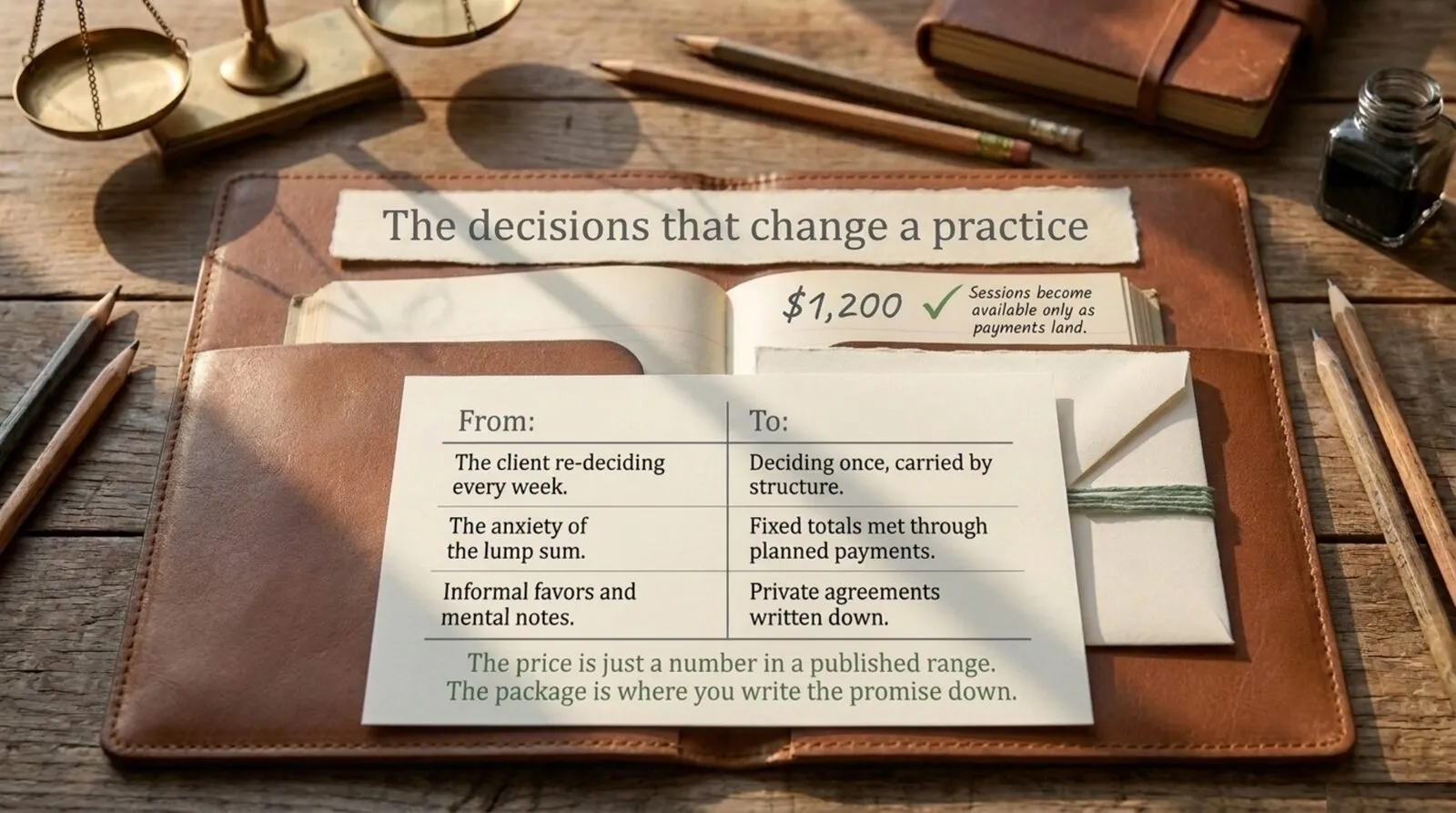
Every survey number I used here is in the survey post, with the arithmetic shown. A price is a promise about what the work is. The package is where you write the promise down.

Founder of Grove. Twenty years building software for skilled professionals. Currently writes mostly on Tuesdays from a small studio in Austin.