
This week, in my regular scan of what the health coaching field posts, two newly certified coaches shared their certificates on Instagram. Same week, same platform. One wrote that she was “so excited to walk alongside people as they reach their health and fitness goals.” The other called it the start of a new chapter after ten years in another career.
I love those posts. They are the most hopeful artifacts the field produces. And every time I see one, I think about what the next six months look like for that person, because the coaches I have talked to while building Grove describe those months the same way: a cliff.
Here is the strange part. The organizations that sell certification know about the cliff. The same week those two certificates went up, one large certification org posted market-opportunity numbers to its feed: 75.5 million health club members in Europe, a 39 billion euro market, demand for certified professionals “bigger than most people realize.” Three posts later, the same org described what it called the income roller coaster: fully booked one month, scrambling the next, trading every free hour for a paycheck. Their solution was a waitlist for a business course bundle.
Both posts are accurate. That is the problem. The market is real, the roller coaster is real, and the thing between them, the actual sequence of moves a newly certified coach should make in their first 90 days, is the part nobody writes down. It does not sell courses.
So here is my attempt, assembled from the coach interviews I have done while building Grove, from watching what the field publishes every week, and from having been the client of a coach who was starting out herself.
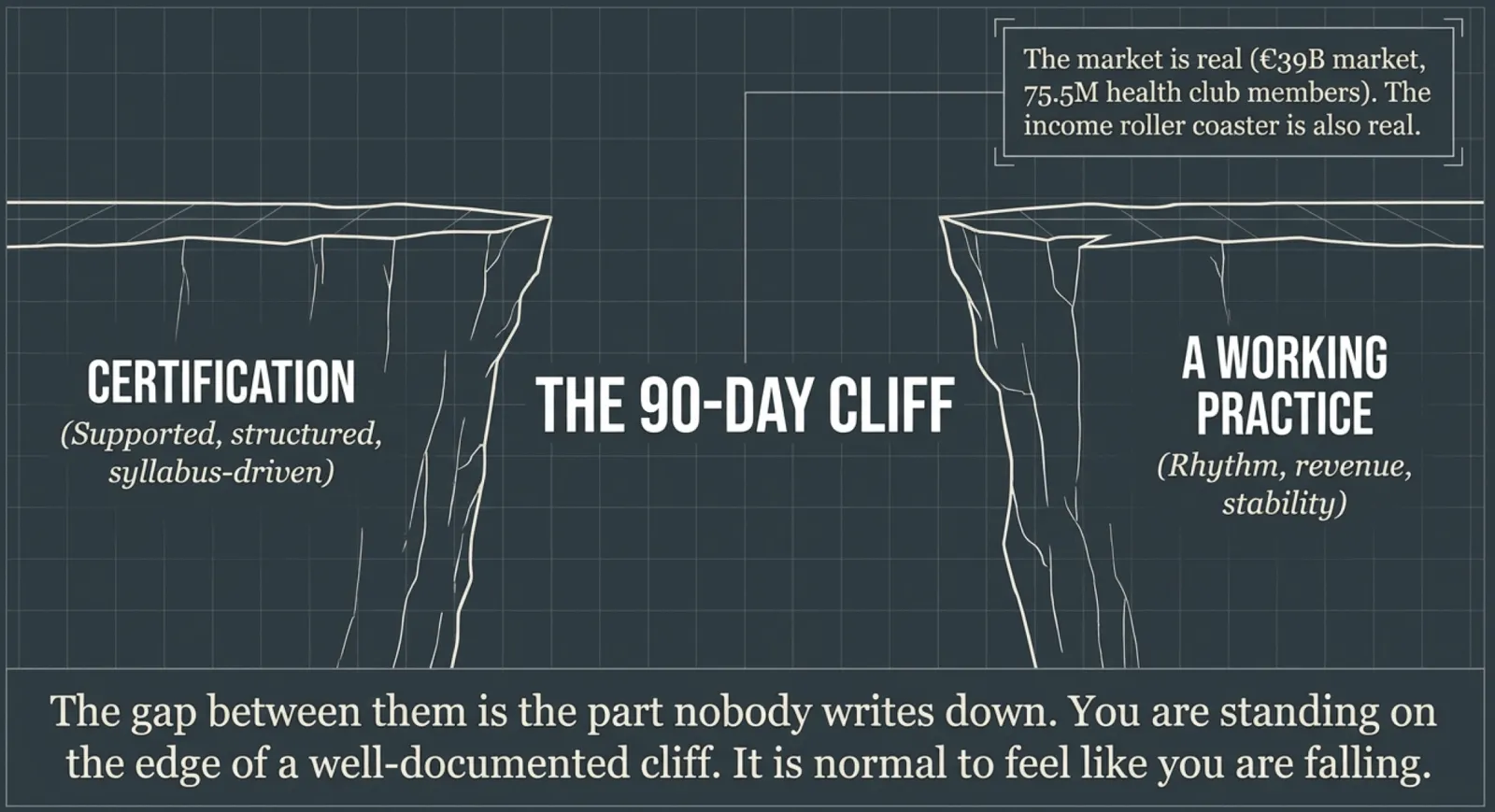
The gap is not a competence gap
First, the reassuring part. The coaching itself works, and the evidence is better than most new coaches realize.
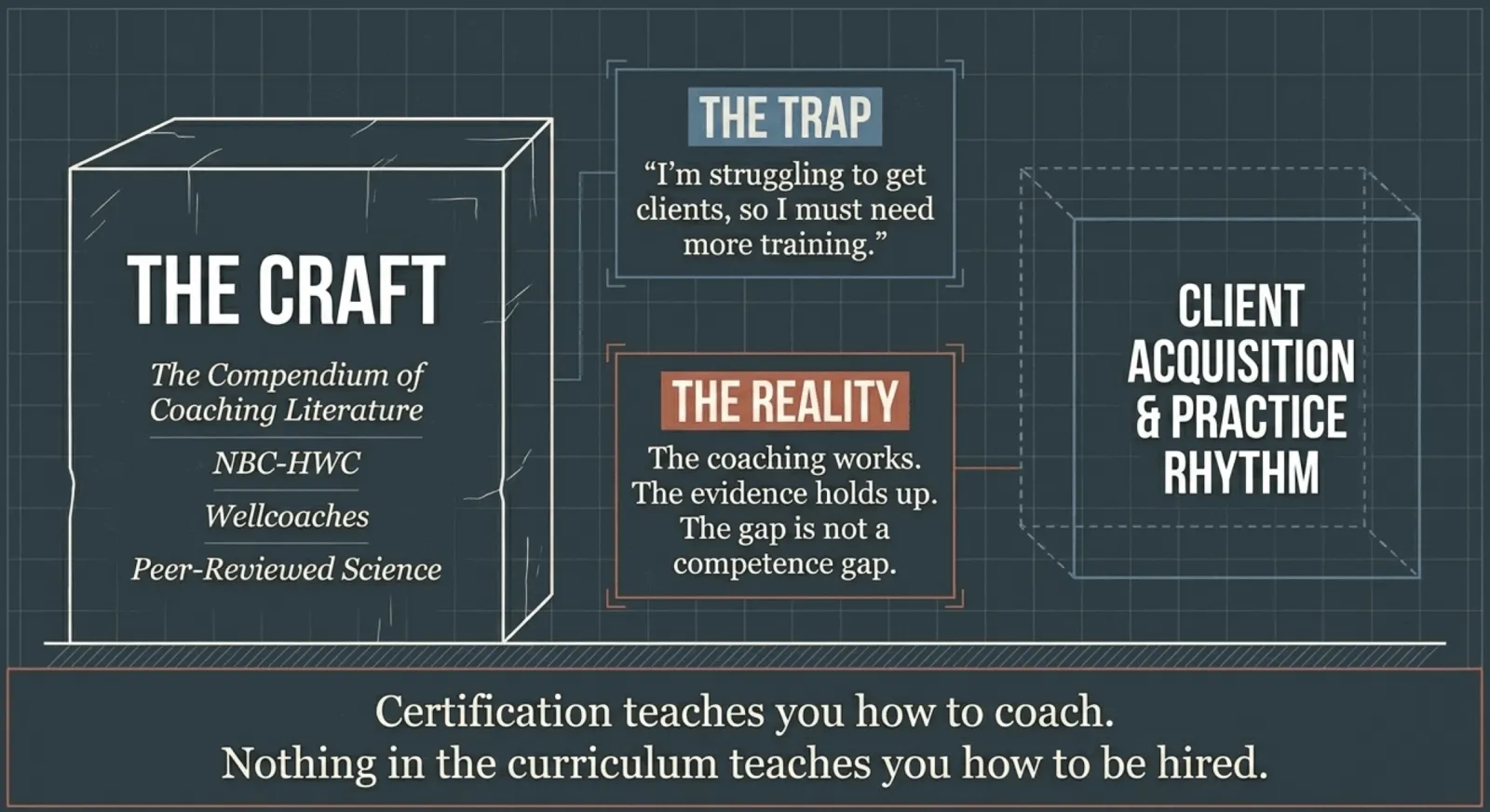
The Compendium of the Health and Wellness Coaching Literature, the field’s systematic attempt to organize its own research base, tracks peer-reviewed studies applying health coaching to diabetes, hypertension, heart disease, and other chronic conditions. The 2023 addendum added another tranche of trials. A 2024 rapid systematic review looked specifically at whether client gains survive after coaching ends, and found sustained improvement across most studies that measured it.
Board certification sits on top of that evidence. To earn the NBC-HWC credential you complete an approved training program, log practice sessions, and pass a national exam. Programs like Wellcoaches train the craft seriously, and the craft holds up.
So when the first months go badly, new coaches tend to misdiagnose it. They conclude they are not good enough at coaching yet, and they enroll in more training. It is the most understandable move in the world: training is the part of this career that comes with a syllabus, and the months after certification do not. But the diagnosis is usually wrong, and the next credential treats a problem the coach does not have.
The gap is not a competence gap. Certification teaches you to coach. Nothing in the curriculum teaches you to be hired. Those are different skills, and the second one is more learnable than it feels in month one.
What the first 90 days are actually for
The standard advice track, the one in every “how to become a health coach” guide, runs: pick a niche, build a website, post content, launch a funnel. The coaches I have talked to who made it through year one mostly did it in a different order. The pattern underneath their stories looks like this.
Coach five real people before you pick a niche
The niche advice is not wrong, it is premature. A niche chosen at the kitchen table is a guess. A niche chosen after coaching five real humans is a pattern you noticed.
The coaches who found their footing fastest started with people they could reach without marketing: a colleague from the old career, a neighbor, someone from the gym, the friend of a friend who mentioned wanting to sleep better. Not family. Real sessions, real cadence, real check-ins between sessions, exactly as if the practice already existed.
Five clients is enough to notice what kind of client makes you lean forward. It is also enough to produce the first referral, and the coaches I interviewed are nearly unanimous that the first stranger-client arrived through a person, not a platform.
Make the ask small, local, and in person
Asking strangers to be coached by you is terrifying, and most of the advice for getting past it (post more content, build your funnel) quietly assumes the fear away. The kinder and more effective versions of the ask I keep running into share a shape: small, local, repeatable, and built around something you would be doing anyway.
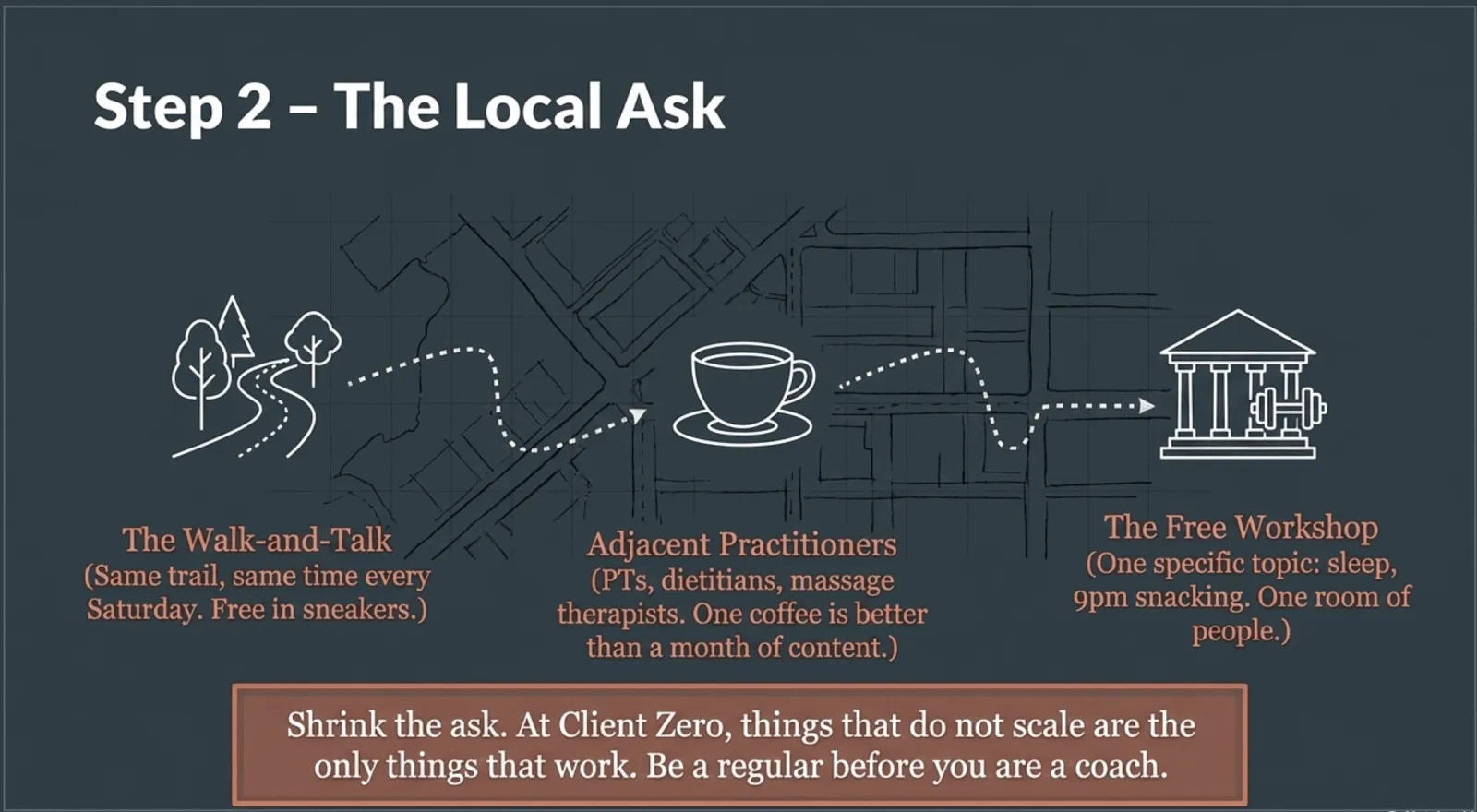
A standing walk-and-talk is my favorite of these. Same trail, same time every Saturday, free, and anyone can bring a friend. It is coaching in its most disarming form: nobody has to sit across a desk from a credential, they just have to show up in sneakers. A free 30-minute workshop at the library, the gym you already use, or the yoga studio down the street works the same way: one specific topic (sleep, snacking at 9pm, the afternoon energy crash), one room of people who chose to be there.
Meetups and run clubs count too, with one rule: be a regular before you are a coach. The person who shows up every week and asks good questions gets asked “so what do you do?” eventually. The person who pitches in week one does not get a week two.
And the adjacent practitioners in your town, the massage therapist, the dietitian, the physical therapist, meet your future clients every single day. They cannot do what you do, and most of them are happy to know someone who can. One coffee each is a better marketing plan than a month of content.
None of this scales. That is the point. At client zero, things that do not scale are the only things that work.
Charge something, even if it is small
The instinct to coach free “until I am ready” comes from a good place: new coaches take the responsibility seriously and do not want to charge for something they are still learning. But readiness arrives after the reps, not before, and waiting for it works no better here than it does for a client waiting on motivation.
Free clients also behave differently. They skip check-ins, they reschedule, they drift, and the new coach learns the wrong lesson from it: that her coaching does not hold people. The price does not need to be impressive. It needs to exist, because a paying client showing up is the first piece of evidence the new practice can bank. Confidence is downstream of evidence. For coaches exactly as much as for clients.
And if charging a friend feels impossible, charge something that is not money: a written reflection each week, a testimonial at the end, an introduction to one person who might need you. The point is an exchange the client honors, not a number.
Build the boring loop before the brand
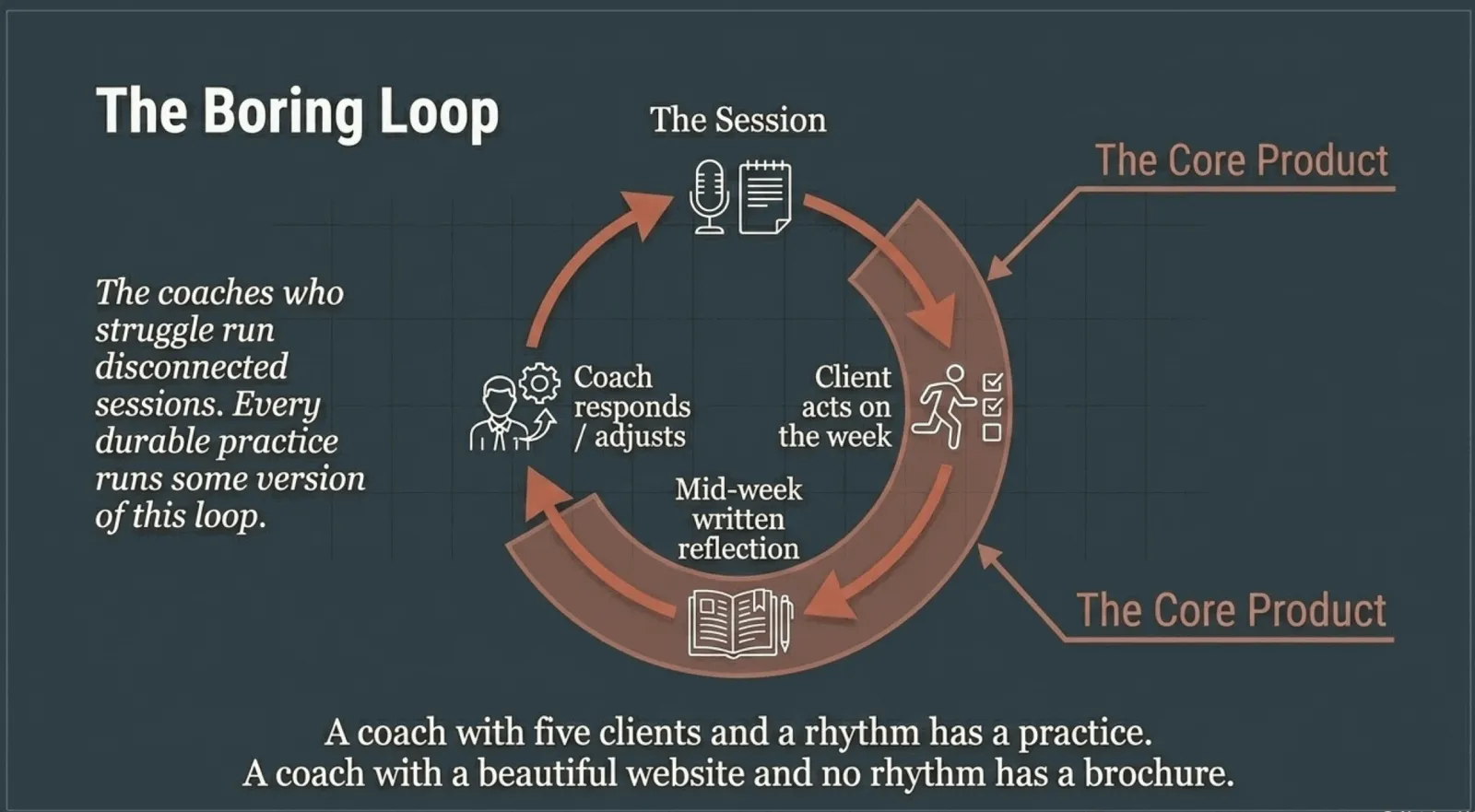
A practice is not a logo and a website. A practice is a loop: the client does the week, reports the week, the coach responds, the next session adjusts. Every durable practice I have seen up close runs some version of that loop. The coaches who struggled hardest in year one were not worse coaches, they were running sessions with nothing connecting one to the next, because nobody had told them the in-between was the product.
The loop can start embarrassingly simple. A weekly reflection the client actually answers. A message midweek when something in the reflection deserves it. Session notes that carry forward, so February remembers what January said. This is the layer Grove is built for, but the loop matters more than the tool. A coach with five clients and a reliable weekly rhythm has a practice. A coach with a beautiful website and no rhythm has a brochure.
Keep the day job math honest
Almost every coach I have interviewed who made it through the first year had either a day job, a working spouse, or savings with a named number of months on them. The ones who had the hardest time had gone all-in early, and not because they were reckless. They believed the brochure, and the brochure left out the arithmetic.
The roller coaster that certification org described is real, but for a new coach it is less about demand and more about arithmetic: five clients paying modest rates is a wonderful practice and a terrible salary. That is not failure. That is month three. Write down the number of clients at which the math changes, and treat the gap between here and there as the project, not as a verdict on the coaching.
What to skip for the first 90 days
The waitlist-course economy aimed at new coaches is large, and most of what it sells is sequencing error. Things that are genuinely useful at client fifteen and actively harmful at client zero:
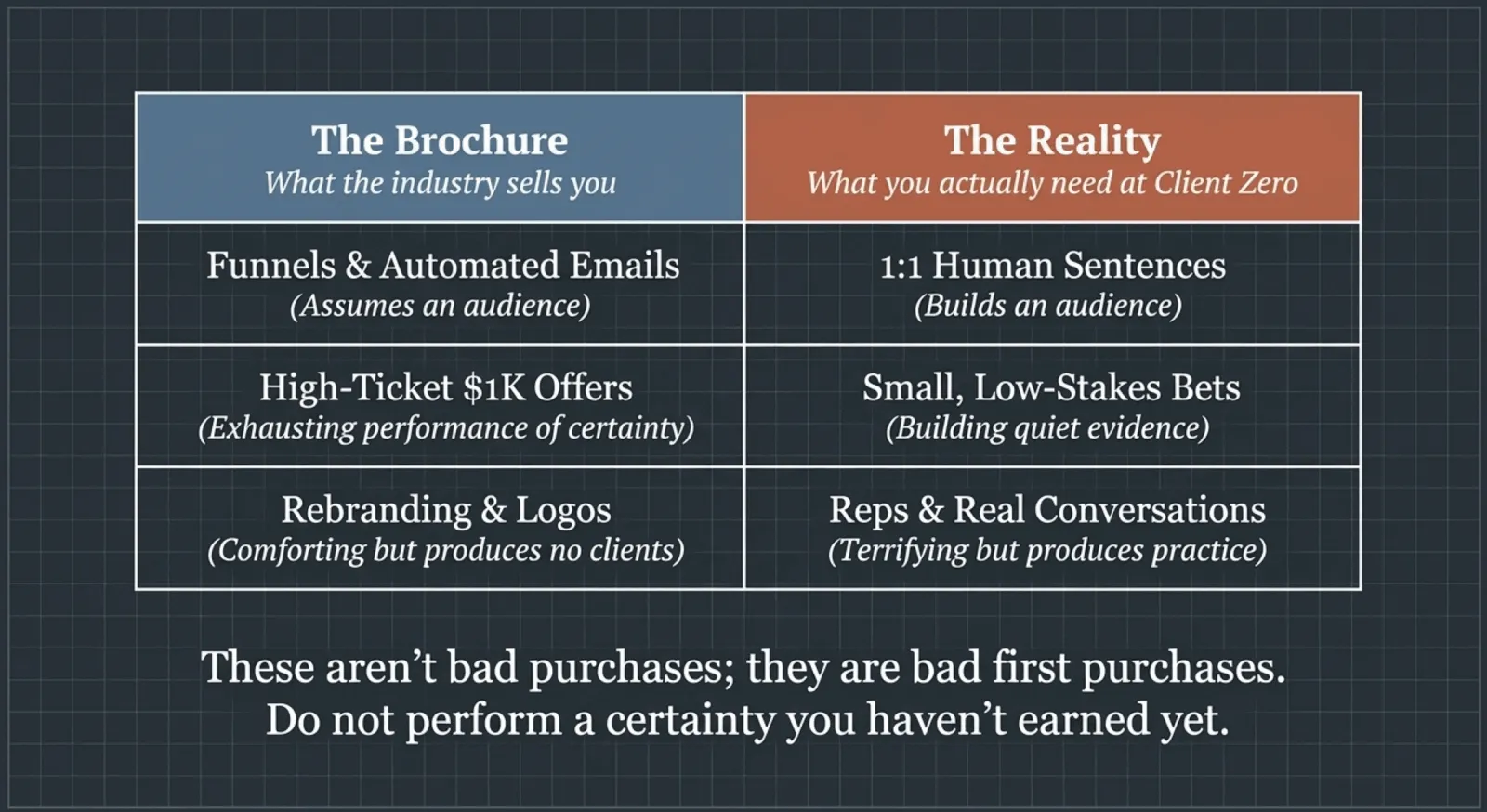
The funnel. Automated email sequences assume an audience. At client zero there is no audience, there are people you know, and people you know respond to sentences, not sequences.
The high-ticket offer. The bundles pitch “$1K+ offers” as the escape from hourly trading. Eventually, maybe. But a premium price at zero testimonials asks the new coach to perform a certainty she has not had time to earn, and performing certainty is exhausting in exactly the months that are already the hardest.
The rebrand. Renaming the practice, redoing the colors, rewriting the bio. This is comforting work in a scary season, and there is no shame in wanting some. It just does not produce a client, and the season gets less scary when one arrives.
None of these are bad purchases. They are bad first purchases, and an industry that profits from the confusion keeps presenting them as first purchases anyway. The sequencing error belongs to the sellers, not to the coaches who bought.
The question under the question
When a newly certified coach asks “what do I do now,” the textbook hears a marketing question and answers with a funnel. I think it is actually the same question her future clients will bring to her: I did the hard preparatory thing, I am standing at the start, and the path is foggier than the brochure promised.
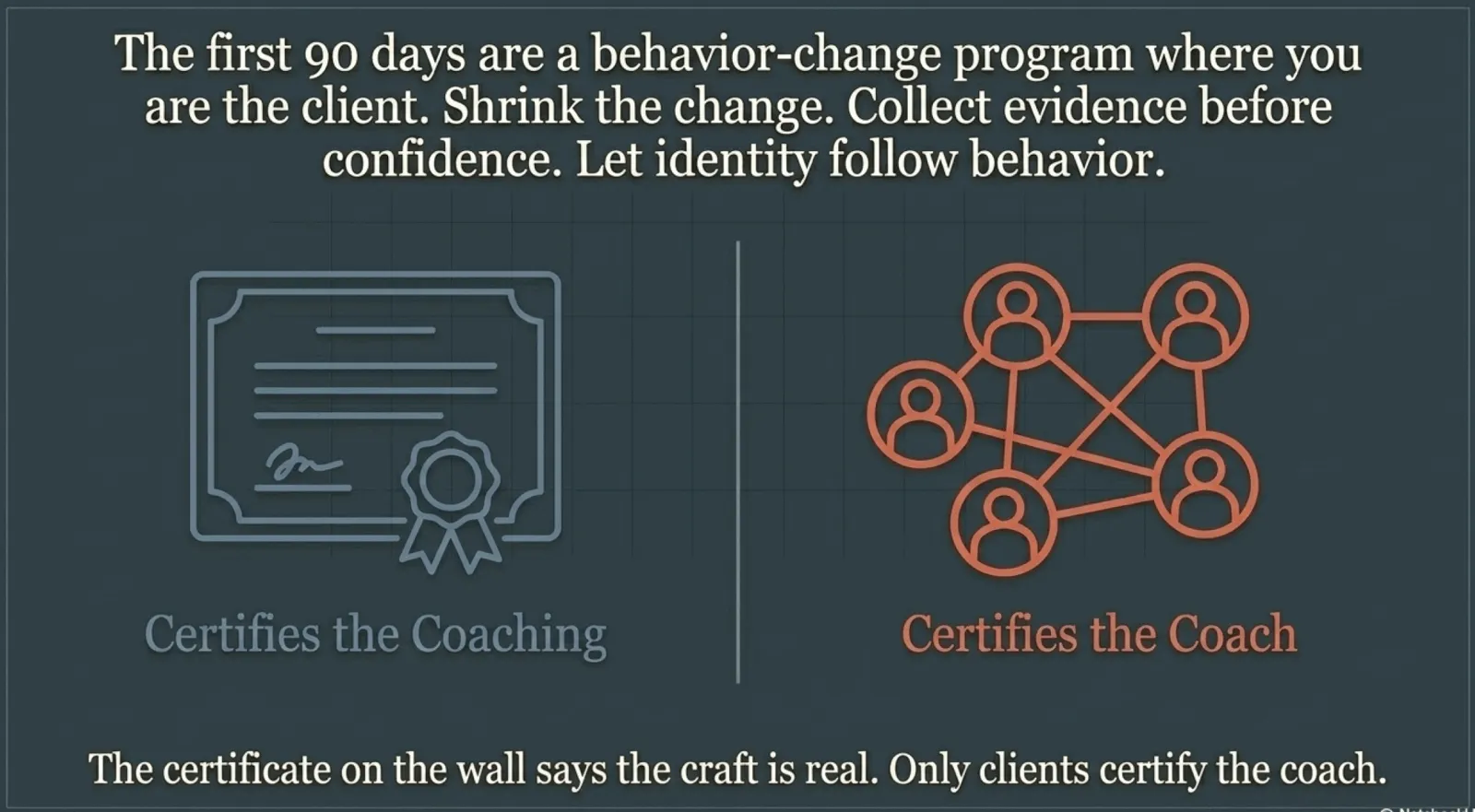
She already knows how to coach someone through that. Shrink the change until it fits inside a week. Anchor it to something that already happens. Collect evidence before confidence. Let identity follow behavior.
The first 90 days of a coaching practice are a behavior-change program where the client is the coach. The certificate on the wall says the craft is real. The first five clients say the practice is. Certification certifies the coaching. Only clients certify the coach.

Founder of Grove. Twenty years building software for skilled professionals. Currently writes mostly on Tuesdays from a small studio in Austin.