
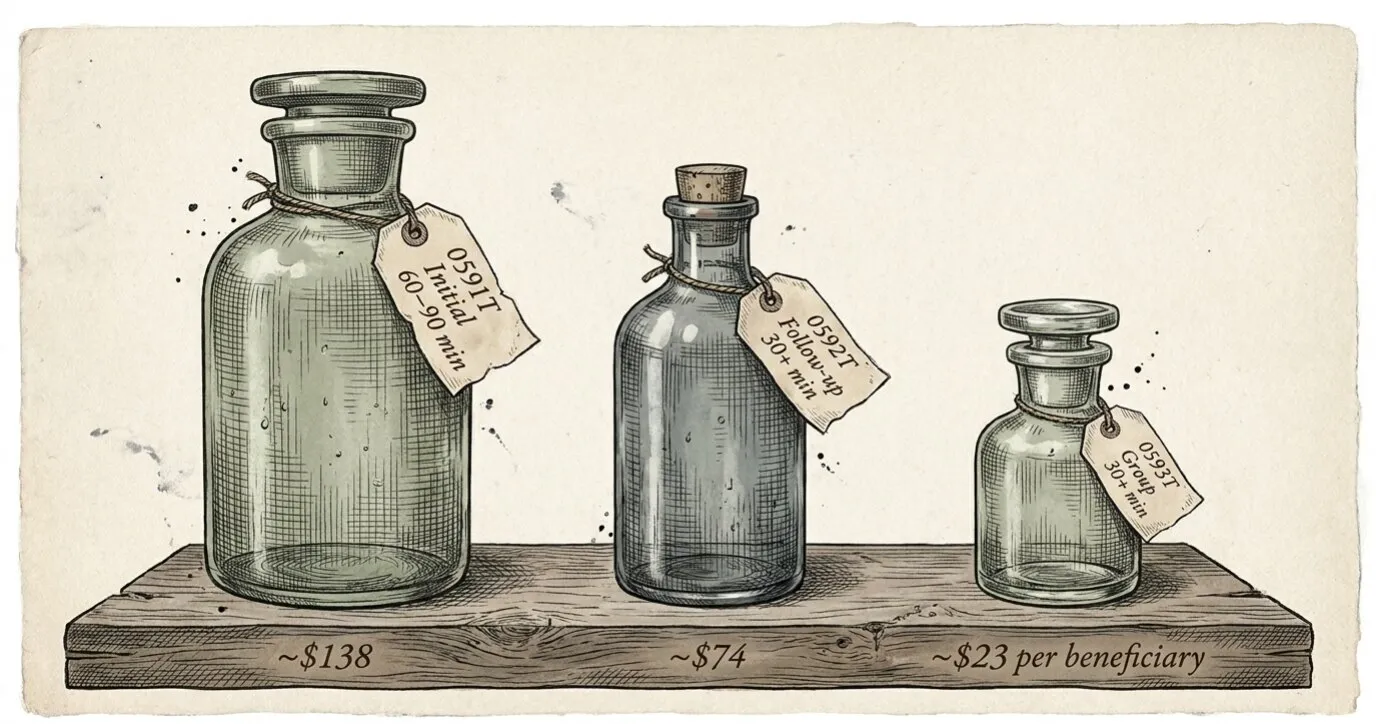
Three billing codes describe health coaching: 0591T, 0592T and 0593T. They have existed since 2020, and for seven years Medicare left their price to its regional contractors. In November 2026 CMS gave them a national rate, starting January 1, 2027.
One distinction comes before everything else: the practice bills Medicare, and the coach does not.
Here is what each code covers, what Medicare allows for it, and what changed between the proposed rule and the final one, with the page numbers so you can check. Much of what a search turns up was written before the final rule, so look at the dates. This post reflects the rule as published on November 9, 2026.
I build software for coaches, not medical billing systems. This explains the published rule, and it is not billing advice.
The short version:
| Code | What it covers | Medicare’s 2027 national figure |
|---|---|---|
| 0591T | Individual initial assessment, 60 to 90 minutes | About $138 |
| 0592T | Individual follow-up session, at least 30 minutes | About $74 |
| 0593T | Group coaching for two or more people, at least 30 minutes | About $23 for each Medicare beneficiary |
Those figures are estimates of what Medicare allows the practice that bills, in an office setting, before it adjusts for location. They are not what a coach is paid. The arithmetic is just below.
What are CPT codes 0591T, 0592T and 0593T?
All three describe one service. CMS calls it health and well-being coaching. Most coaches say health and wellness coaching, and for these codes it is the same work.
- 0591T is the individual initial assessment, 60 to 90 minutes.
- 0592T is an individual follow-up session of at least 30 minutes.
- 0593T is a group session, two or more people, at least 30 minutes.
The group code works differently from the other two. CMS’s rule says it “would be billed once per beneficiary in the group.” So a group with eight Medicare beneficiaries in it is billed eight times, once for each person.

The descriptions of the two individual codes say “face-to-face.” Telehealth is allowed separately: the codes have been on Medicare’s telehealth list since 2024. The dates when those telehealth rules run out are in the longer post.
The codes come with a definition of the service, written by the American Medical Association, and CMS adopted it. It begins: “Health and well-being coaching is a patient-centered approach wherein patients determine their goals.” I wrote about what that sentence means for coaches in Does Medicare cover health coaching?
How much does Medicare pay for each code?
The rule does not print a dollar amount for these codes. It publishes relative value units, or RVUs, and a conversion factor, and the dollars are multiplication.
CMS set two conversion factors for 2027: 32.9548 for practitioners who are qualifying participants in an alternative payment model, and 32.6286 for those who are not. The figures here use the second. With the first they come out about one percent higher.
These are the total office-setting RVUs in CMS’s Addendum B, multiplied by the conversion factor of 32.6286:
| Code | Total relative value | Times 32.6286 |
|---|---|---|
| 0591T, initial assessment | 4.22 | $137.69 |
| 0592T, follow-up | 2.27 | $74.07 |
| 0593T, group, per beneficiary | 0.69 | $22.51 |
Read them as estimates, with four cautions. They are national figures, before Medicare adjusts for location. They are for an office setting; in a hospital or other facility the totals are roughly half. A national rate is not a promise that a session is paid: the coaching still has to be reasonable and necessary, and the practice has to meet Medicare’s billing rules. And the figure is the amount Medicare allows the practice that bills. What a coach is paid out of it is whatever she and the practice agree to.
CMS revises its files, so check the current one before quoting anyone a number. These totals match the Addendum B file dated November 5, 2026.
To see what a month of sessions adds up to for a practice, use the calculator in the longer post.
Can a health coach bill Medicare with these codes?
No. The coach works as what the regulation calls auxiliary personnel, under a practitioner’s supervision, and the amended regulation says:
“Only the supervising physician (or other practitioner) may bill Medicare for incident to services.”
A provider number does not change that. The National Board for Health & Wellness Coaching puts it this way in its FAQ on the final rule: “Having an NPI does not automatically provide Medicare billing privileges or authorize an individual to bill Medicare independently.”
The supervision is general, which means the practitioner does not have to be in the building while the session happens. It does not make the coach independent. The session is still billed “incident to” the practitioner’s own care, and Medicare’s rules for that kind of billing still apply to the practice. Whether a particular arrangement qualifies is a question for the practice and its billing counsel.

Which credentials qualify
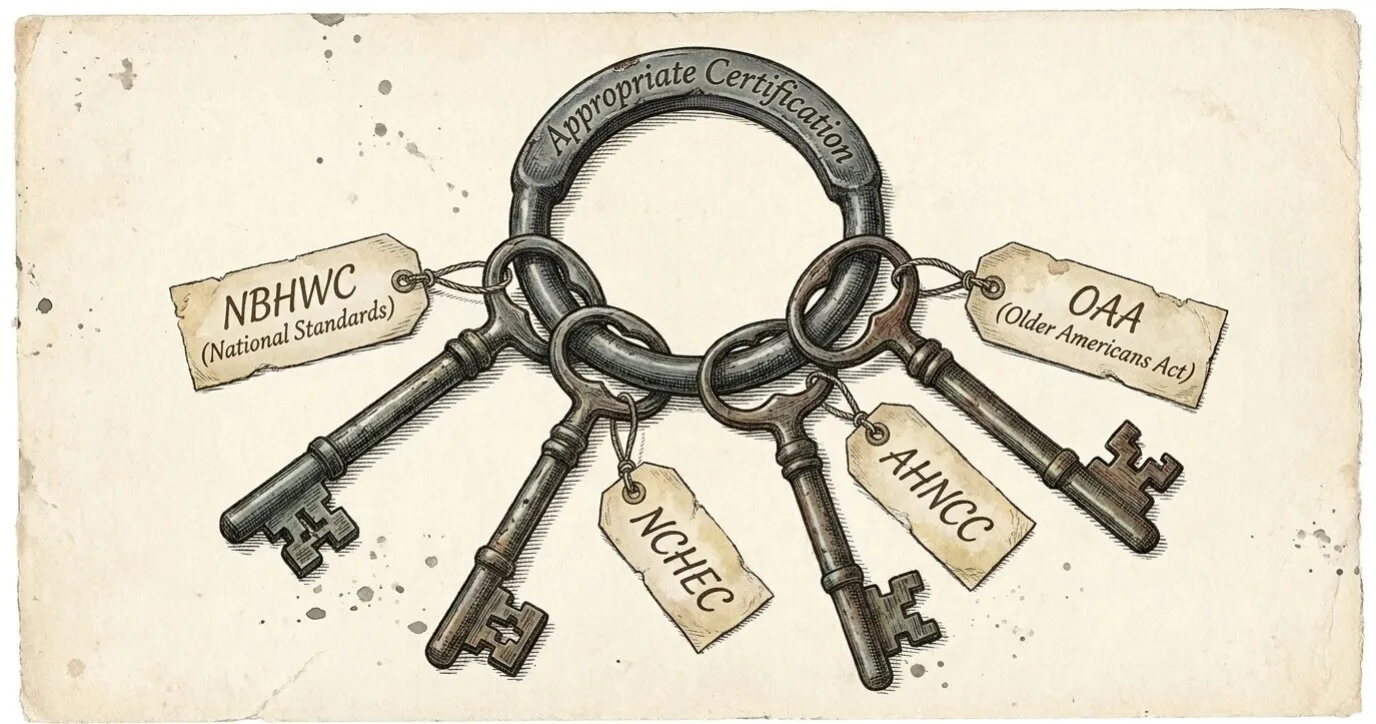
The coach needs “appropriate certification to perform the services.” CMS names four pathways and says the list is not limited to them: the NBHWC National Standards, NCHEC’s eligibility for Certified Health Education Specialists, the AHNCC national standards for Certified Nurse Coaches, and training from the evidence-based programs funded under the Older Americans Act. The wording for the first is “fulfilling” the National Standards, and the rule does not say the NBC-HWC credential itself is required. The longer post takes them one at a time in Which credentials count.
What changed between the proposal and the final rule
CMS proposed national pricing for the codes in July and finalized it in November. Three things changed in between, and a lot of what is online still describes the July version.
The codes are staying. In the proposal, CMS asked whether it should create new codes of its own, called HCPCS G-codes, “rather than actively pricing these Category III CPT codes.” Many commenters wanted the switch. Others wanted to keep the codes that practices already use. CMS kept them:
“We believe this approach will help avoid unnecessary confusion and administrative complexity, especially for practices and payers already set up to use the existing CPT codes.”
The individual sessions are valued higher. The work RVU is the part of a code’s total that stands for the time and effort of the service itself. CMS first set it for the two individual codes by borrowing from care-management codes built around 20 minutes of staff time. Commenters pointed out that this left “a 60-minute session and a 30-minute session” valued “nearly identically, and both at a fraction of their actual time.” CMS agreed: “the proposed crosswalks do not sufficiently reflect the time associated with furnishing these services.” It moved both codes to a comparison that accounts for 60 minutes and for each additional 30. The group code stayed where it was proposed.
| Code | Work RVU proposed in July | Work RVU in the final rule |
|---|---|---|
| 0591T, initial assessment | 1.00 | 1.81 |
| 0592T, follow-up | 0.70 | 1.00 |
| 0593T, group, per beneficiary | 0.23 | 0.23 |

The supervising practitioner does not have to be in the building. CMS proposed direct supervision and finalized general supervision. That change is covered in the longer post.
Do other insurers pay for these codes?
The rule does not decide that. It sets a national rate in Original Medicare, and NBHWC’s FAQ is plain about the limit: “Medicare Advantage and state Medicaid programs operate under different payment structures.” A private insurer makes its own decision too.
The codes themselves are not Medicare’s, and other payers can use them. CMS’s reason for keeping them mentions “practices and payers already set up to use the existing CPT codes,” and the commenters who argued for keeping them said it would “ease dual Medicare-commercial billing.” Whether a plan pays for the codes is a question for the plan.
If your clients pay you directly, none of this changes how you are paid. Grove is built for that practice. It is not billing software and it does not submit claims.
Where the codes came from
Medicare did not create these codes. The U.S. Department of Veterans Affairs and the National Board for Health & Wellness Coaching applied to the American Medical Association for them, and the VA announced the result in December 2019. The codes took effect on January 1, 2020.
They are Category III codes, which the AMA describes as “a temporary set of codes for emerging technologies, services and procedures.”
A code gives a service a name that a claims system can count. It does not set a price. That is how these three went seven years with a name and no national rate.
What moved the number
The detail I notice in the coaching section is how the value changed. CMS started from a 20-minute comparison. Commenters told the agency that a 60-minute session is not a 20-minute one, and the agency’s reply begins, “We agree.” The supervision rule changed the same way.
The codes are still temporary, and a fee schedule is rewritten every year. The rule sets a national rate for 2027, and it does not settle how coaching fits into a practice. On session limits, CMS says it “will monitor utilization and may re-evaluate these policies in future rulemaking.”
What practices do with the codes in 2027 is the next thing to watch. The next proposed rule is the next chance to describe the work accurately.
Sources. The CY 2027 Physician Fee Schedule final rule (CMS-1848-F; the coaching section is 91 FR 71112 to 71116), CMS’s Addendum B, the VA’s announcement of the codes of December 30, 2019, the AMA’s page on Category III codes, and NBHWC’s FAQ of November 5, 2026.

Founder of Grove. Twenty years building software for skilled professionals. Currently writes mostly on Tuesdays from a small studio in Austin.
