
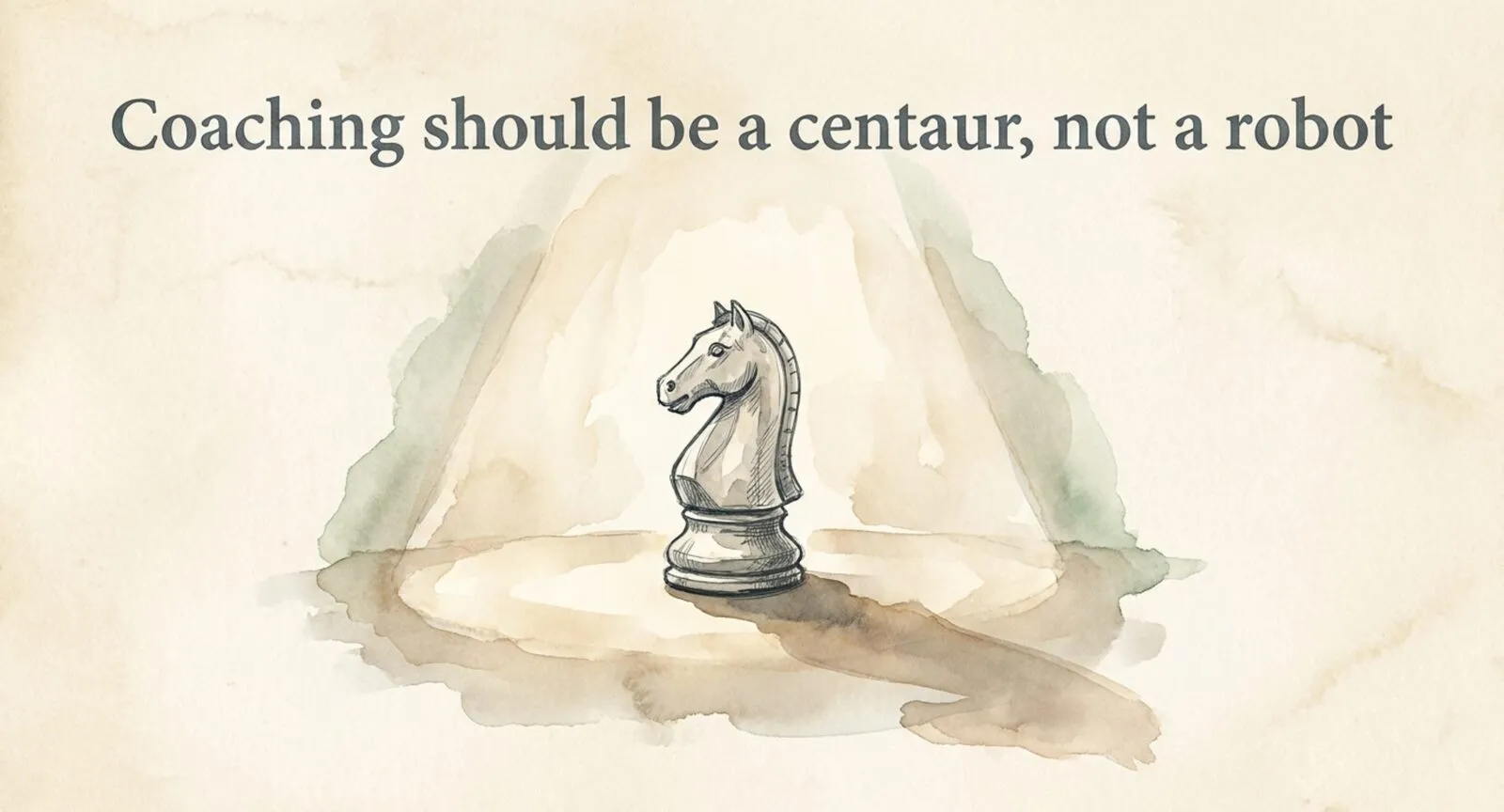
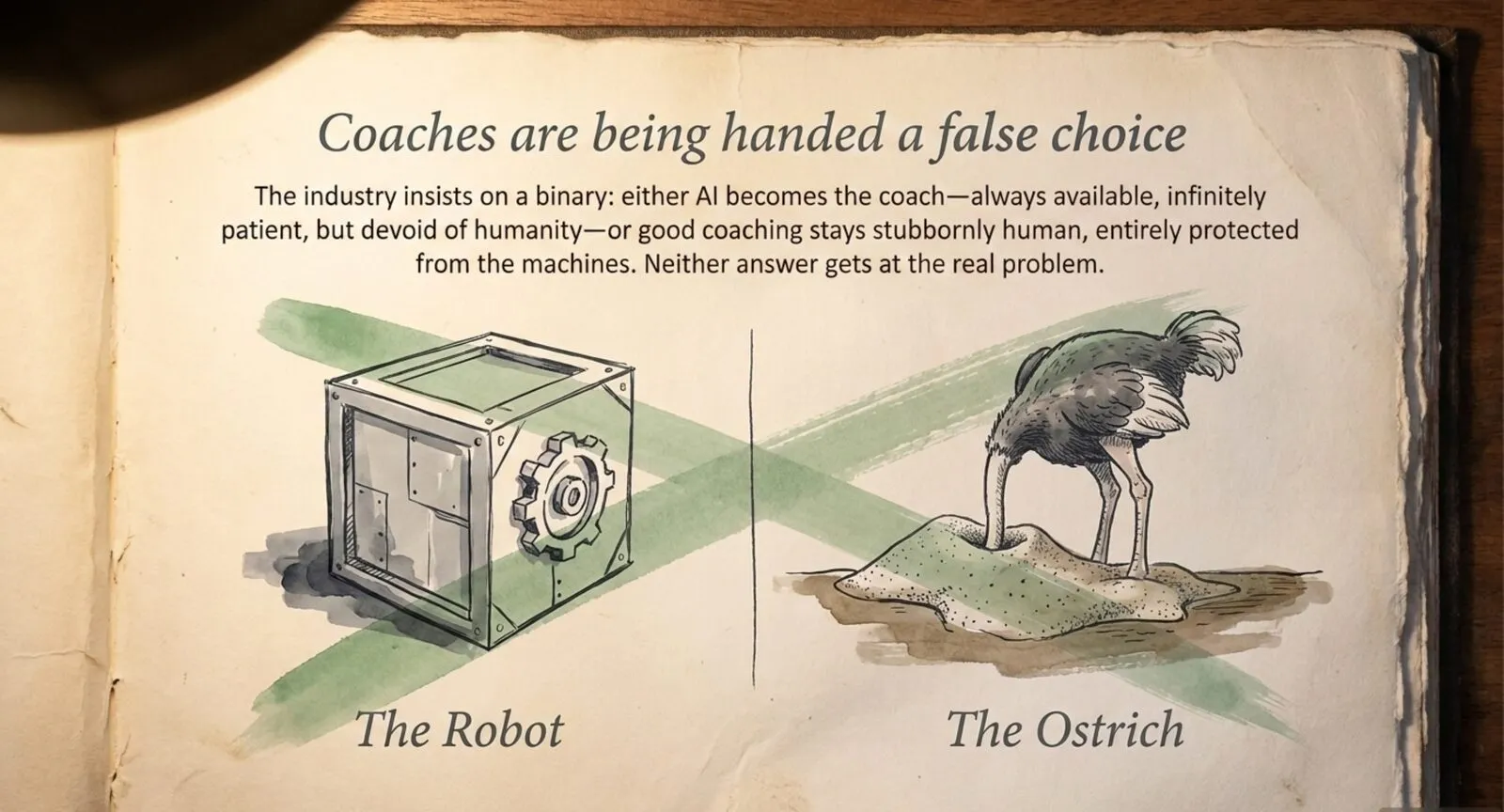
Coaches are being handed a false choice.
Either AI becomes the coach: always available, infinitely patient, cheaper than a person. Or good coaching stays stubbornly human, protected from the machines.
But neither answer gets at the real problem coaches are trying to solve.
A coach’s value is not that she can remember every detail, summarize every check-in, notice every pattern, and hold every thread across six weeks of someone’s life. Her value is what she does with those things: the judgment, the relationship, the question she asks at exactly the right moment, the fact that another human being genuinely cares whether change happens.
So what if we stopped asking whether AI can coach, and asked a different question:
What work should the machine carry so the human can be more human?
Chess ran this experiment before we did.
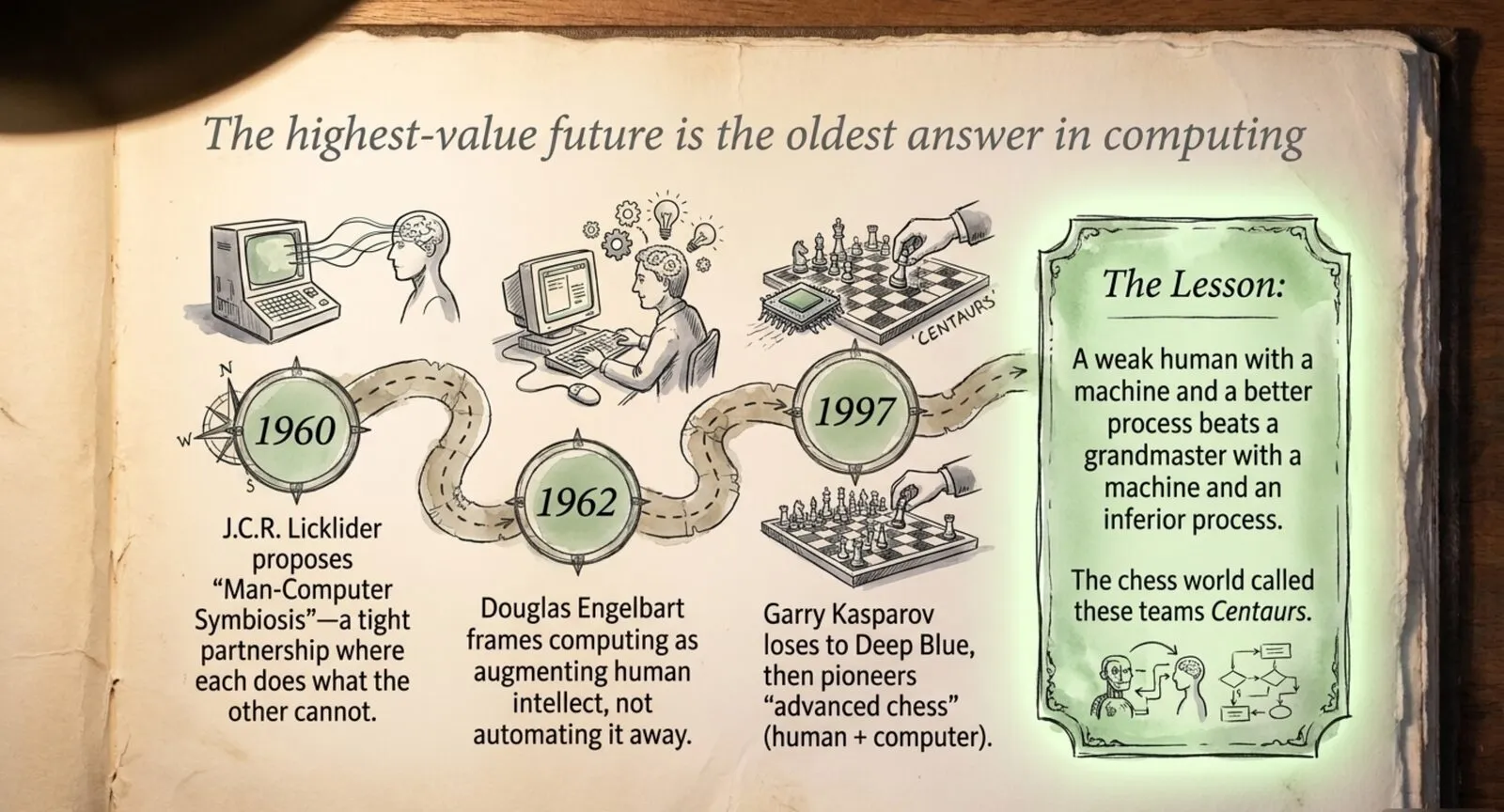
In 1997, Deep Blue beat Garry Kasparov, and the headlines declared human chess over. What happened next was more interesting. Within a year Kasparov was experimenting with “advanced chess,” where a human plays with a computer against another human-plus-computer team. And a few years after that, an open freestyle tournament run on those rules produced the result that should have made more noise than the loss ever did: the winners were two amateurs working with ordinary computers, beating grandmasters paired with stronger machines. Their advantage was not raw strength on either side. It was the way they worked together. Kasparov’s own verdict on that tournament: a weak human with a machine and a better process beat a strong human with a machine and an inferior process.
The chess world had a name for those teams. Centaurs.
I think coaching is about to learn the same lesson, and I would rather we learn it on purpose.
The two dead ends
Both halves of the false choice deserve names, because you will keep meeting them.
The first is the robot: AI replaces the coach. This is the direct-to-consumer pitch, an app that promises to be your coach with no human anywhere. It optimizes away the relationship, and in coaching the relationship is not incidental infrastructure around the intervention. It is part of the intervention. People do not usually stall because they lack a plan. They stall because no one is in it with them, and a chatbot, however fluent, is not in it with anyone.
The second is the ostrich: pretend none of this is happening. Stay human-only, refuse the tools, and keep drowning in the between-session load by hand. This one feels principled. It is actually just slower, and it leaves the coach more distracted, not more present, because all the continuity and pattern-tracking and remembering is still being done by a tired human brain in the margins of a day. It also keeps coaching expensive and scarce: when every additional client requires more fully human labor, fewer people can afford support, and the people who do get it are still depending on a caregiving system stretched thin enough to miss things.
Neither one gets you a better practice. The robot has no human to make change stick. The ostrich has a human buried under work a machine could carry.
The third answer is the oldest one
The centaur is not a new idea. It is one of the oldest serious ideas in computing, and it has been pointing the same direction for sixty years.
In 1960, J.C.R. Licklider wrote a paper called “Man-Computer Symbiosis.” His bet was that the highest-value future was not computers replacing people, and not people refusing computers, but a tight partnership where each does what the other cannot. Two years later Douglas Engelbart framed the goal of computing as augmenting human intellect, not automating it away. There is a long lineage of human-computer research built around that idea, running from there through the centaur teams to today’s studies of human-AI collaboration: not replacing human judgment, augmenting it. And in that lineage, the design of the partnership is the whole game.
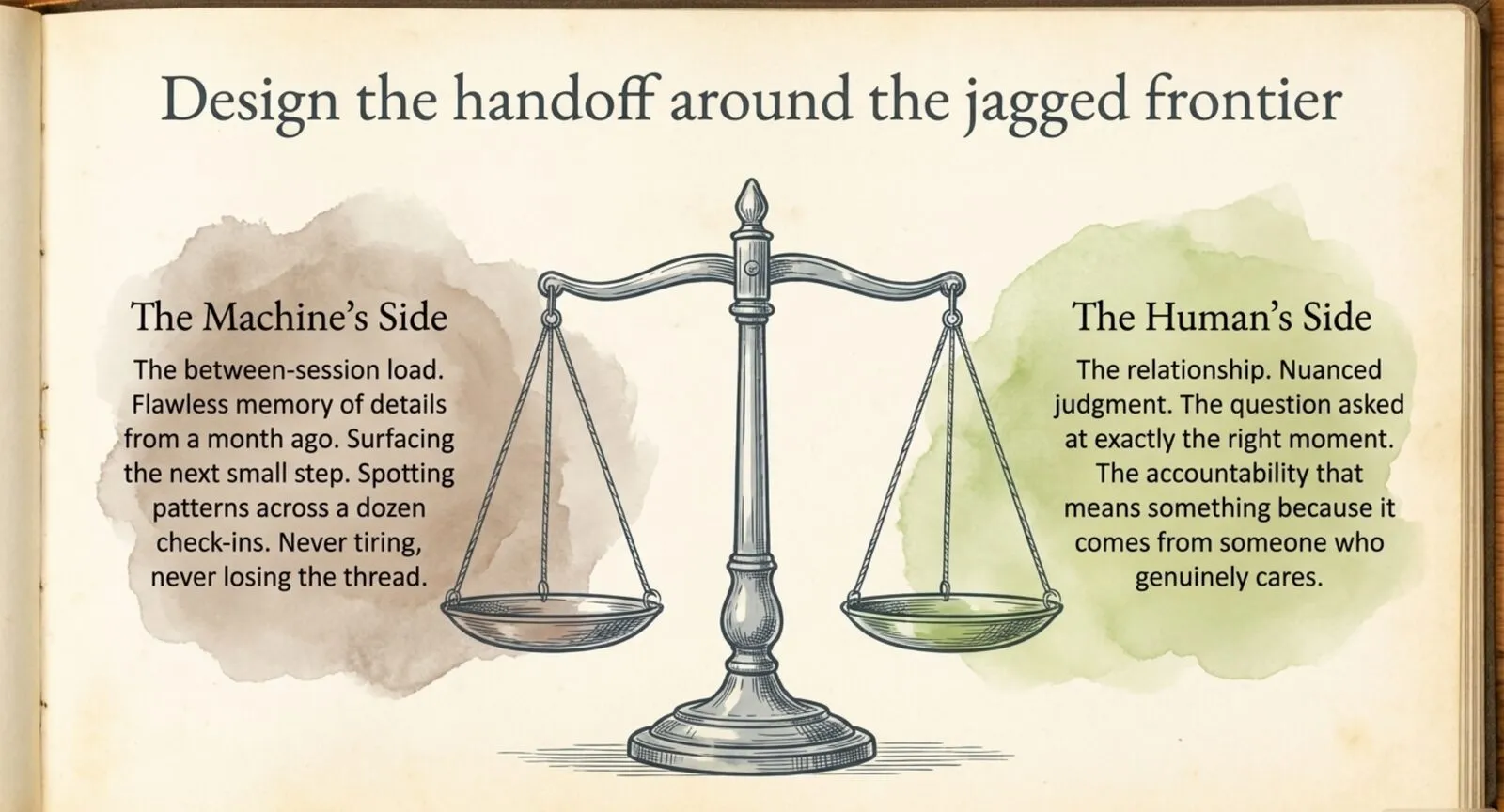
More recent work makes it concrete. Researchers describe a “jagged frontier” of AI ability: these systems are brilliant at some tasks and confidently wrong at others, and the line between is not intuitive. That finding is not an argument against using AI. It is an argument for designing the handoff deliberately. The conclusion I draw from it for coaching, and the bet Grove is built on, is that the machine’s read should go to the coach before any of it reaches a client, because the coach holds the context the model does not. The centaur wins precisely because the human covers the machine’s blind spots and the machine covers the human’s limits.
What that looks like in a coaching practice
Map it onto the actual work and the division almost designs itself.
Give the AI the between-session load, the part no human has the hours for: continuity across weeks, spotting the pattern in a client’s check-ins, remembering the detail the client mentioned a month ago, surfacing the next small step, never tiring, never losing the thread. And, where a client has explicitly chosen it, reflecting an observation back to them without ever crossing into advice.
Keep for the human the part only a human can hold: the relationship, the judgment, the moment of real connection, the accountability that means something because it comes from someone who actually cares whether you show up.
If you are not already working this way, here is the difference in ordinary terms. Picture a coach the night before a session with a client she last saw three weeks ago. In those weeks: a dozen check-ins, a reflection about a brutal stretch at work, a walking streak that quietly broke, a mention of a sister’s wedding coming up. The solo version of prep is twenty minutes of scrolling at 9pm, trying to rebuild the thread from memory. The centaur version is a short brief, already written, addressed to her: the client has named the afternoon slump three times, the streak broke the same week the work stress spiked, the wedding is ten days out and might be worth asking about. She reads it in two minutes, disagrees with half of it, keeps the one observation that matters, and walks into the session present instead of reconstructing. The machine did the remembering. She does the coaching.
Notice the direction that brief travels. It goes to the coach, not the client. That is the design choice we anchored Grove on, and we gave it a name: the coach gets first pass. Everything the machine concludes about a client is addressed inward, to the person with the context, and only what the coach makes of it ever reaches the client. The AI drafts the read; the human decides what it means. That single rule is what keeps the centaur a centaur. Point the same machinery directly at the client and you are back to building the robot.
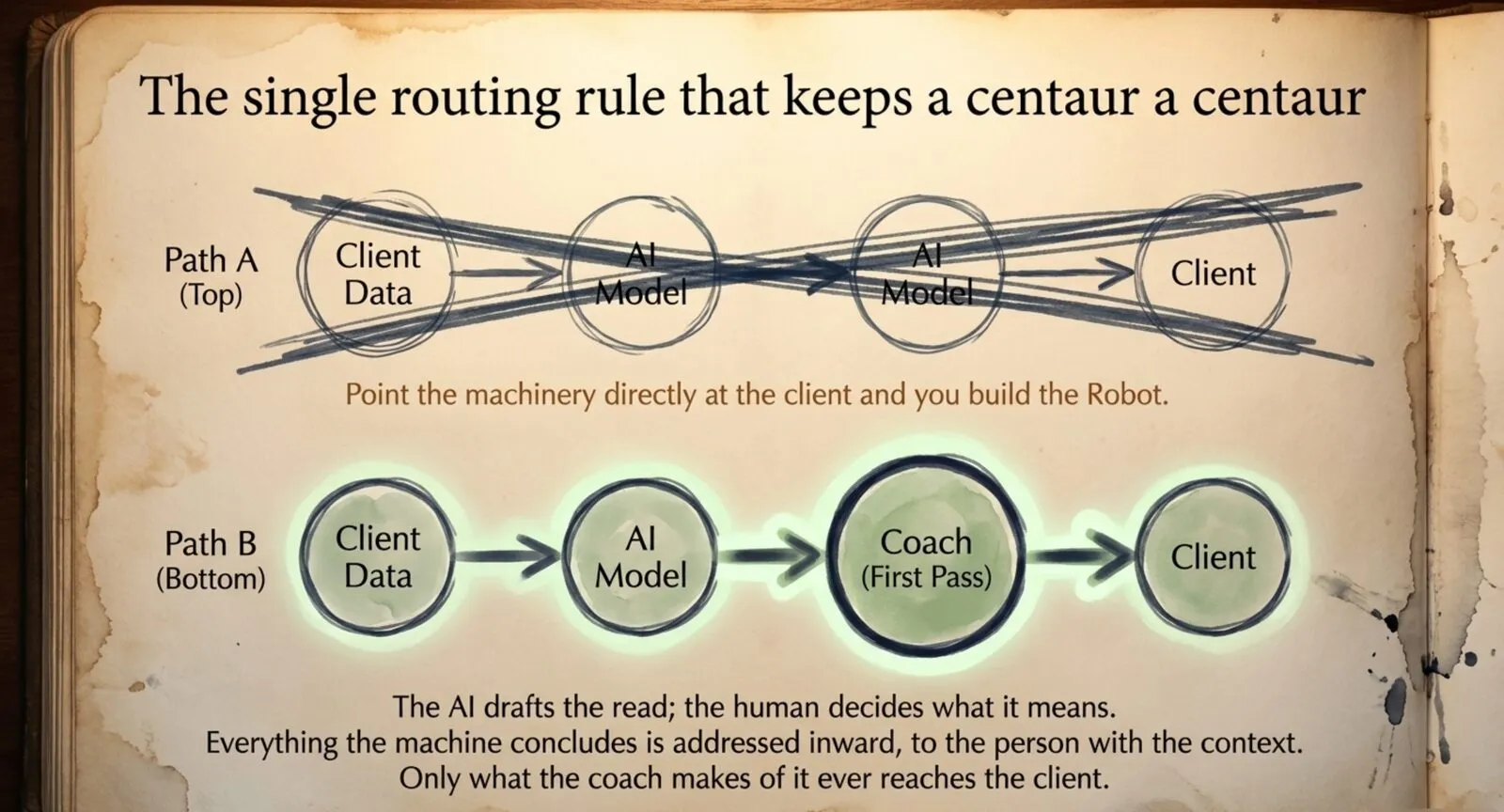
This is the reframe that matters, and it is the opposite of the robot pitch. Good AI does not replace a coach’s care. It gives back the capacity to care, by clearing the drudgery that was quietly turning an attentive coach into a distracted one. Used well, AI is the thing that re-humanizes coaching, not the thing that hollows it out.
The catch: the centaur only wins if it is well built
Here is the part the chess story is honest about and most AI pitches skip. A centaur is not automatically better. A sloppy human-AI team underperforms a good solo. The advantage comes entirely from the design of the collaboration, and that design has rules.
The AI has to be grounded in what is real, working from the client’s own record rather than inventing a plausible-sounding answer, and it has to say “I am not sure” when the signal is thin instead of bluffing. The coach has to actually take the first pass, not rubber-stamp a brief she stopped reading. And the whole thing has to respect a hard line on consent, using only what a client chose to share, because trust is the substrate the entire relationship runs on. Get those wrong and you do not get a centaur. You get a confident machine and a checked-out human, which is worse than either alone.
Here is what holding that line looks like up close. In Grove, when a client finishes a check-in, Sage can reply, if the client has said yes to replies at all, and the contract for those replies is noticing, not telling. “You have named the afternoon slump three times this week” is a reply. “You should try moving your workout to the morning” is not. And the reason is not just that it came from a machine. Unrequested advice is weak coaching from anyone, because the client’s authorship of their own plan is the engine of the change: whoever does the thinking gets the learning. So when a sentence crosses from noticing into advising, it does not get handed to a better messenger. The observation underneath it goes to the coach, who decides whether it becomes a question, a conversation, or nothing at all. That distinction took real design work to hold, and it is the whole difference between a machine that hands the thinking back to the client and a machine that quietly starts coaching.
So the discipline is the product. The grounding, the first pass, the consent boundary, the honesty about uncertainty. Those are not constraints we tolerate. They are what makes the collaboration actually win.
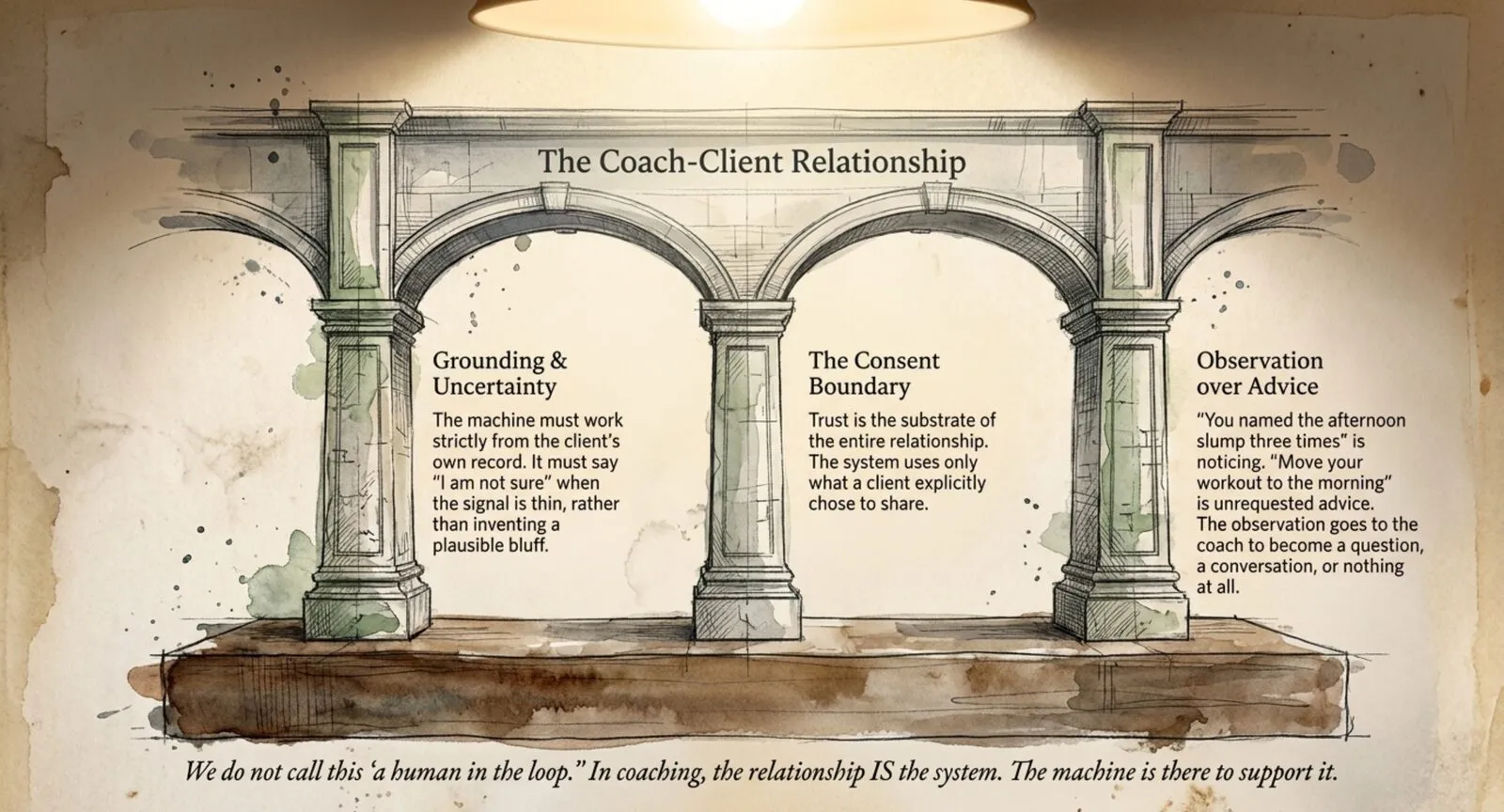
We also avoid the industry phrase for all of this, keeping a human in the loop. It makes the human sound like a supervisor bolted onto an automated system. In coaching, the relationship is the system. The machine is there to support it.
The question was never “human or AI”
It was always “how do they ride together.” Some coaches will keep a whole practice in a notebook and serve their people beautifully, and nothing in this essay argues with that. The choice gets real when the load outgrows the notebook: more clients than one memory can hold, threads that run for months, the point where growing the practice means shortchanging someone. The coaches who meet that moment best will not be the ones replaced by the tools, and they will not be the ones buried by the work. They will be the centaurs: more present with their people because the load is finally shared, working from a memory that does not slip, building a practice a tired brain could never hold alone.
That is the future worth building toward. Not a robot pretending to care, and not a human pretending the machines went away. A partnership, designed on purpose, where the machine carries the memory and the human carries the relationship. The client leads the coaching. The coach gets first pass. The work gets lighter.

Founder of Grove. Twenty years building software for skilled professionals. Currently writes mostly on Tuesdays from a small studio in Austin.