

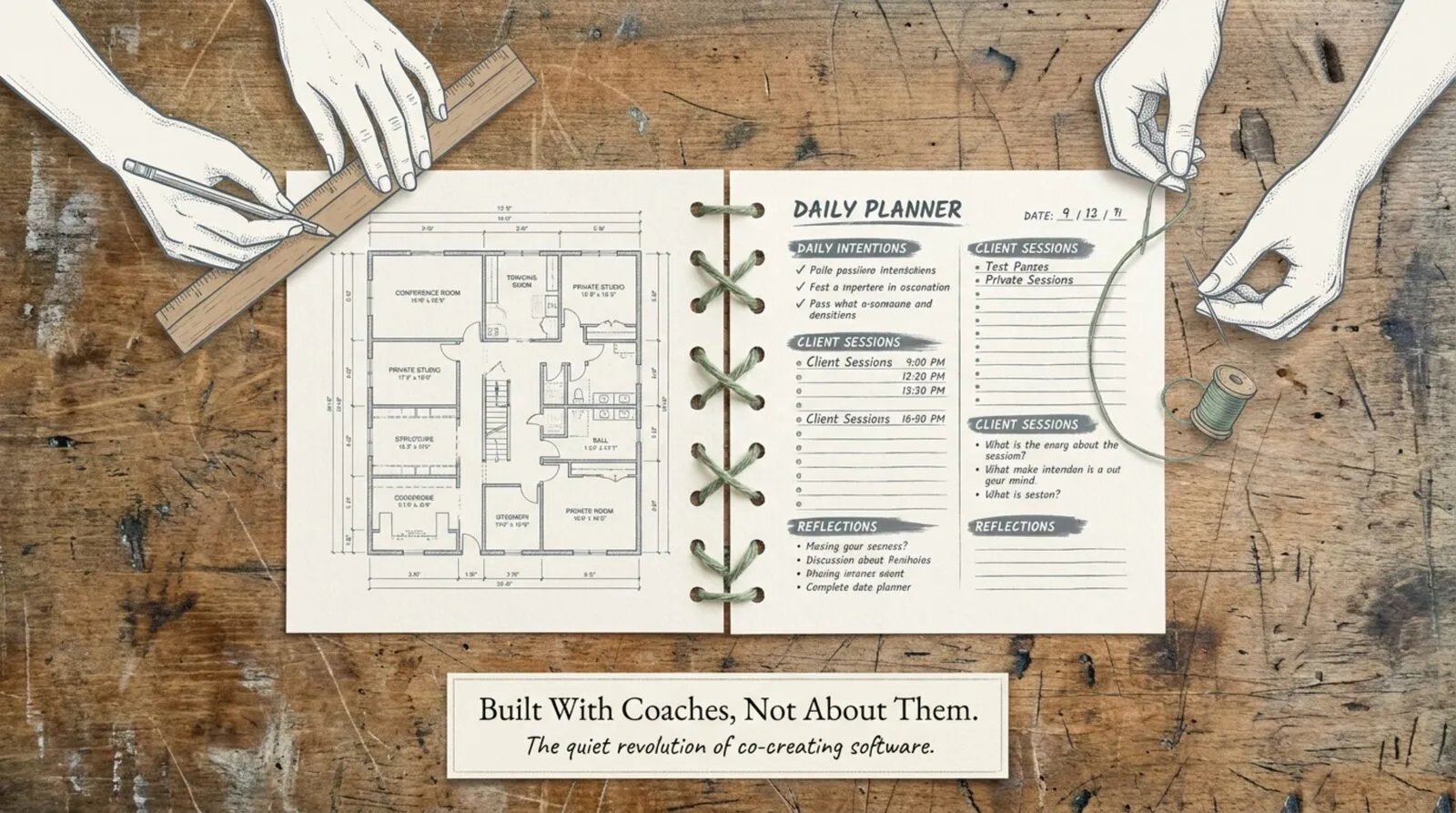
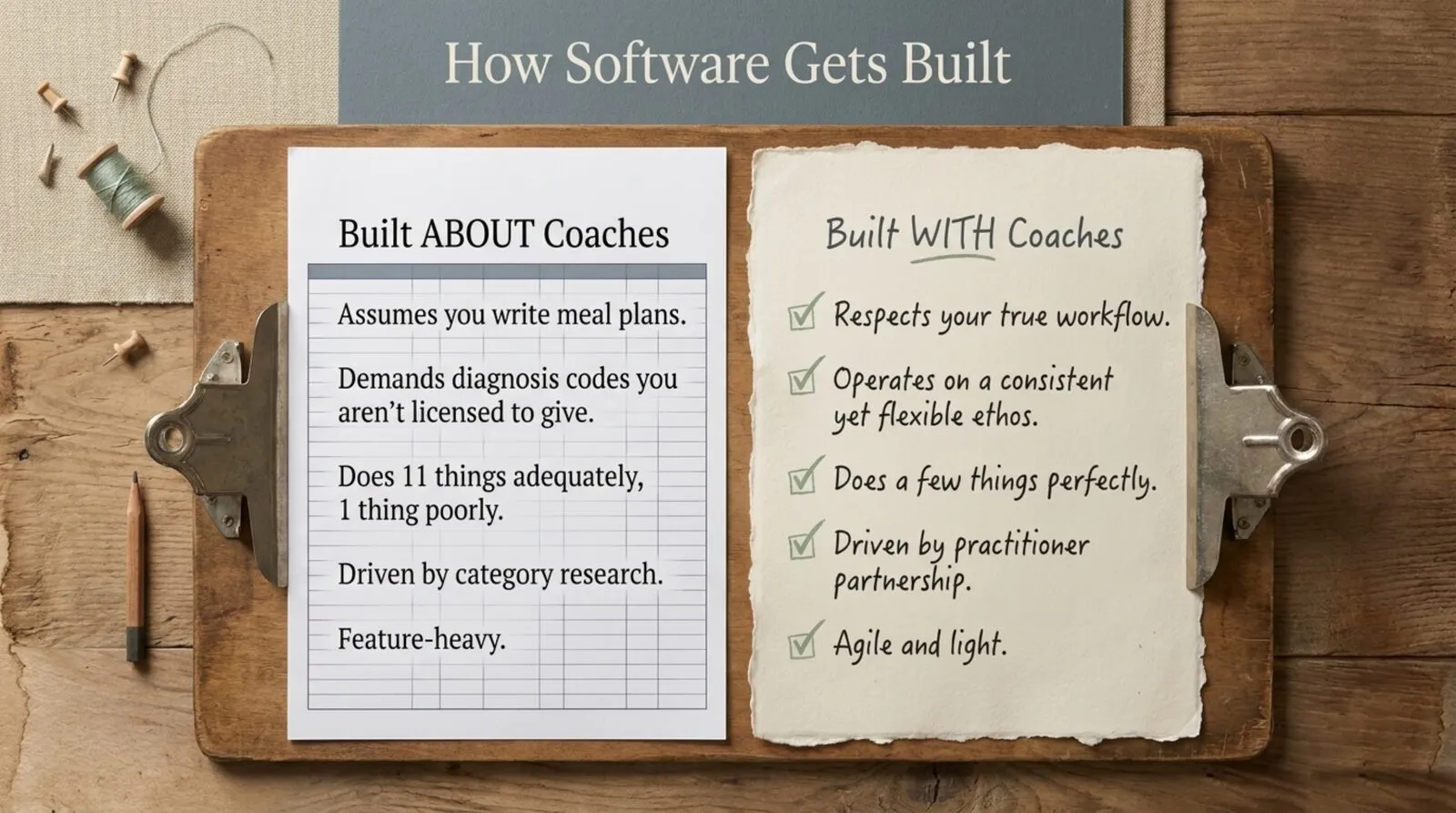
Every coach I have interviewed has a story about a tool that was built for somebody else. The nutrition platform that assumes you write meal plans. The records system that wants a diagnosis code you are not licensed to give. The all-in-one that does eleven things adequately and the one thing you actually care about not at all.
None of those tools were built badly. They were built about coaches. Somebody studied the category, listed the features, priced the tiers, and shipped. Nobody sat with a coach and watched what her week actually costs her.
I learned the difference from my mother, long before I knew it was a lesson.
The bed board
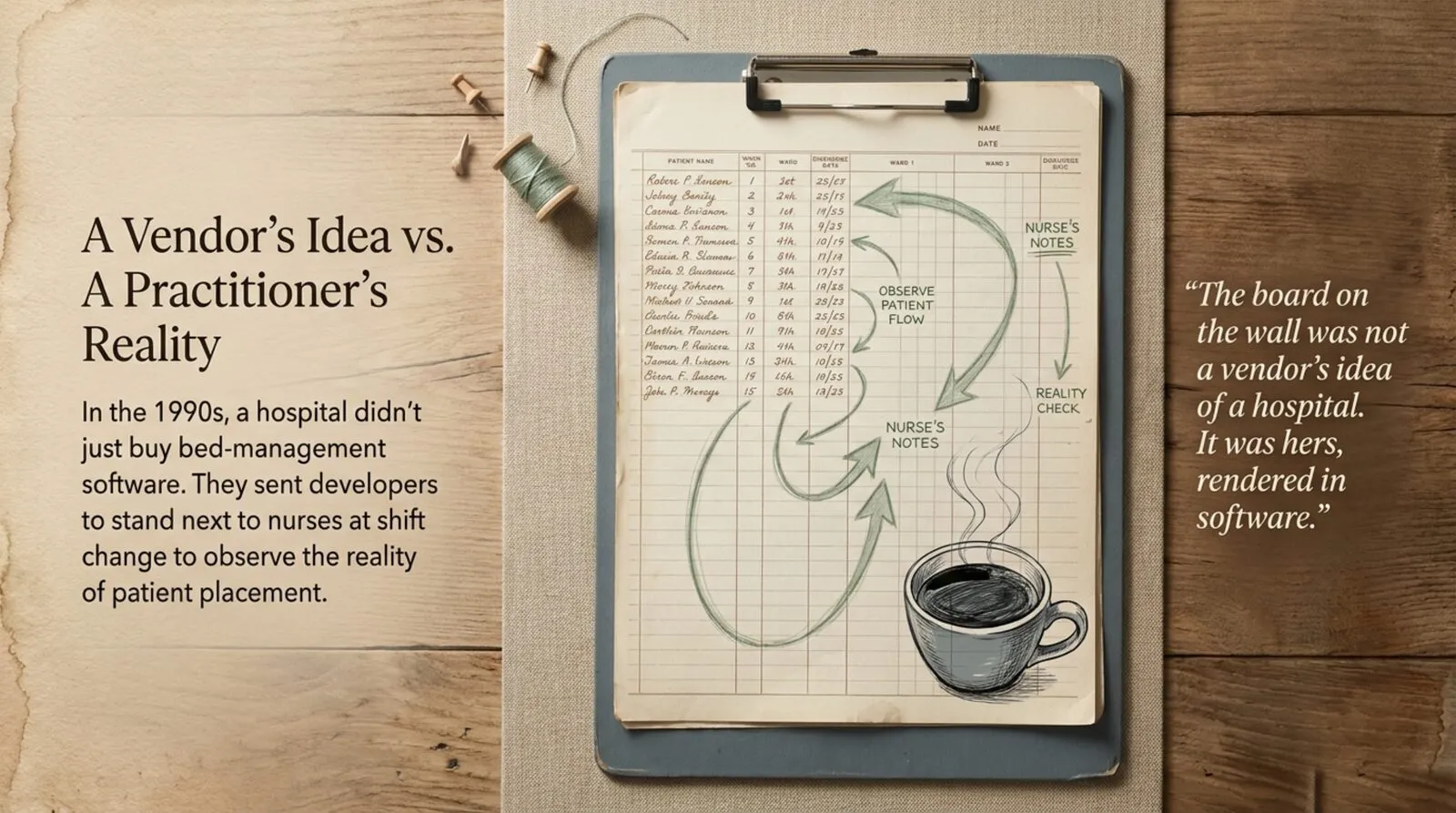
My mother spent her career in hospitals, first as a case manager and later as a Director of Patient Placement, which meant she owned the question of who goes in which bed and when. In the 1990s her hospital worked with TeleTracking, a company building software for exactly that problem: which beds were open, which were being cleaned, how long a patient waited downstairs for a room upstairs. She was a development-partner user. The people writing the software kept showing up to ask her, and the nurses and case managers around her, what actually happened on a floor at shift change.
I was a kid. What I absorbed was not the technology. It was watching my mother be treated as the expert on her own work, and then watching a whole hospital get better at moving people through it because someone had bothered to ask. The board on the wall was not a vendor’s idea of a hospital. It was hers, rendered in software.
Twenty years of building software later, that is still the only method I trust. So when I started Grove, the first thing I went looking for was not a customer. It was a partner.
Enter Rachel
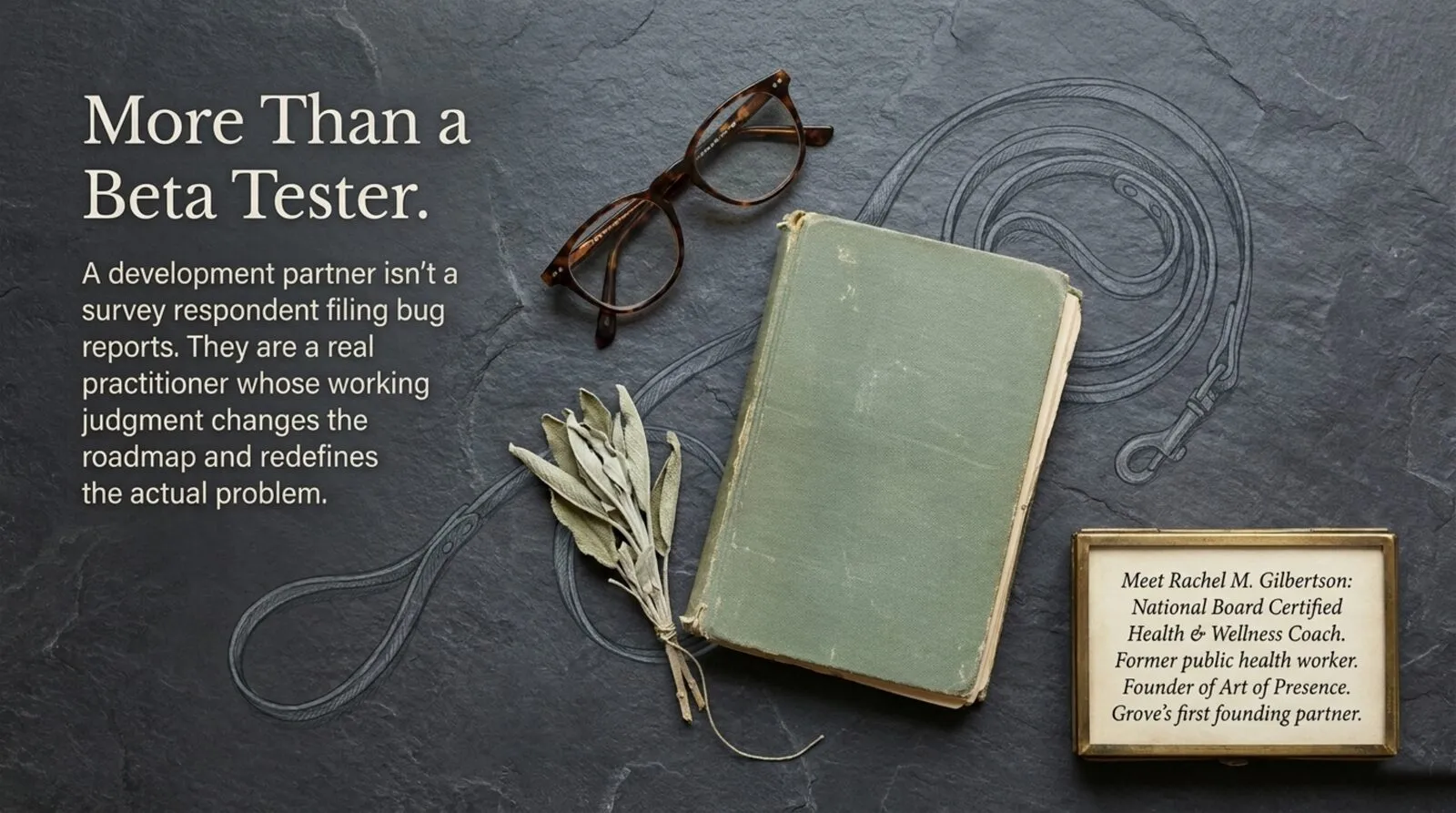
Rachel Gilbertson is a National Board Certified Health & Wellness Coach who runs a practice called Art of Presence, weaving wellbeing, life, and soul work for clients in seasons of transition. She has been a wellbeing coach for nineteen years. Her work is less about tracking than about navigating change and, in her own phrase, aligning with intuitive knowing. Before going solo she co-created an employee wellbeing program at a local university and spent several years helping run a public health family home visiting program.
She became Grove’s first founding coach in June, and she has held something close to my mother’s role at that hospital. Not a customer I sell to. A practitioner whose judgment has changed what I build, and more than once, what I thought the problem was.
What follows is the honest ledger. Not everything she asked for got built, and I will get to that.
What Rachel actually changed
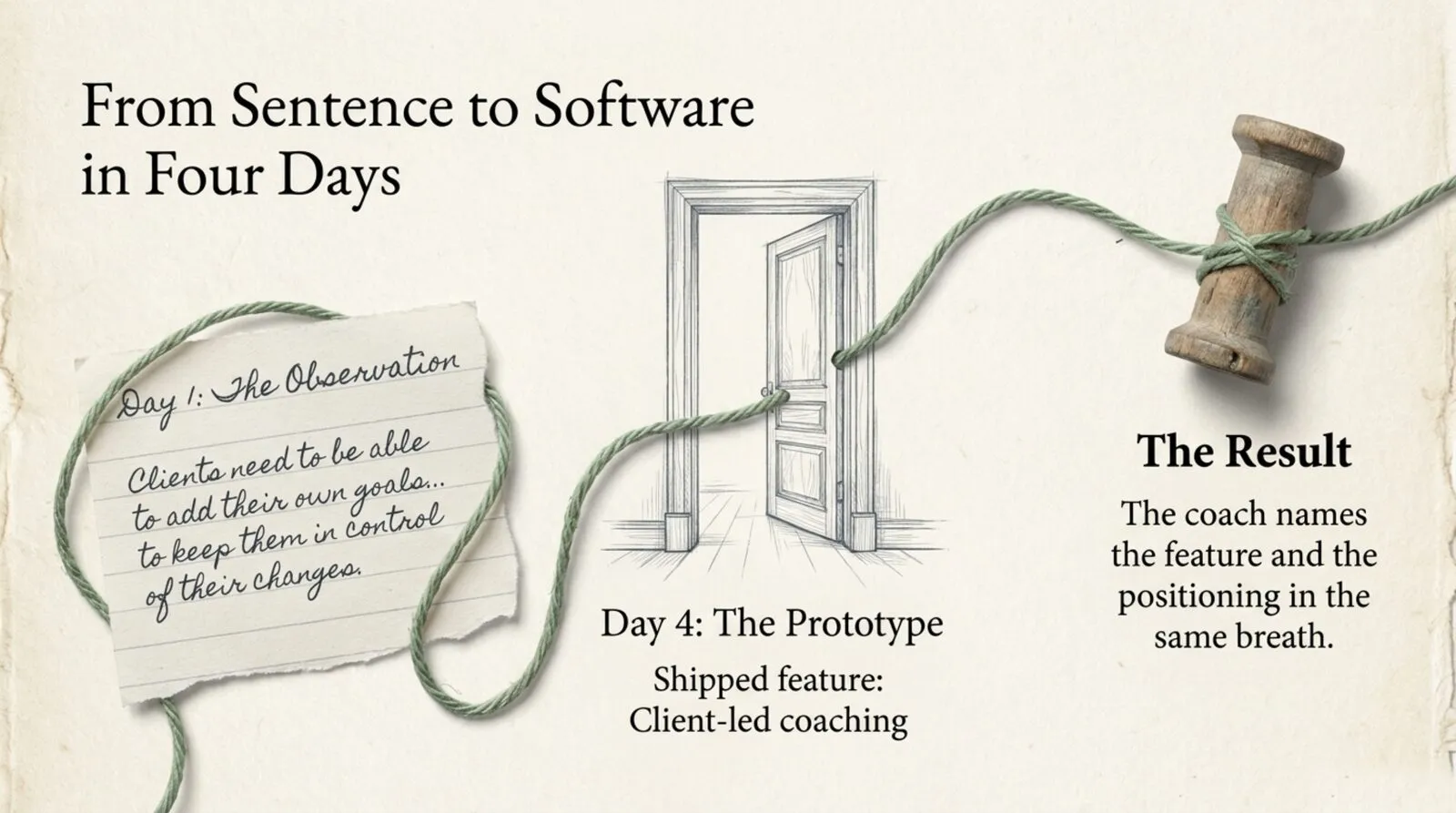
1. Clients can own their own plan. In late June Rachel sent me a note about goals and habits: “I think it could be helpful to have clients able to add their own goals and habits to track since things may shift before meetings and ultimately it keeps them in control of their changes.” She hedged it with “I may just be new to using it.” She was not new to using it. She had found a real hole: coaches could author goals and habits, and clients could not.
Four days later I sent her prototypes. Her reply settled a design question I had been going back and forth on for weeks, which was whether the client should own the plan or the coach should propose it. Her answer was both, and she gave me the language for it:
“Either the coach can add them as part of the follow up or the client can add/edit at anytime keeping it ‘consistent yet flexible’ which is what I often talk about with clients. Consistent where you feel like you’re making progress yet flexible enough to shift with the changes of life.”
Client-led coaching is a shipped part of Grove now, and “consistent yet flexible” ended up in our internal writing guide as the phrase we reach for. A coach named the feature and the positioning in the same paragraph.
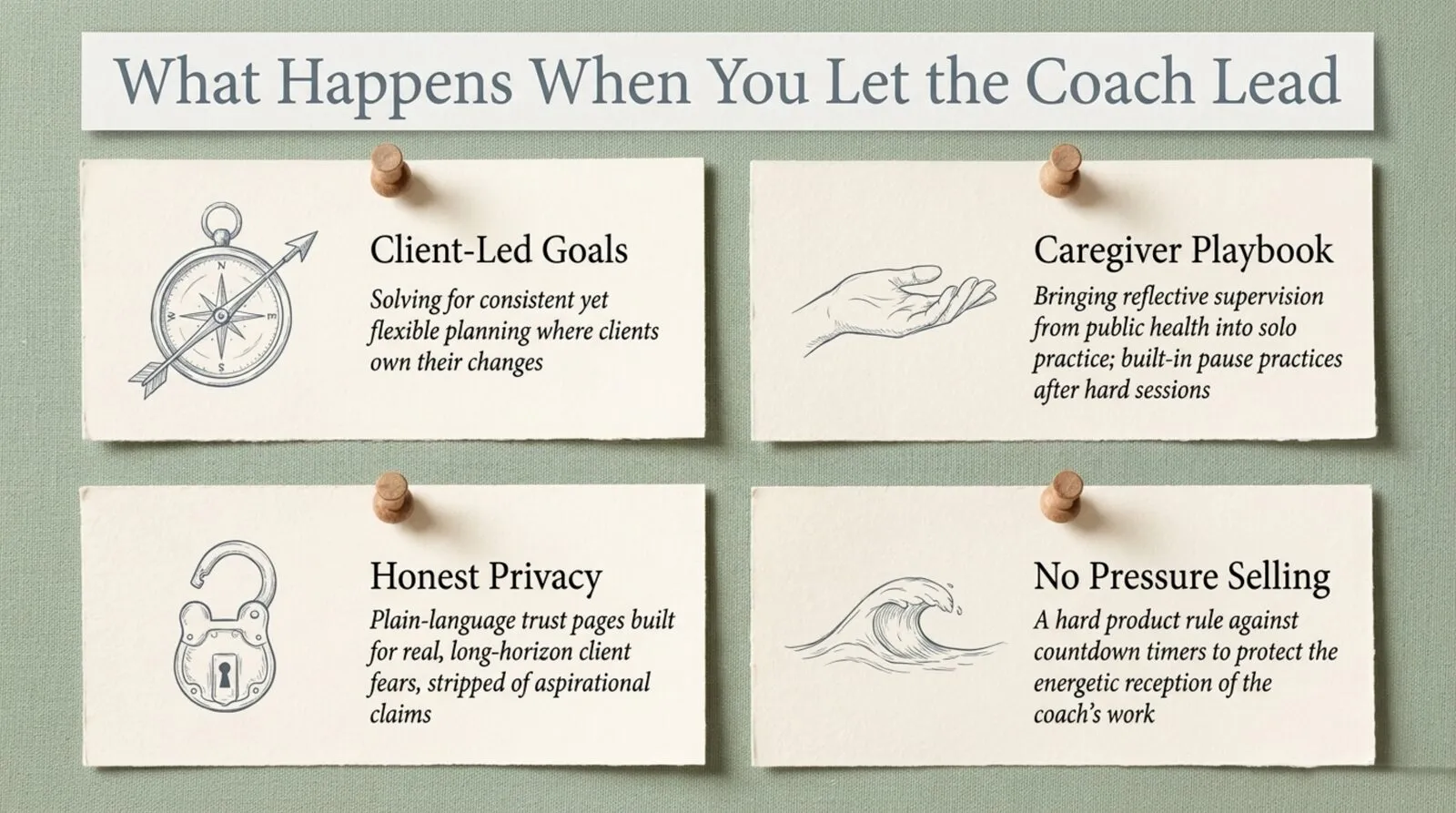
2. The caregiver playbook. On an early call, the thing Rachel lit up describing was not a coaching framework. It was a staffing structure: reflective supervision in family home visiting. Informal support after a hard visit. A monthly one-on-one with someone who is explicitly not your performance supervisor. A monthly group where one nurse brings a case and everyone works it together. None of it a perk. All of it on the calendar and in the budget.
Then she went solo, and all of it disappeared. Her own answer was to hire a coach of her own, the way most therapists keep a therapist. The structure question stayed open anyway: support you hire is not the same as support built into the shape of the work.
That conversation became a starter playbook in Grove called Sustainable Caregiving, with a short pause practice after hard sessions and a weekly review of the care load. It exists because a coach told me how her old profession solved a problem her new one ignores. An earlier suggestion of hers had already become the small “set the session down” moment in Grove, built before she ever signed up, and it was what I brought to our founding-coach conversation: here is a thing you said, already in the product.
3. How we talk about privacy, and how honest the page is. On our first call I explained how Grove strips names before anything reaches the AI. Her reaction was immediate interest, followed by a genuinely long-horizon worry. She had started social media in college, watched it change and expand and grow over the years, and only later realized she had handed it twenty years of personal data without understanding the trade. She was not going to let that happen to her clients’ words. That worry became a Journal post explaining the anonymization model in plain language.
Then she pushed it further. She asked for privacy language she could hand her own clients, offered to help write it, and sent me her own materials as a model, having already solved for the worksite-wellbeing client who wants to know what her employer can see. Our trust page is the result of that thread: she reviewed it for whether it actually lands with a coach, and I checked every claim on it against what the code really does, so that nothing on the page is aspirational. A page about honesty is a bad place to round up.
Months later, her reason for turning Sage on was not the AI:
“I’d love to check out Sage as I trust you and all that you’ve shared about the privacy precautions you’ve built into Grove.”
4. The rule against pressure selling. Rachel does not do countdown timers or last-chance pushes, and she explained why in a line I have quoted internally more than any other: the energy with which you create something is the energy it is received with. That is now a hard rule in Grove’s writing guide. We came close to shipping urgency copy more than once. We did not, because of her.
5. How booking works. She walked me through her real scheduling setup screen by screen, including the parts that annoy her. Watching a working system in the hands of the person who depends on it is worth more than any feature comparison, and our self-booking work looks the way it does because of that hour.
What she asked for that does not exist (yet)
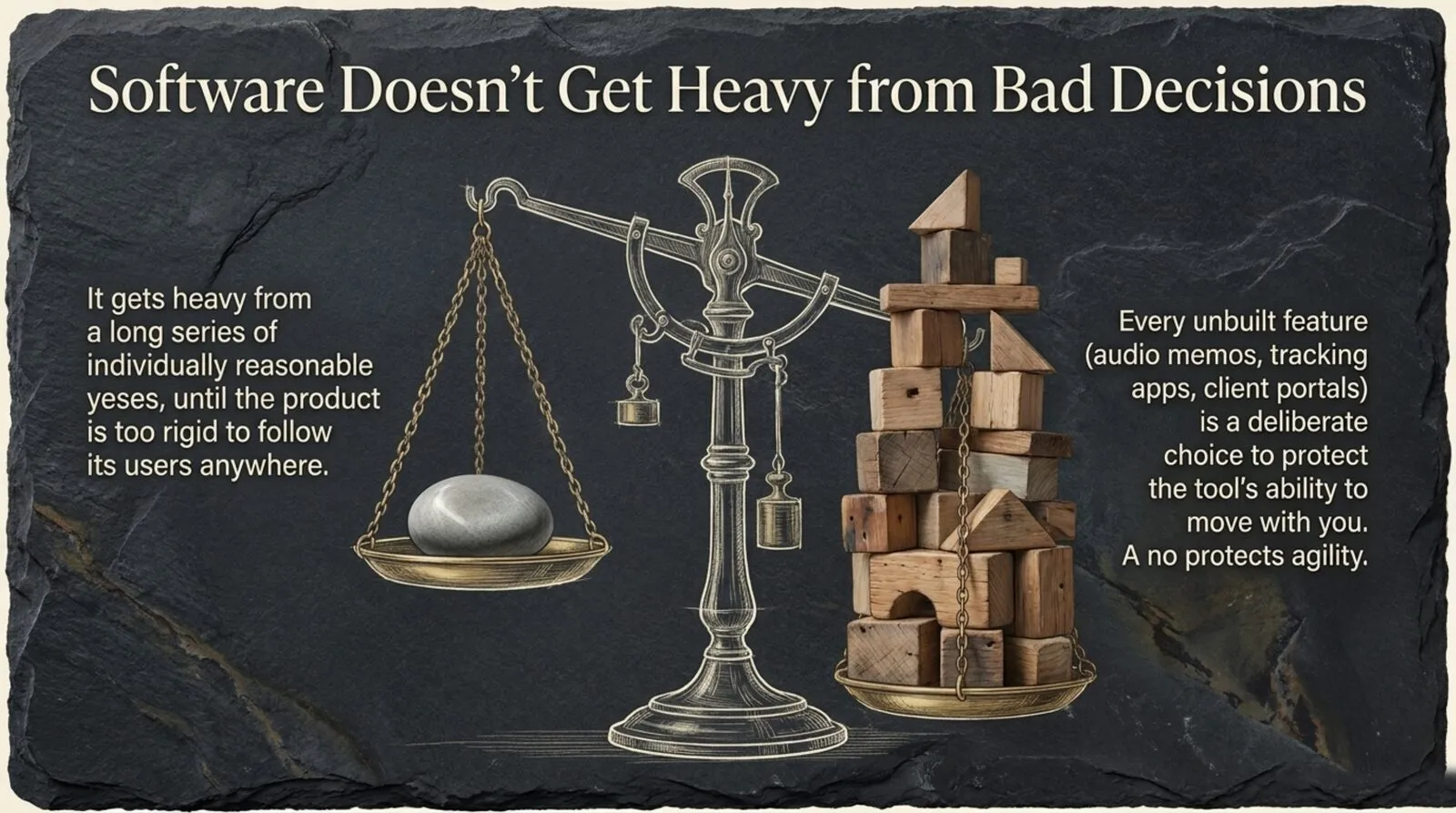
Voice memos. Text-message session reminders. Food, water, and activity tracking. Client-initiated sharing, where a client sends something over without the coach asking first. A coach-branded client portal. There is also a whole parked product line about coach wellbeing, drawn from that reflective supervision structure, that I want to build more than almost anything else on the list.
None of those are unreasonable. Most of them exist in products she has used. So why not just build them?
The boring half of the answer is arithmetic. I am one engineer. Every yes is a no to something else, and the something else is usually the thing three coaches asked for instead of one.
The real answer is harder, and it is the same reason I opened this post the way I did. The tool that does eleven things adequately and your one thing not at all did not get that way through laziness. It got that way by saying yes. Every feature is permanent: it has to be maintained, kept working while everything around it changes, explained to every new person, and defended against the day it conflicts with something better. Software does not get heavy from bad decisions. It gets heavy from a long series of individually reasonable yeses, until the product is too rigid to follow its users anywhere. The ability to turn a coach’s sentence into a working prototype in four days is not magic. It is a direct consequence of how little Grove is carrying.
So a no is not always a judgment about whether the idea is good. Often it means: not before I know that more than one practice needs it, and not before I know where it goes. Rachel knows which of her asks are sitting unbuilt, because I tell her. That is the part that makes it a partnership rather than a suggestion box.
The part that goes both ways
In August she sent me her own coaching materials, a daily planner page and a workbook she built for her clients. Her structure runs intention, attention, attitude, action, impact, with intention framed as a feeling rather than a task. You do not write “finish the deck.” You write how you want to feel today.
I put four pieces of it into my own working week, the one I actually run, assembled with Claude so the planning and the reflection happen without me having to remember them. It has held up for weeks now.
The planner is the smallest part of it. I go to Rachel’s Mindfulness Monday series every week and have for months. Monday is usually the day I arrive already moving too fast, three problems deep before I have decided which one matters, and that session is what puts me back at a speed where I can actually think. At the end of October I am going to her Rewilding retreat. None of that is research. I am not taking notes for the product.
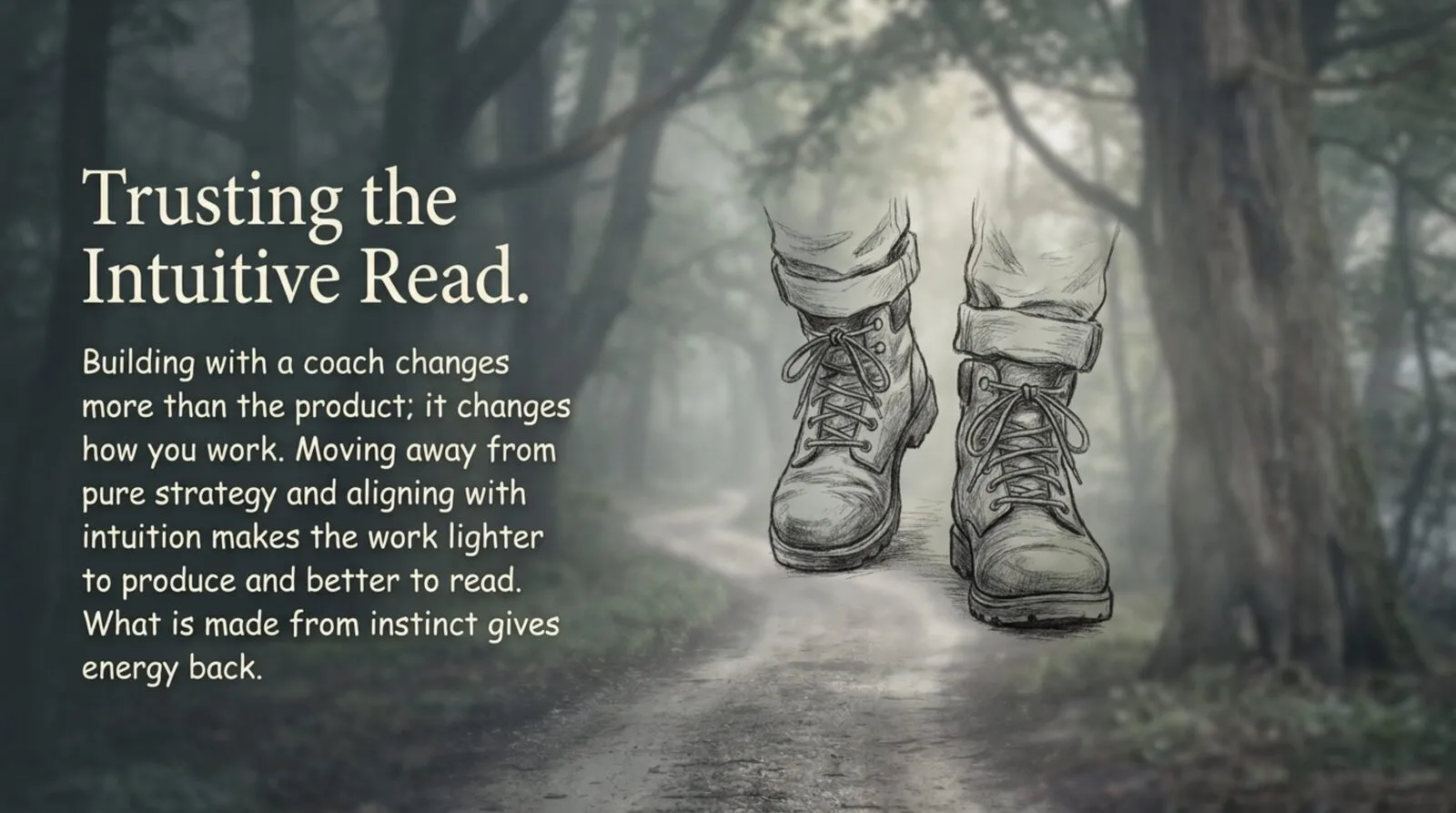
The bigger change is harder to name. I write a lot for Grove, and for a while I was producing what a founder produces when she has read about marketing: technically correct, on strategy, and quietly draining to make. Rachel talks often about aligning with intuitive knowing. Somewhere along the way I started putting that question to my own work, which is whether the thing I am about to publish is actually mine. Trusting my own read has made the writing lighter to produce and better to read. What I make from instinct gives me energy back. What I make from strategy alone takes something out of me, and I suspect that shows on the page more than I would like.
She also posts from her morning dog walks, small unpolished notes from wherever she has ended up that day. They turn up in my feed on the mornings I need them, and they do two things at once. They remind me who I am building this for, and they remind me to keep going.
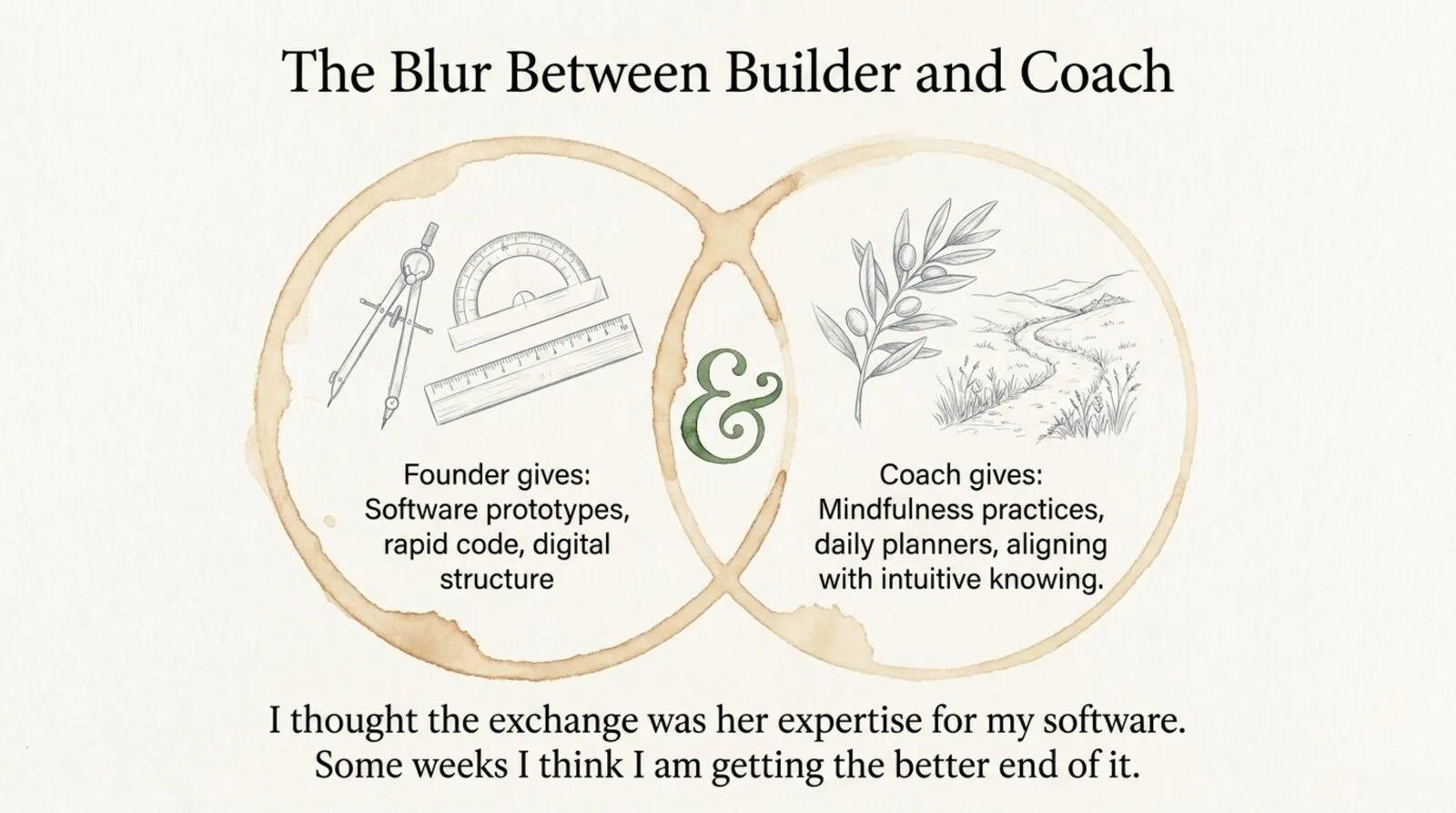
Somewhere in the last year I lost the clean line between the coaches I am building for and the coaches who are, quietly, coaching me. I went looking for a development partner. I found a group of practitioners who do this for a living and cannot really help doing it. I thought the exchange was her expertise for my software. Some weeks I think I am getting the better end of it.
Built with, not about
There is a real cost to this method. One coach is one coach, and the fastest way to build the wrong product is to treat a single articulate customer as the market. I have said no to Rachel, and I have sat on requests of hers for months waiting to see whether a second or third coach named the same thing.
But the alternative, which is the industry norm, is to build about coaches. To infer the practice from a competitor’s feature list and a category report, and to find out you were wrong when nobody renews.
My mother was not a software person. She was the person who knew what happened on a floor at shift change, and somebody was smart enough to ask her. Rachel does not build software either. She is a coach who knows what a client does with a plan when life moves, and what a coach carries home after a hard session.
The software is only ever as good as who you let in the room.

Rachel M. Gilbertson is a National Board Certified Health & Wellness Coach and the founder of Art of Presence, a practice that weaves wellbeing, life, and soul work. A wellbeing coach of nineteen years, she co-created an employee wellbeing program at a local university and helped run a public health family home visiting program before going solo, and she was Grove's first founding coach.

Founder of Grove. Twenty years building software for skilled professionals. Currently writes mostly on Tuesdays from a small studio in Austin.