
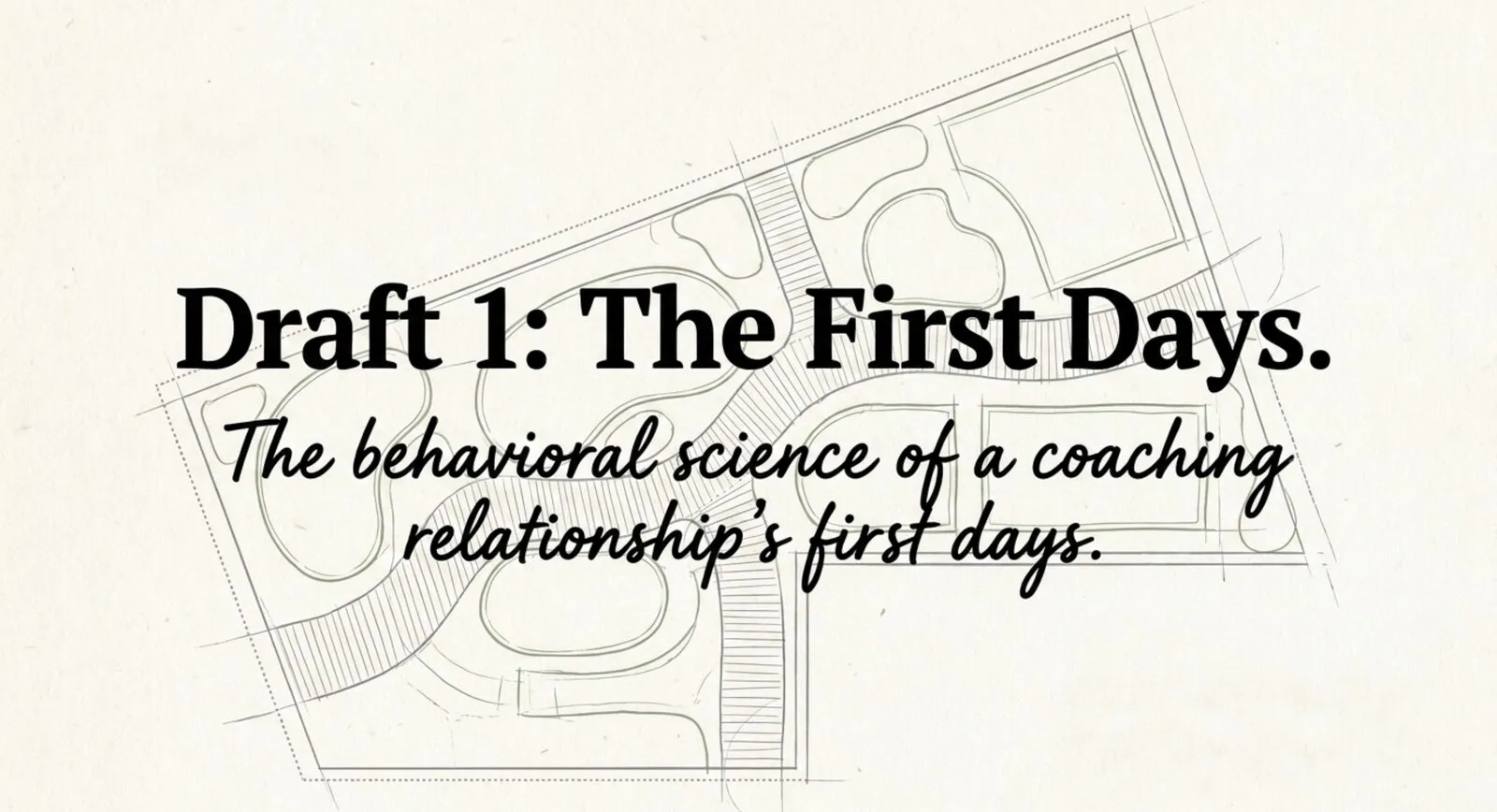
When someone says yes to working with a coach, the yes stays warm for a little while. They sat with you, they felt heard, they left that first conversation believing something could be different this time. Then the logistics arrive: the intake packet, the scheduling link, the app invite, the tracker with its empty fields. The most hopeful decision they have made all year gets handed a clipboard.
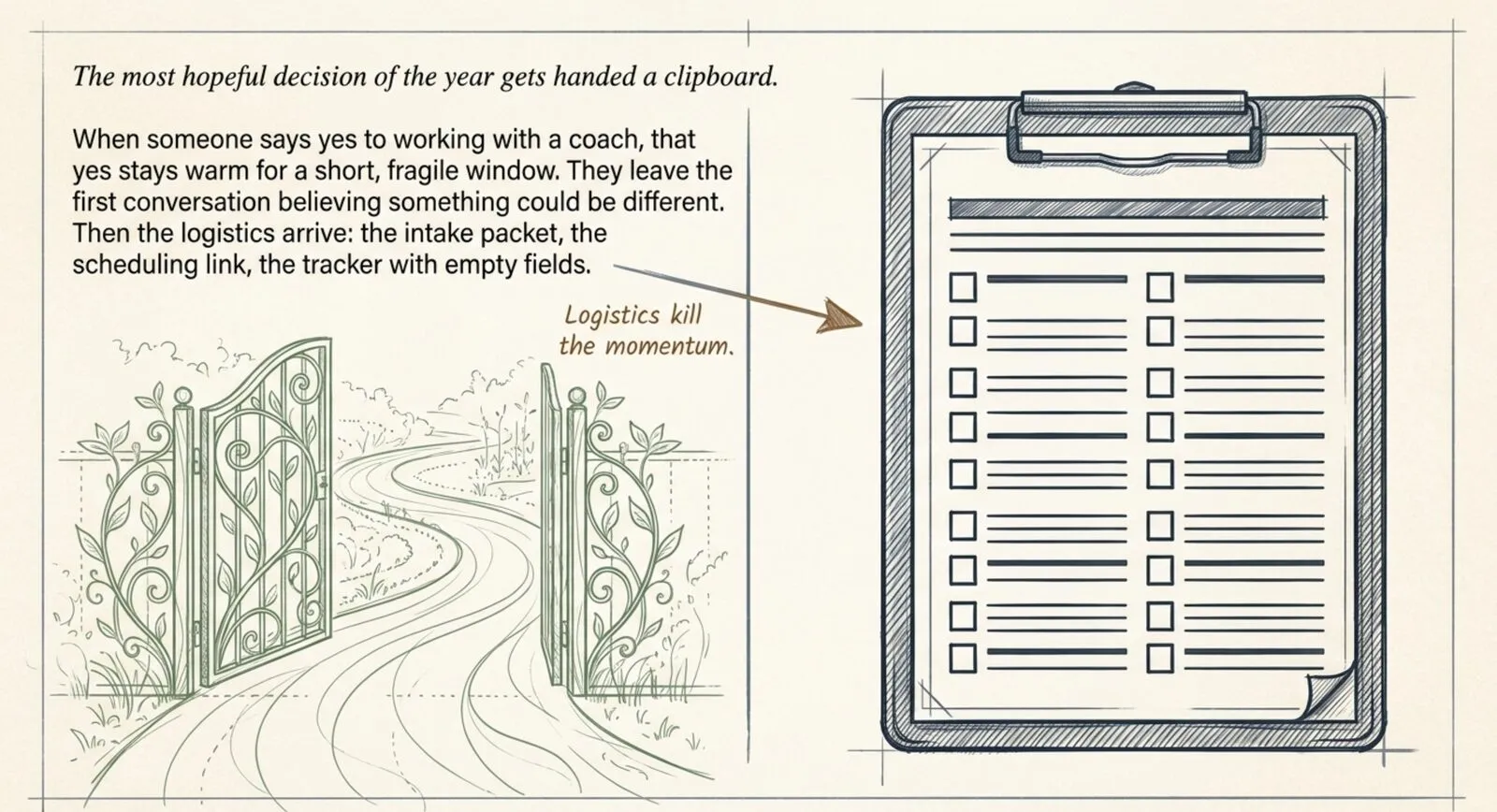
The profession already knows this is backwards. Coach training is nearly unanimous about what comes first, and it is not the paperwork and not the habit list. The NBHWC, the board that certifies health and wellness coaches, describes the work as supporting a client’s vision, aligned with their aspirations and purpose. The Wellcoaches protocol, one of the oldest evidence-based curricula in the field, orders the process explicitly: vision first, then goals, then the weekly experiments that serve them. Ask who the person is becoming before you ask what they will log on Tuesday.
I have spent the past few months building that ordering into Grove, and I will describe what we shipped further down. But the more useful thing I took from the work is not about software at all. It is about how much of coaching’s effect is concentrated in the first days of the relationship, and how specifically the research says those days want to be spent.
A fresh start is a real, measurable thing
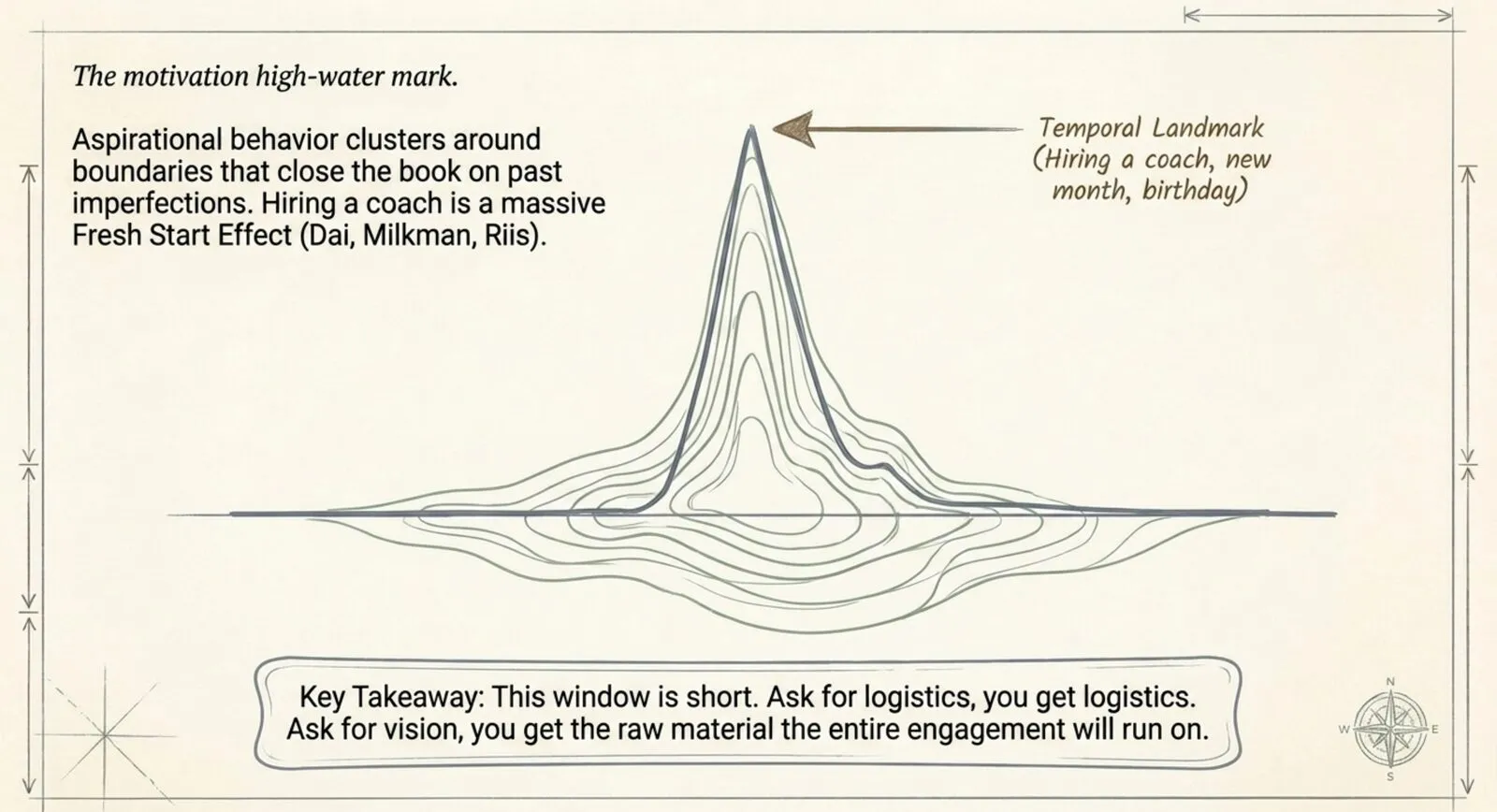
Hengchen Dai, Katy Milkman, and Jason Riis found that aspirational behavior clusters around temporal landmarks: the start of a week, a month, a birthday, a new semester. Google searches for “diet,” gym attendance, and goal commitments all spike right after these boundaries. They called it the fresh start effect. A landmark closes the books on the old period, files your past imperfections in it, and hands you a self who has not failed at anything yet.
Hiring a coach is exactly that kind of landmark, and it may be the strongest one a person ever hands you. A new client is not just willing to fill out forms in week one. They are briefly, unusually willing to think in big-picture terms about who they want to be. That window is a motivational high-water mark, and it is short. Whatever you ask for during it is what the relationship gets. Ask for logistics and you get logistics. Ask for a vision and you get the raw material the entire engagement will run on.
Two practical things follow from the study, and they reach well past week one.
First, spend the fresh start on meaning, not mechanics. The paperwork can wait a day. The question “what would be different a few months from now, if this worked?” cannot, because the person who answers it best is the person who just decided to change.
Second, fresh starts are renewable, and a coach can hand them out. The client who vanished for three weeks is dreading “week four of failing.” A temporal landmark lets you rename it: first of the month, back from vacation, day one of the restart. Same calendar, different mental accounting, and the research says the difference is not cosmetic. We wrote before about clients who go quiet instead of quitting; the fresh start is the door back in.
Why vision, why, and identity do so much work
The instinct to start with vision is old coaching wisdom. What the behavior-change literature adds is the mechanism, and the mechanism tells you how to do it well.
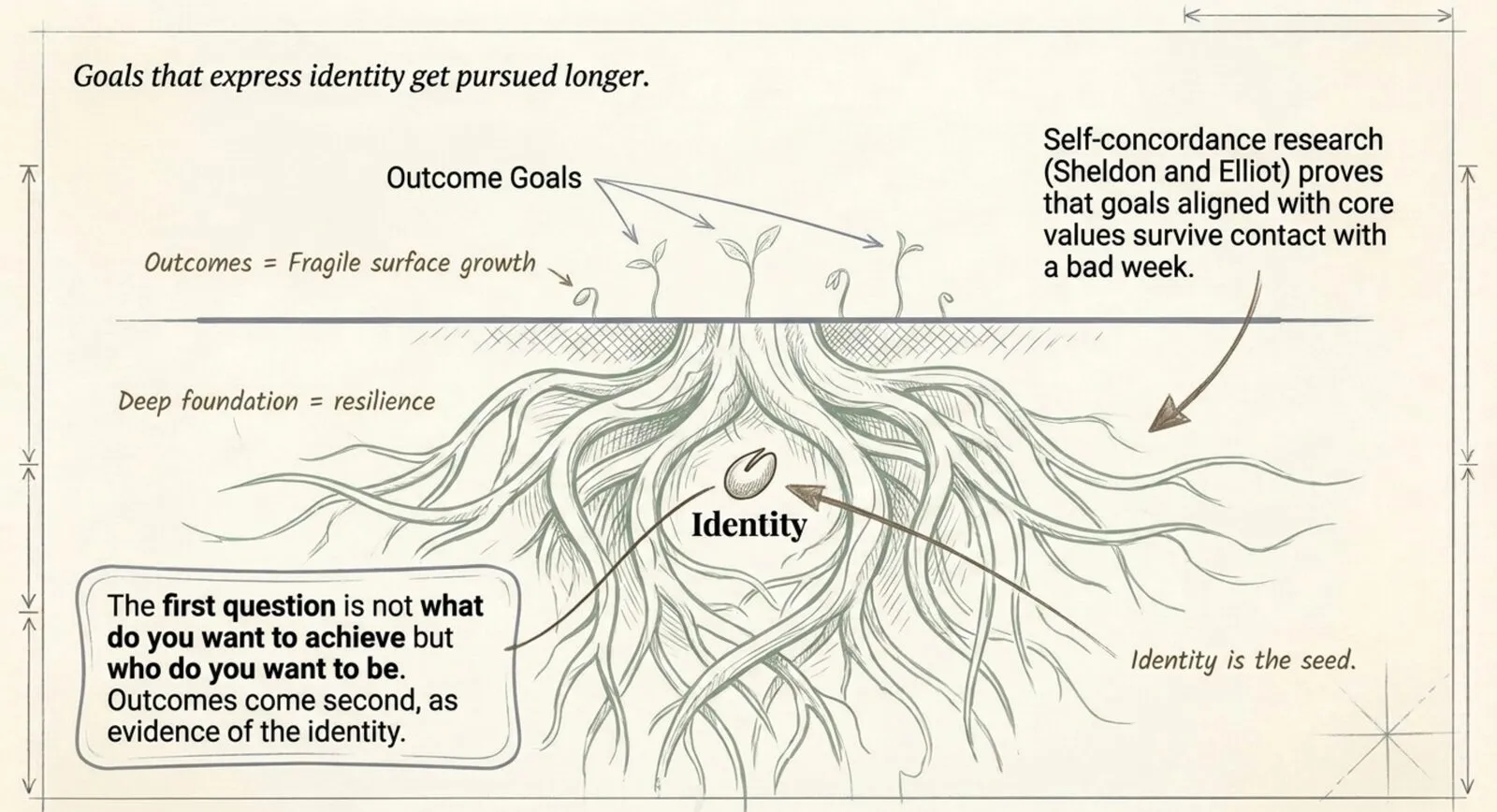
Goals that express identity get pursued longer. Kennon Sheldon and Andrew Elliot call this self-concordance: in their longitudinal studies, goals aligned with a person’s core values and interests attracted more sustained effort, were attained more often, and paid larger well-being dividends when reached. A goal that belongs to who you are survives contact with a bad week in a way a borrowed target does not. James Clear turned this into the most quoted line in modern habit writing, that every action is a vote for the person you wish to become, but the finding predates the phrase. For the intake, it means the first question is not “what do you want to achieve” but “who do you want to be”: a good sleeper, someone who follows through, someone who handles life with calm. The outcome goals come second, as evidence of the identity rather than the point of it.
Reflection converts doing into learning. In field and lab experiments by Giada Di Stefano, Francesca Gino, Gary Pisano, and Bradley Staats, trainees who spent the last fifteen minutes of the day writing brief reflections outperformed their peers by 23% on the final assessment. Not more practice. The same practice, plus a few minutes of articulating what it meant. A client who writes one honest line about their day is doing the thing the research measured. The vision gives that line somewhere to point: today, read against the person I said I wanted to become.
Self-monitoring is the workhorse of behavior change. A systematic review of self-monitoring studies found a consistent association between tracking and outcomes across diet, activity, and weight: the people who keep noticing keep changing. The design problem is cost. A check-in that demands ten minutes gets abandoned by week three. About a minute, anchored to a why the person wrote themselves, is a price a real life can pay daily.
Put together, the first days of an engagement have one job: capture the identity and the vision while the fresh start makes them easy to say, then make the daily noticing cheap enough to survive ordinary life. Everything else in the engagement leans on that foundation.
Putting it into your own practice
None of this requires particular software. The moves are simple enough to run with a form, a shared doc, or twenty minutes of the first session. These are the ones the research supports most directly, and the ones we heard again and again from coaches while designing ours.
1. Ask three questions before the plan exists. Who do you want to be? One pick is plenty. What would feel different a few months from now, if this worked? A sentence, in their own words. What do you want to work on? Cap it at three areas; the cap is a kindness. Notice what is not on the list yet: no habits, no numbers, no schedule.
2. Make every question skippable, and say so. “Skipping costs you nothing. We will just cover it in conversation instead.” An intake where nothing is graded and nothing is required reads as an invitation; one where every field is mandatory reads as an exam. The client who skips the vision question has still told you something worth knowing, and the autonomy you grant in minute one sets the posture for everything after. Ownership is the same principle we built client-led coaching on: the plan, and the vision under it, belongs to the person whose life it has to survive.
3. Keep their exact words. Write the vision down verbatim, not translated into coaching language. “I want to stop feeling like a visitor in my own kitchen” is worth ten of “improve nutrition habits.” The words are the client’s proof of authorship, and they are the most powerful thing you can echo back later: in the week-six review, in the hard conversation after a lapse, in the moment they want to quit.
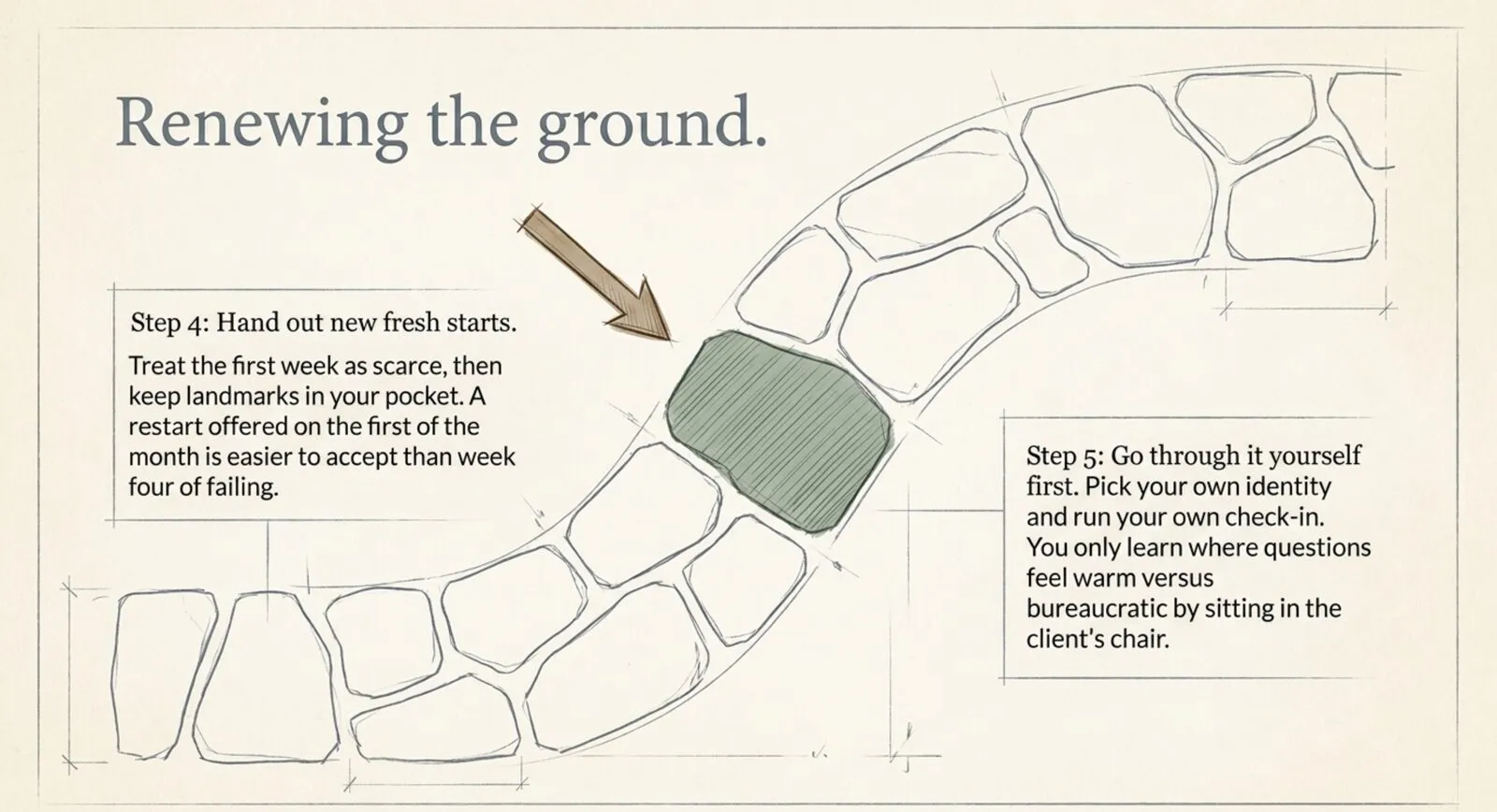
4. Spend fresh starts deliberately, and hand out new ones. Treat the first week as the scarce resource it is: vision first, logistics later. Then keep a few landmarks in your pocket for the rest of the engagement. A restart offered on the first of the month is easier to accept than a resumption of week four, and the offer itself tells the client that falling off is a chapter break, not the end of the book.
5. Go through it yourself first. Whatever intake you ask clients to do, do it on you: pick your own identity, write your own vision sentence, run your own daily check-in for a while. Partly because the coaching tradition has always valued practitioners doing their own work, and partly for craft: you learn where your questions feel warm and where they feel like paperwork, from the only chair that can tell you.
What we built in Grove
Grove’s new onboarding is this list, turned into screens.
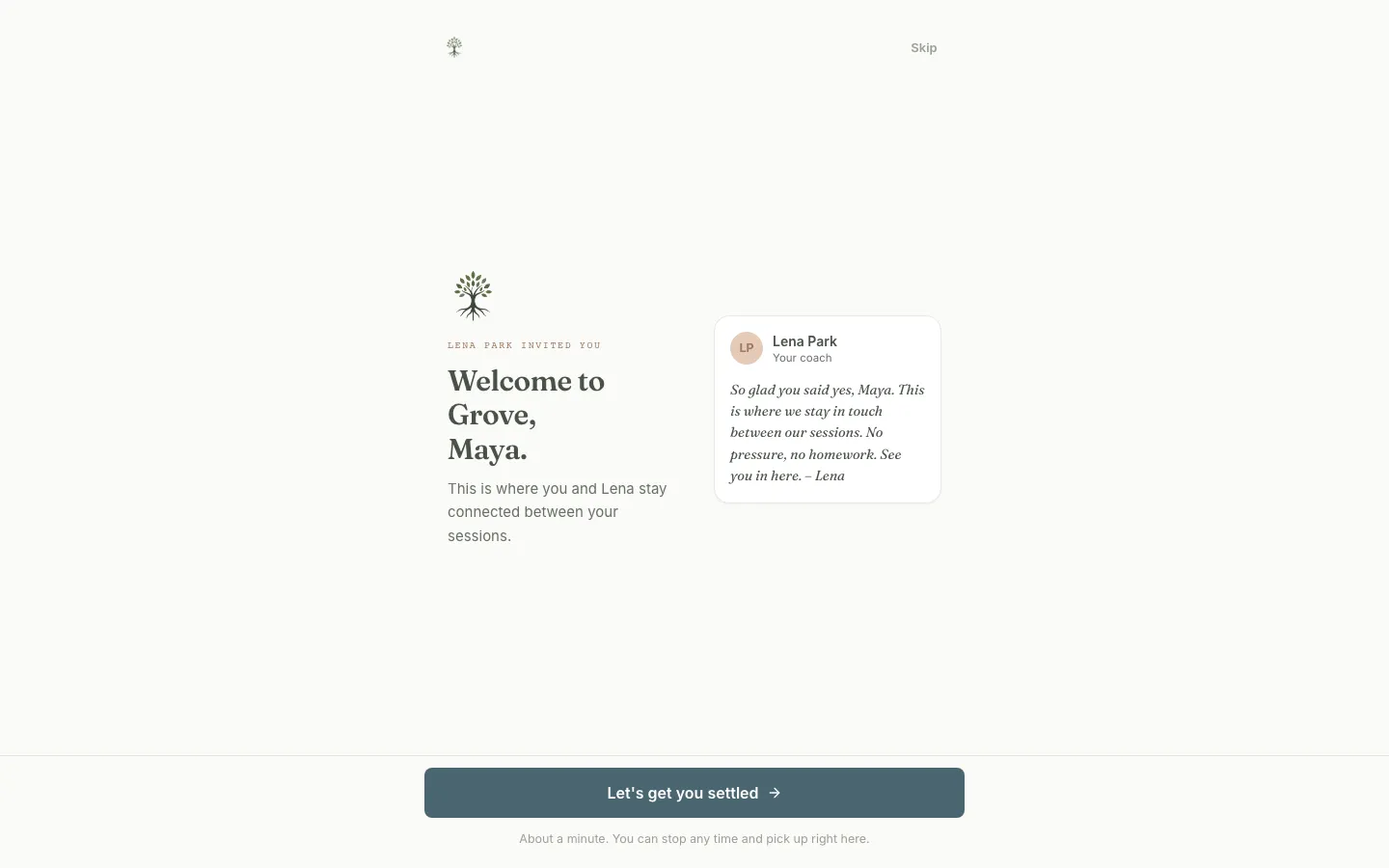
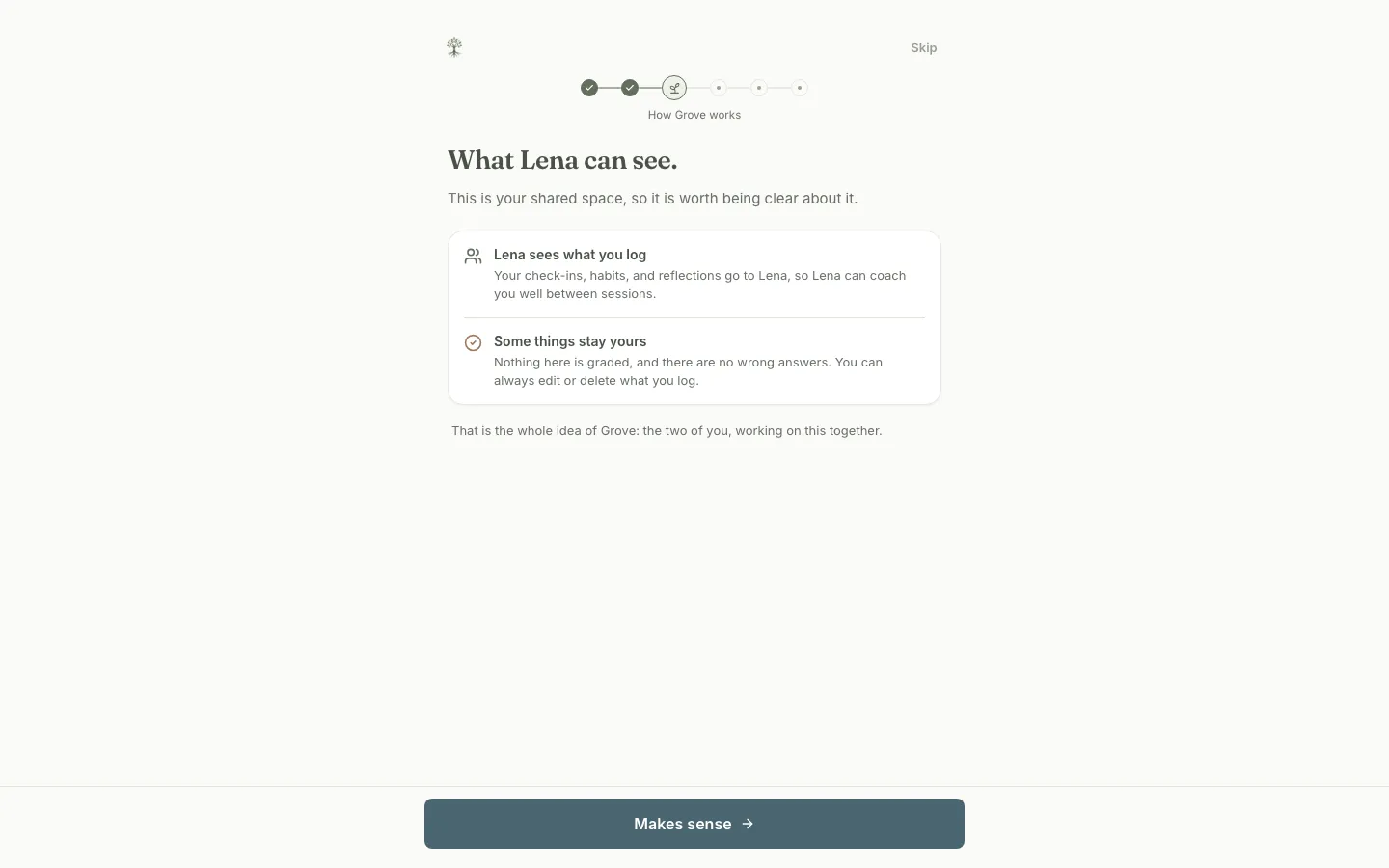
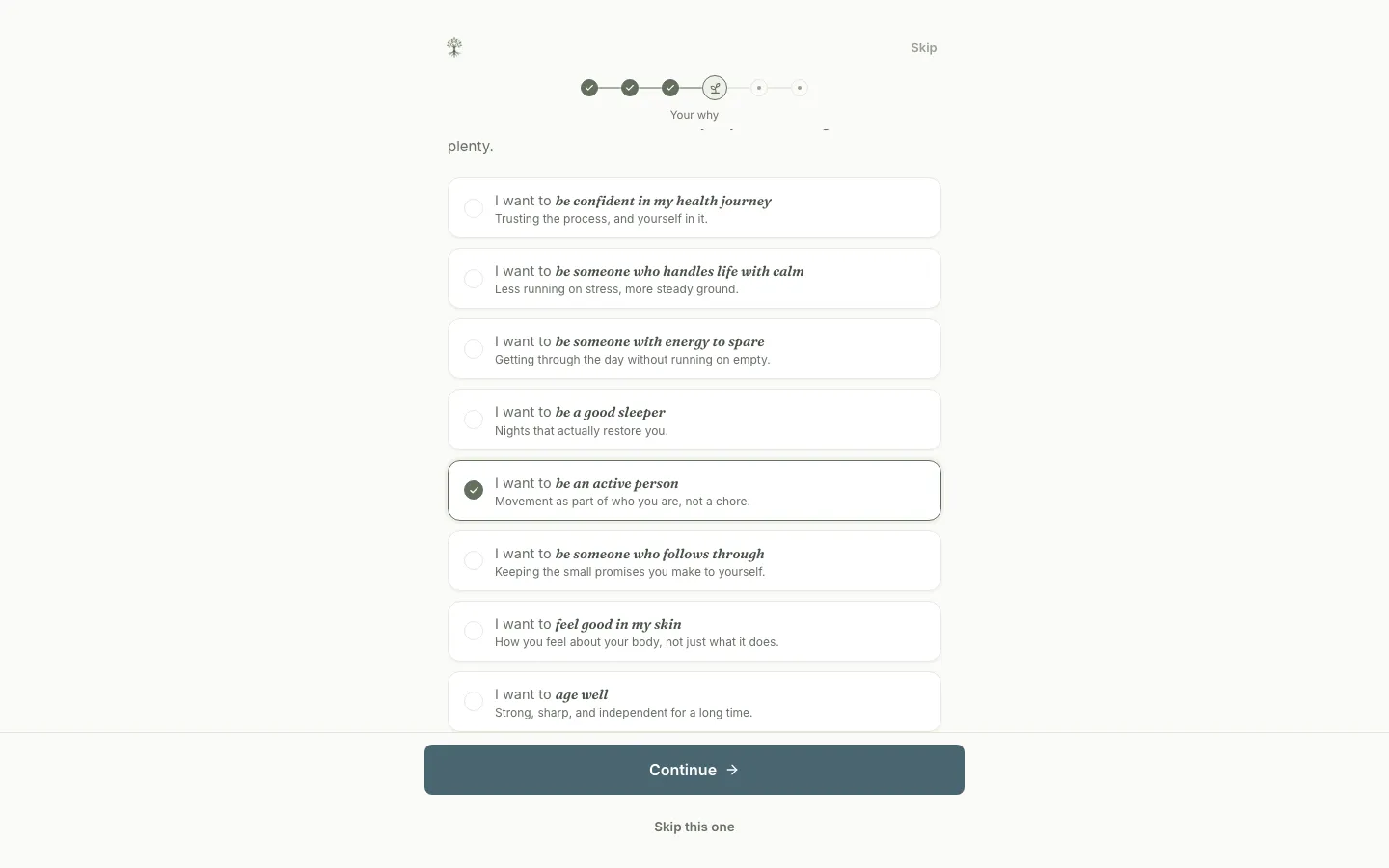
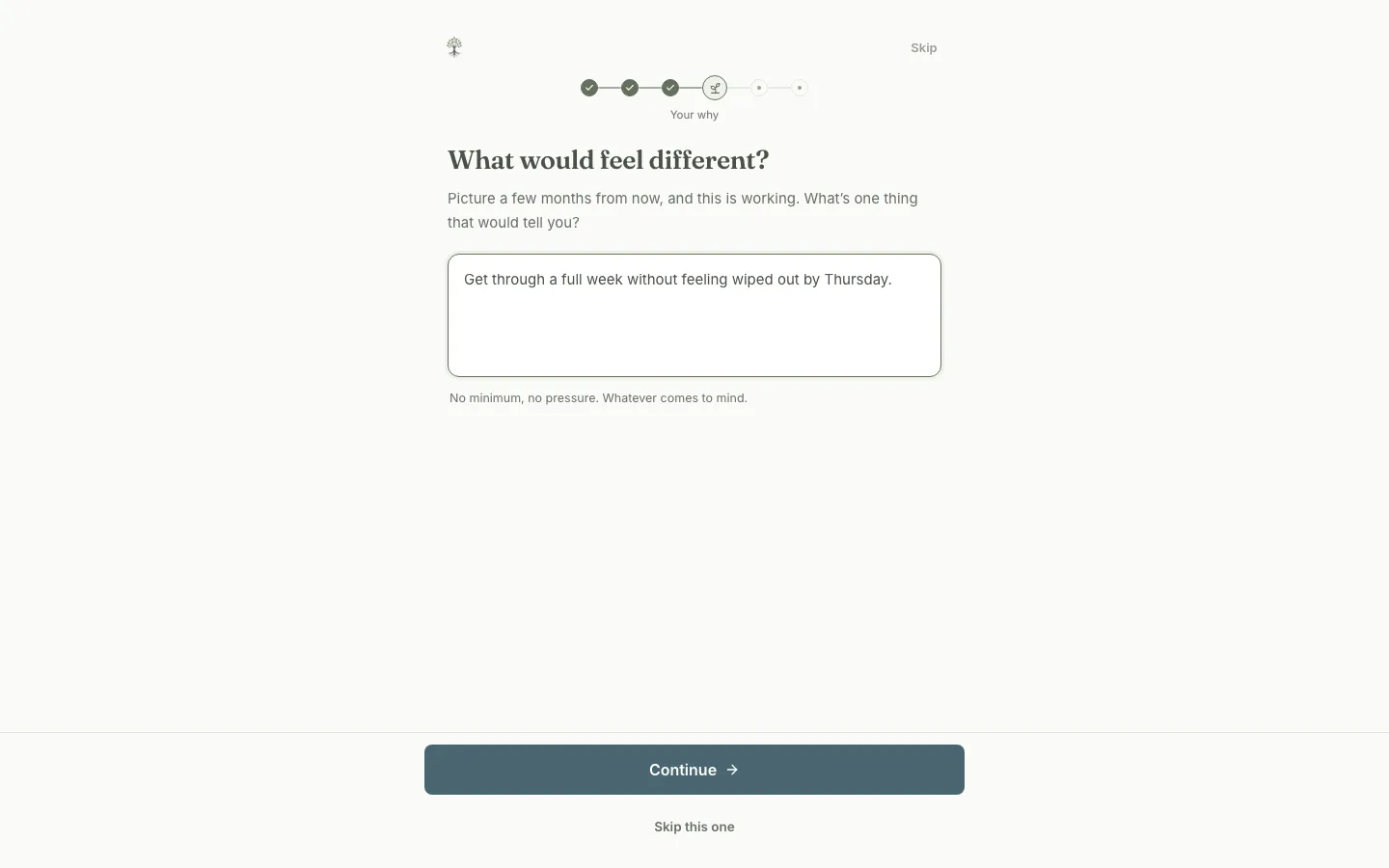
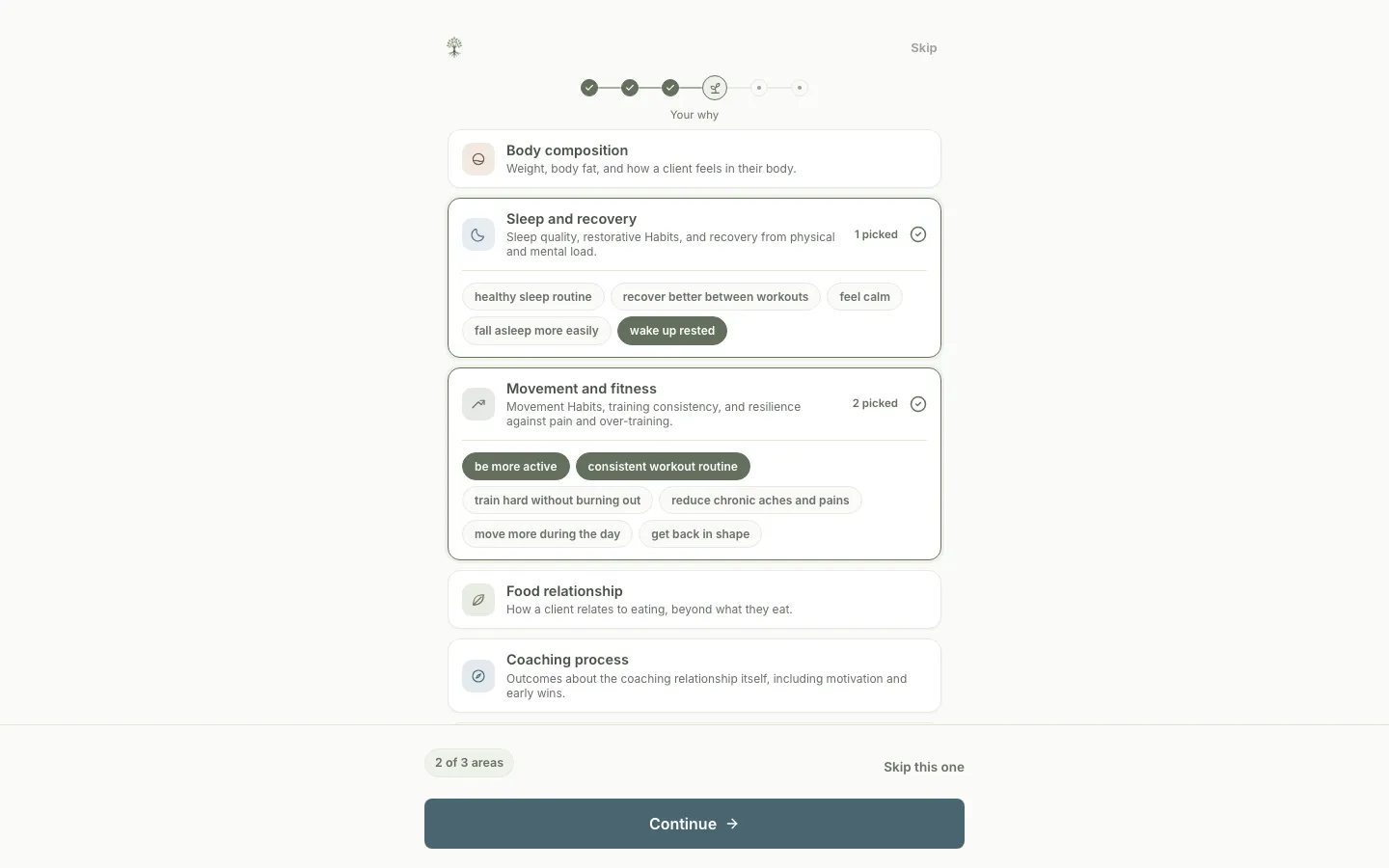
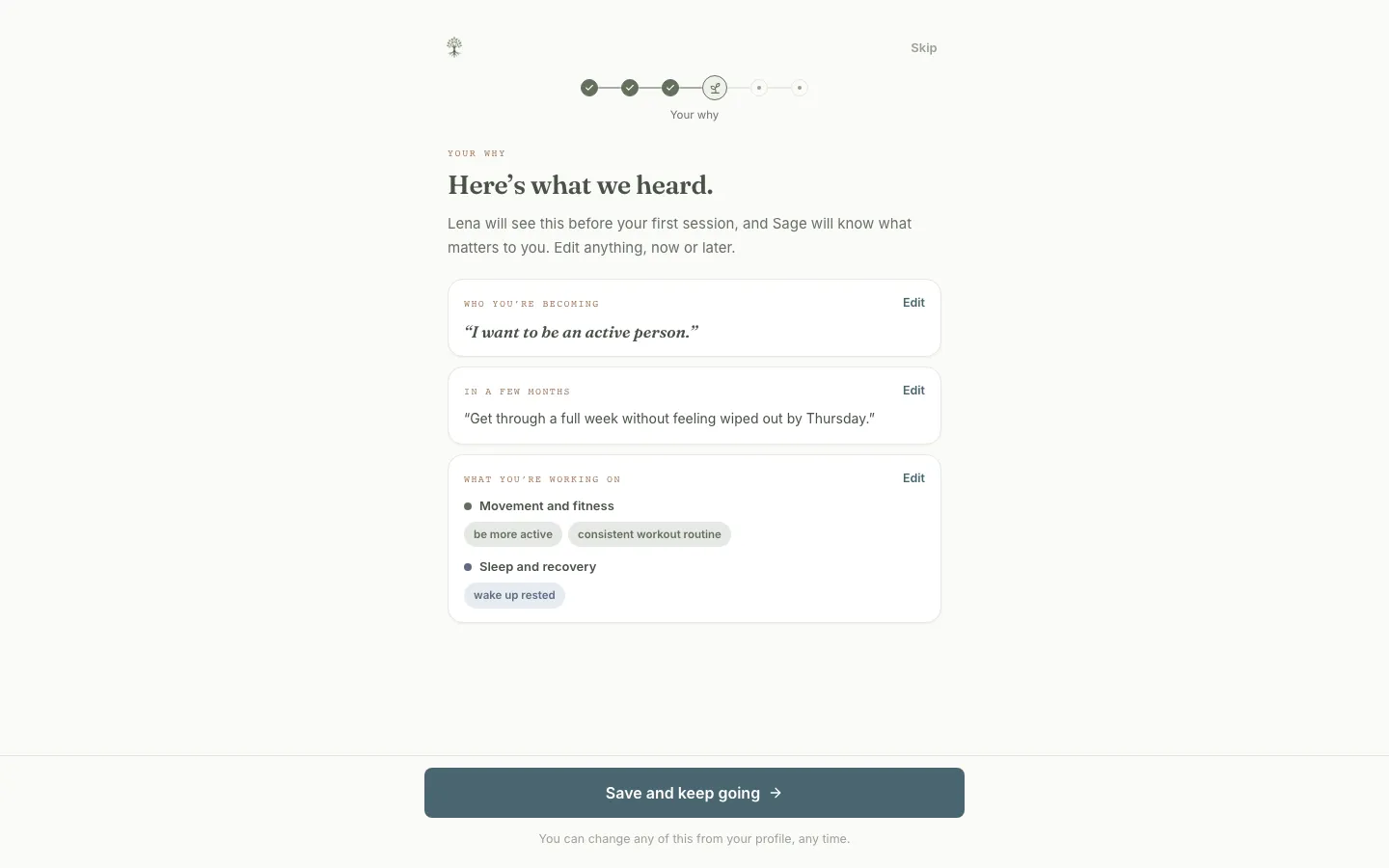
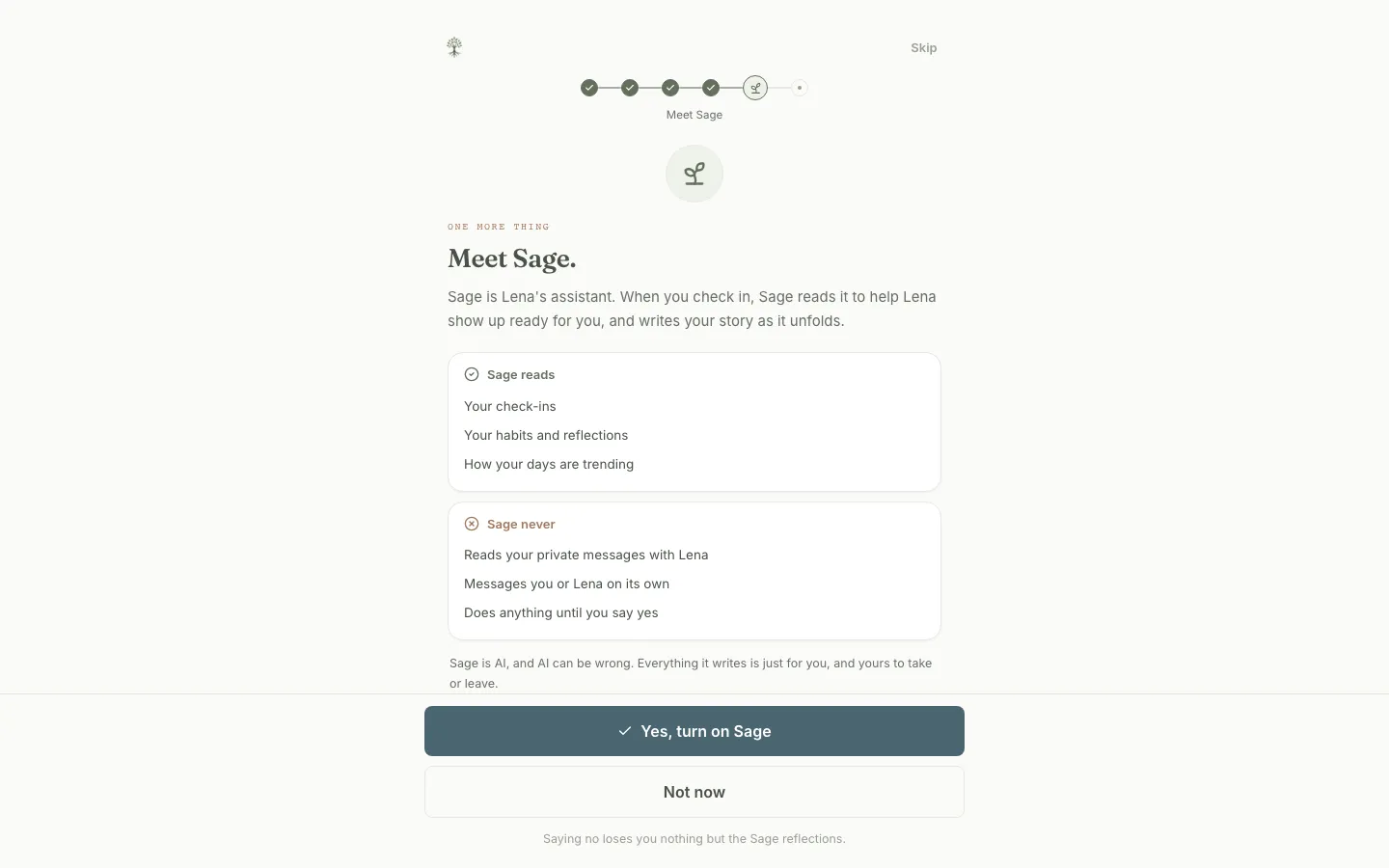
A client who taps their coach’s invite no longer lands on a form. They land in a welcome built around the relationship, their coach’s name and a short note from her first. The practical screens come early and stay brief (a name, a reminder time, where things live, and exactly what the coach can see, said plainly), and then come the three questions in coach language: who do you want to be, what would feel different, what would you like to work on. Every question is skippable, and the flow says so plainly. The read-back screen is titled “Here’s what we heard,” a skipped question gets “You skipped this one, which is completely fine,” and the flow closes with the Sage choice and the first check-in, done right inside it, with the send button naming exactly who will read it. By the first session, the coach has the client’s why in the client’s own words.
Here is that first minute, screen by screen:
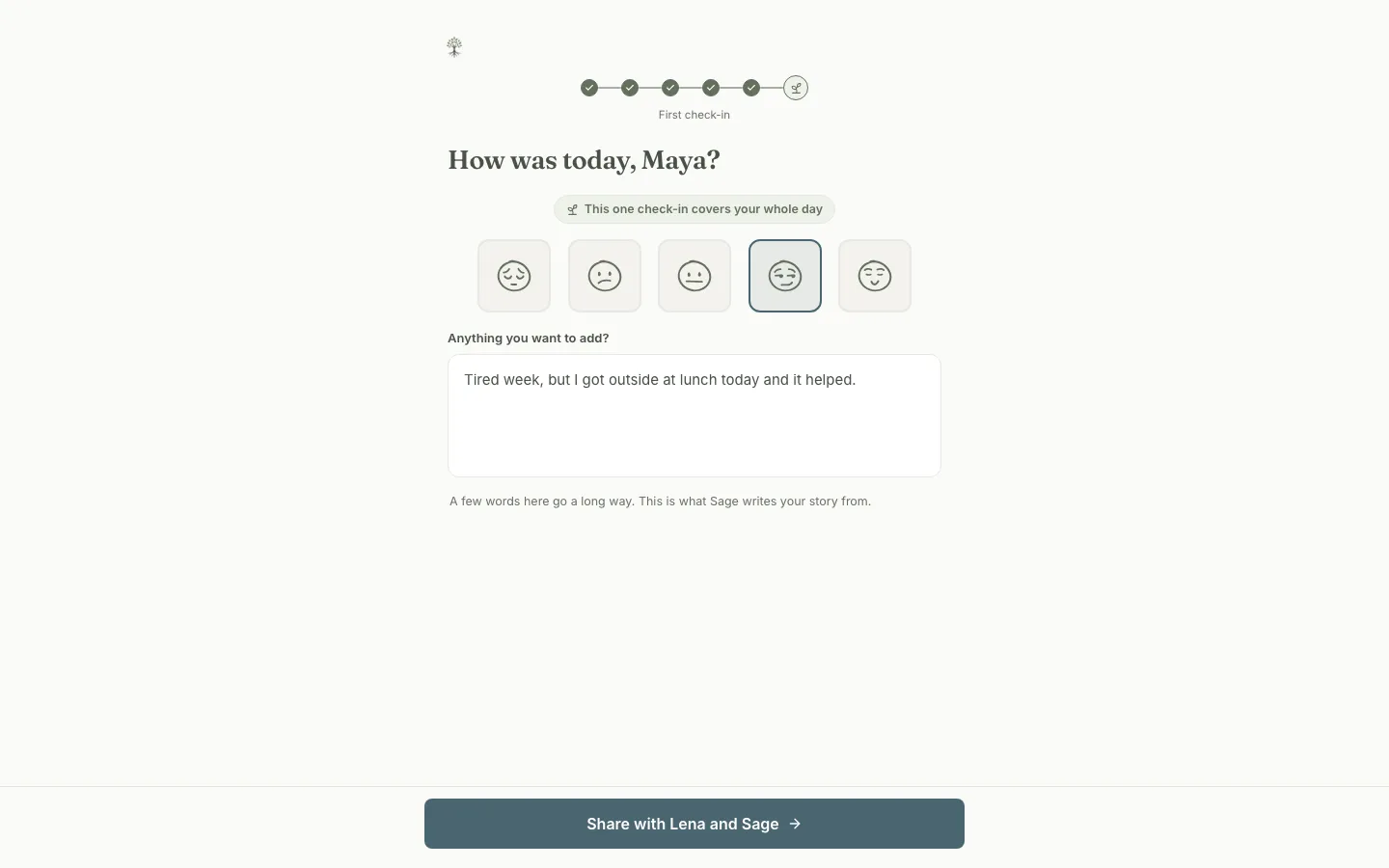
The coach gets the same thing pointed inward: she onboards as her own first client, with her own identity goal, her own vision sentence, a private lens on the practice she is building, her own thirty-second check-in, and her first Daily Pulse generated in the same sitting from her own words. Rule five, built in.
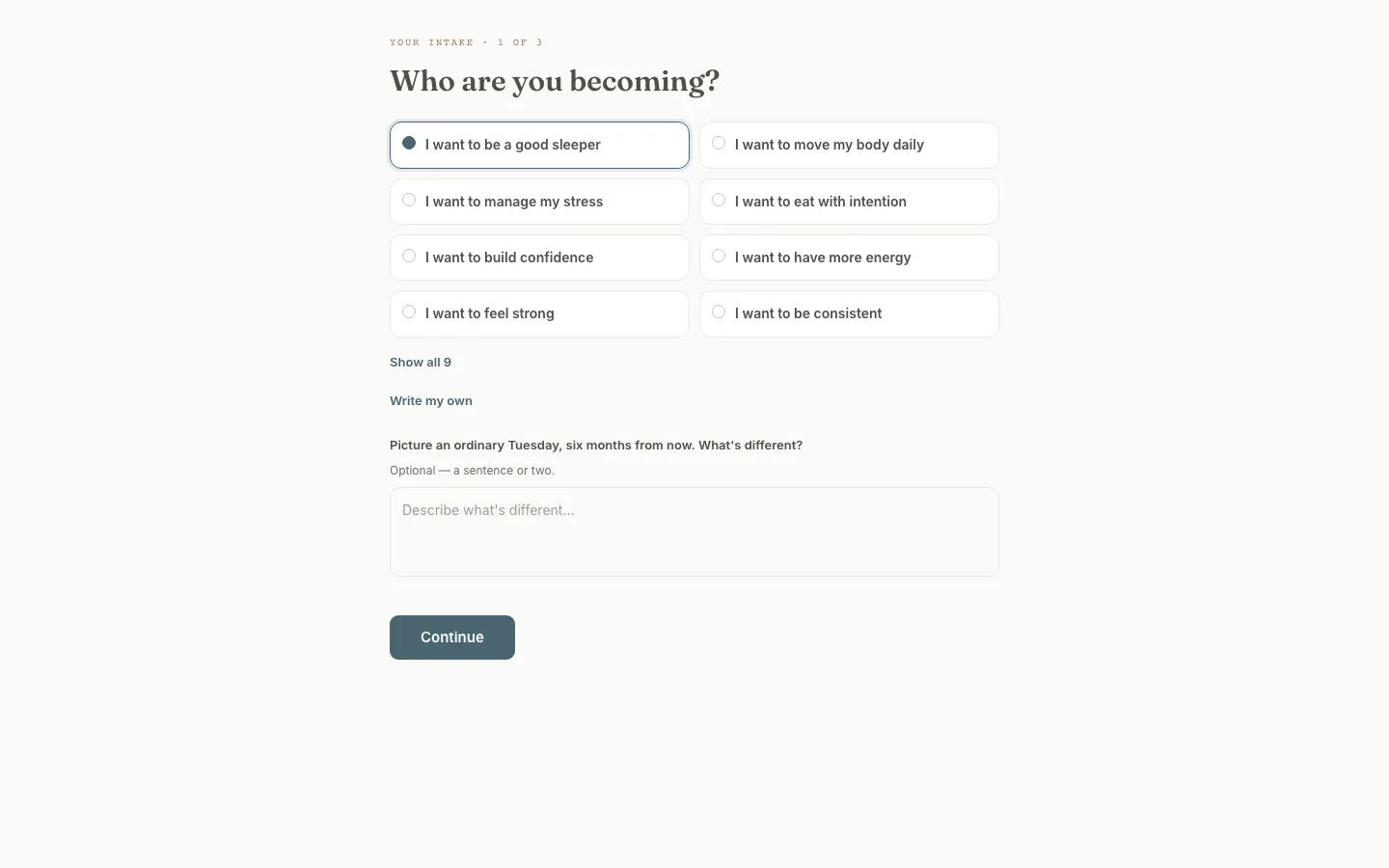
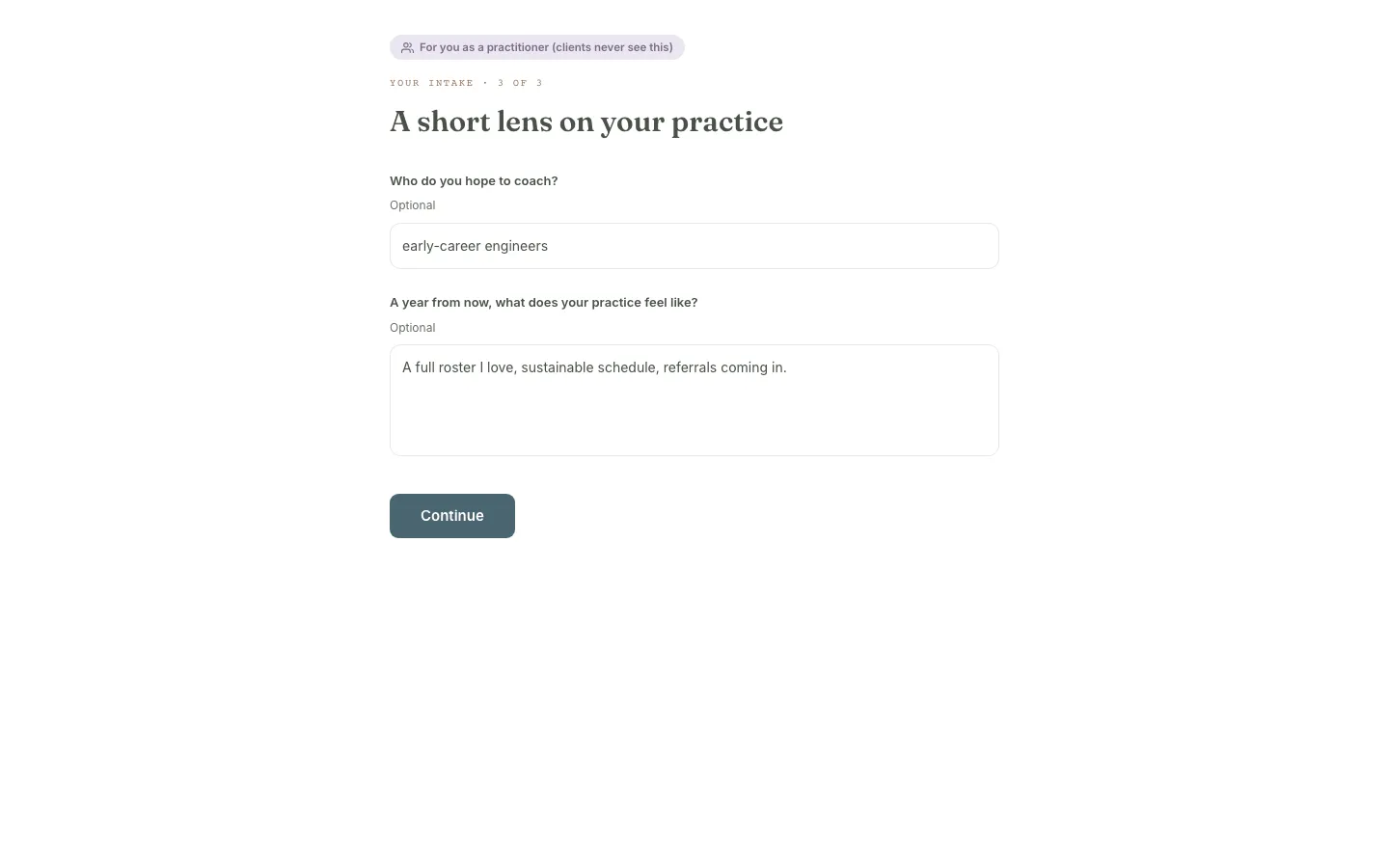
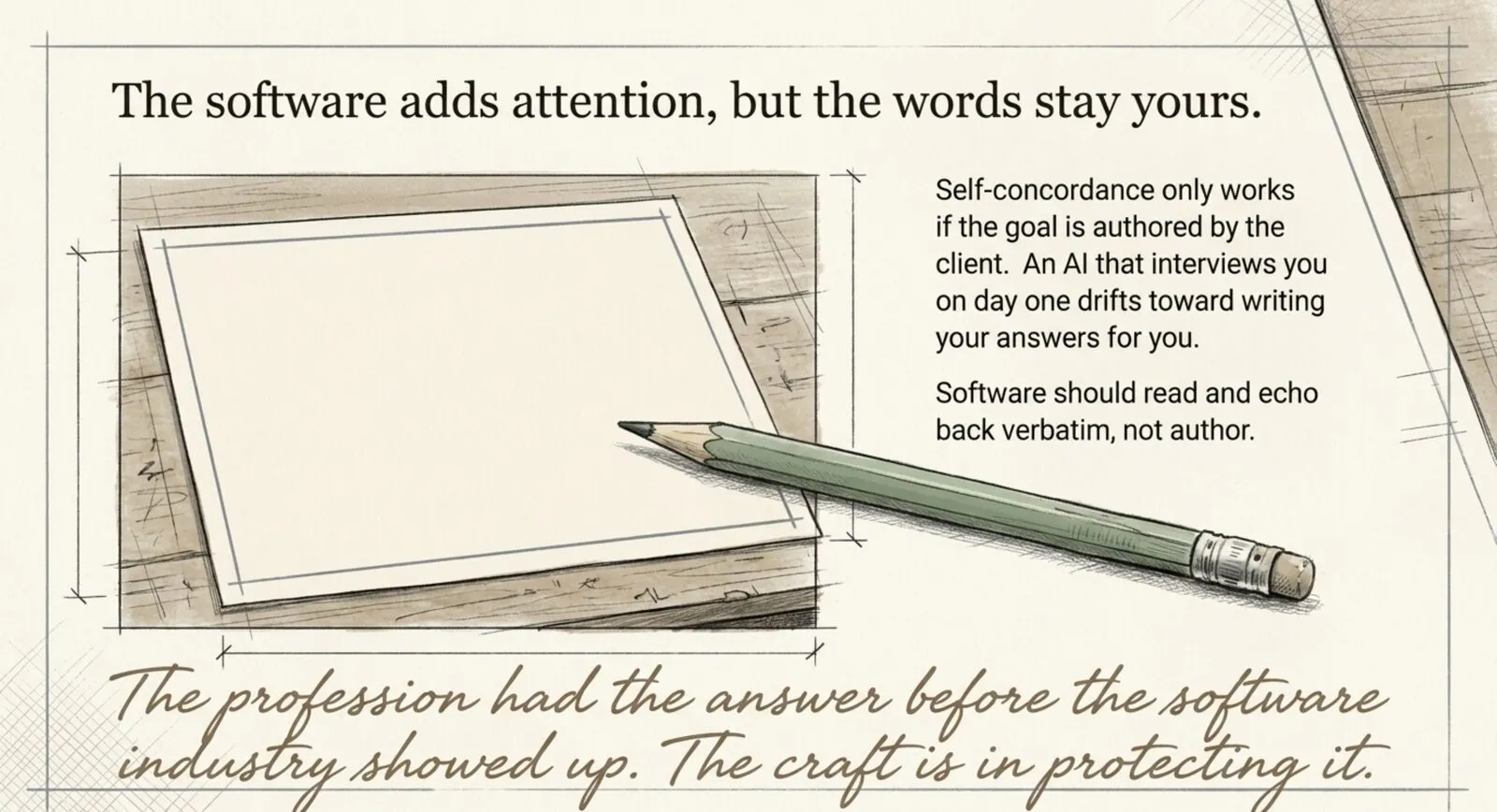
One design choice worth naming, since we build AI tools: the intake is deliberately a form, not a conversation with Sage. A form has edges you can see, and every word saved at the end is a word the person typed themselves. Self-concordance only works if the goal is actually yours, in your own language, and an AI that interviews you on day one drifts toward authoring your answers for you. So Sage’s first job in Grove is to read, not to write: the first Pulse quotes your note back verbatim and ties tomorrow to the identity you chose. The words stay yours. The attention is what the software adds.
A fresh start is not something a coach or a piece of software can give anyone. People arrive already holding one: a coach just said yes to, a certification just earned, a version of themselves they can picture but have not lived yet. The only real choice, for a product or a practice, is what to ask first. The profession had that answer long before the software industry showed up. The craft is in protecting it.

Founder of Grove. Twenty years building software for skilled professionals. Currently writes mostly on Tuesdays from a small studio in Austin.