
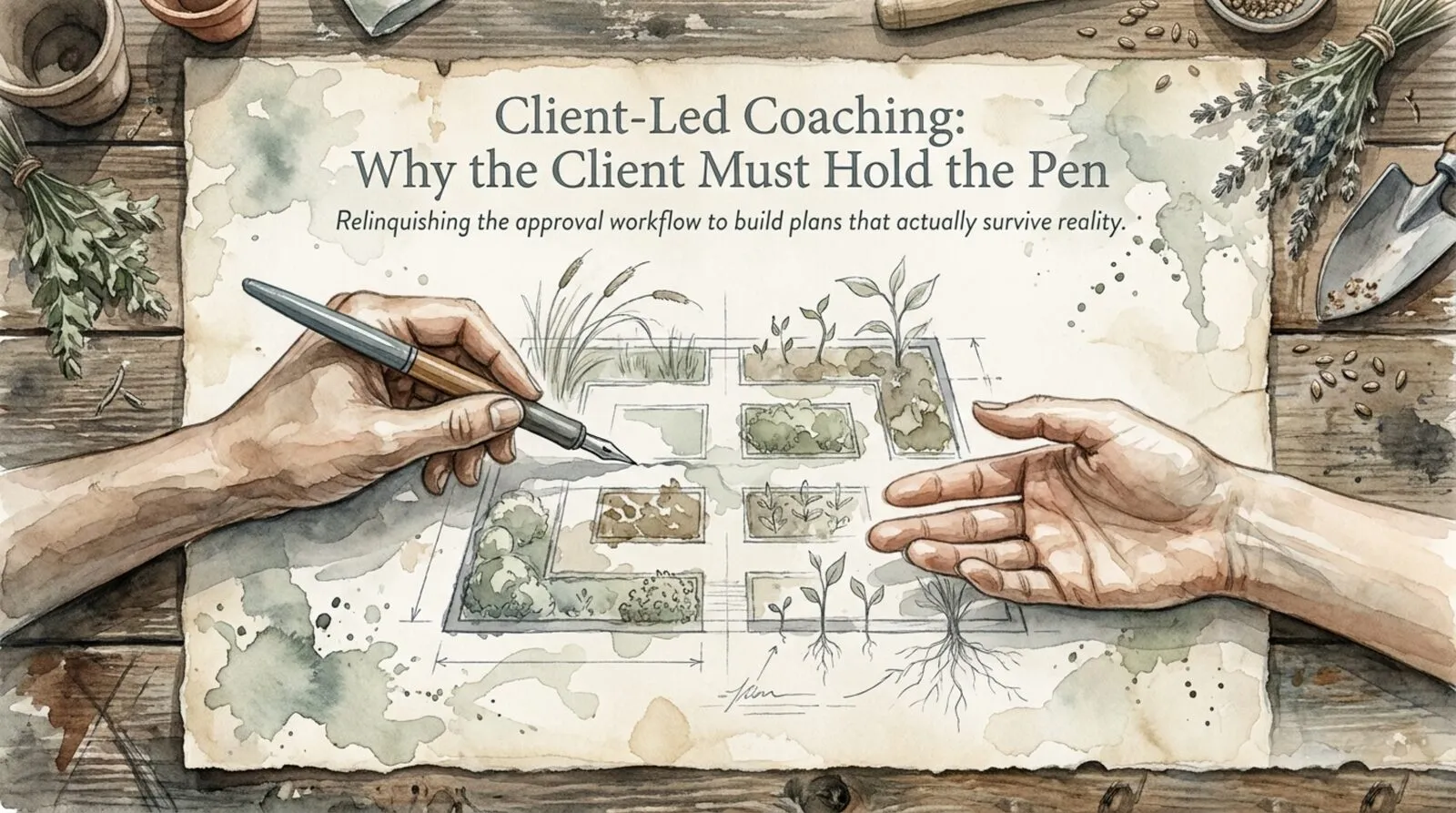
In the discovery conversations I have had while building Grove, coaches keep describing the same quiet moment. The plan was set in session. The client agreed to it, maybe even helped shape it. And somewhere around week three, the check-ins thin out, the habits stop getting marked, and the plan just sits there, untouched, like a gym membership in February.
The easy read is that the client lost motivation. I have started to believe something more specific, and more fixable: the client is not ignoring the plan. They are ignoring your plan. A plan someone else holds the pen on is a plan you can only comply with or fail. And when a brutal week arrives, failing quietly is easier than asking permission to change it.
I have been reading Katy Milkman’s How to Change this week, and one study will not leave me alone, because it shows that exact mechanism in miniature.
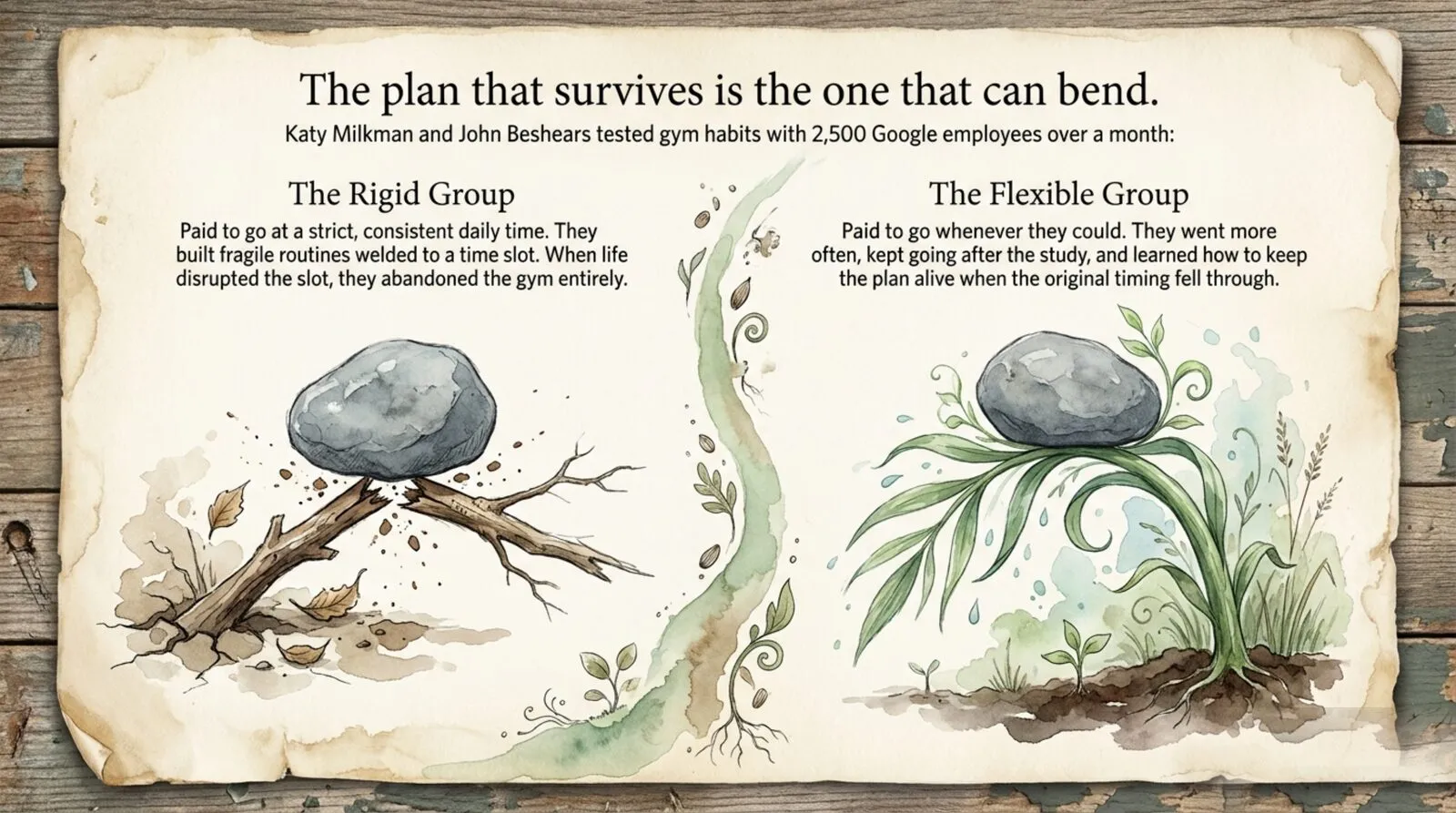
Milkman and John Beshears ran a month-long experiment with about 2,500 Google employees who wanted to exercise more. Half were paid to hit the gym inside a planned, consistent daily window, the same time every day, the way habit advice usually goes. The other half were paid to show up whenever they could. The rigid group did what you would predict: they built a routine welded to their time slot. And when life bumped them out of that slot, they skipped the gym entirely. The flexible group went more often during the study, kept going after the payments stopped, and had learned something the rigid group never got to practice: how to keep the plan alive when the original plan fell through. The paper is in Management Science, and Milkman has called it one of the most important findings of her career.
The plan that survived was the one people could bend without breaking.
One of our founding coaches put the fix in six words: a client’s plan should be consistent yet flexible. Consistent where you feel like you are making progress, flexible enough to shift with the changes of life. She was describing her clients. She was also, without meaning to, describing the Google study.
What client-led coaching means
The textbook version of coaching already agrees with all of this. Coaching is collaborative. The client is the expert on their own life. Every certification teaches it.
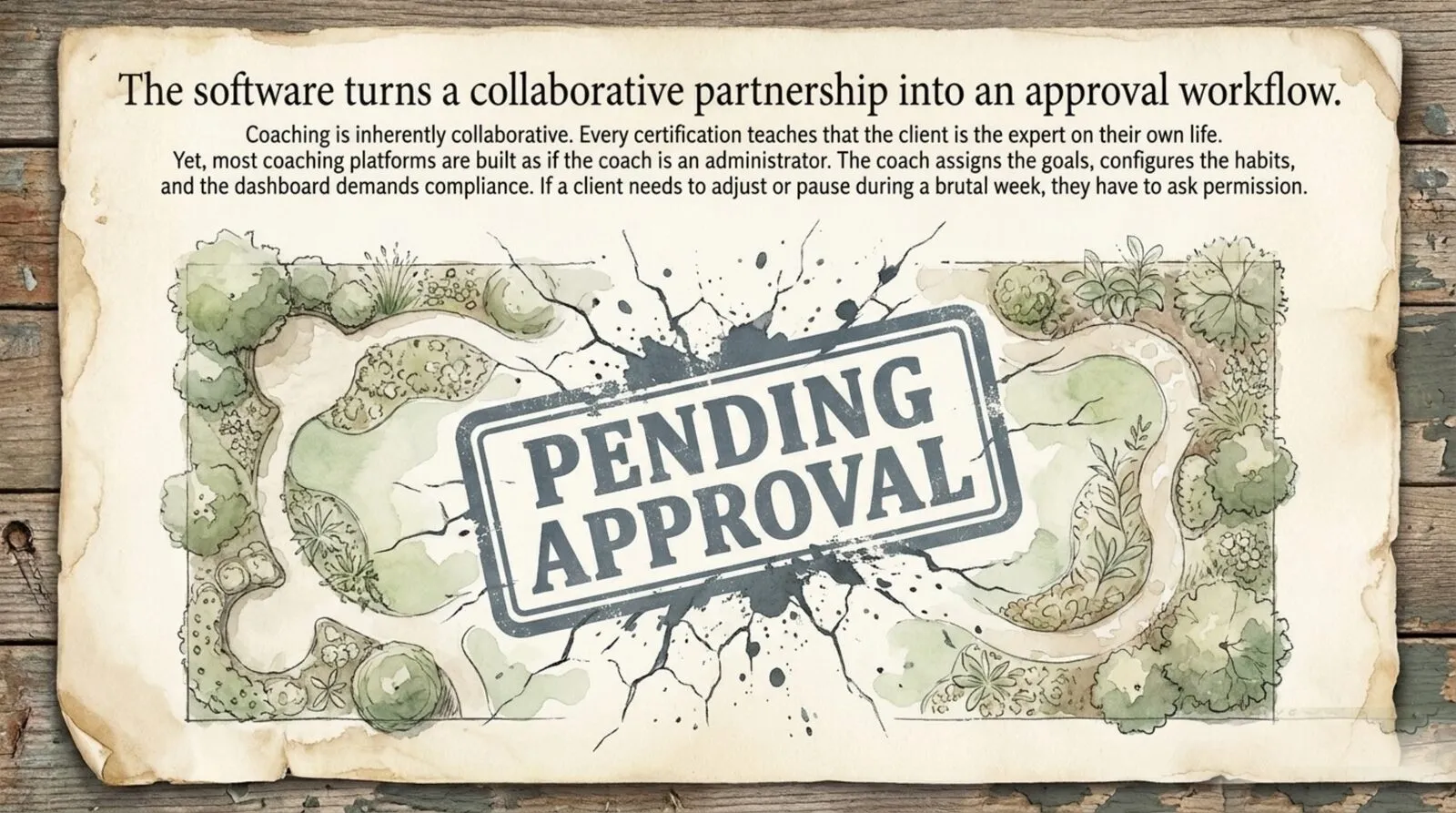
Then the client goes home, and the software takes over. Most coaching platforms are built like the coach is an administrator: the coach assigns the goals, the coach configures the habits, the client complies, and the dashboard reports the compliance back. If the client wants to change anything, even pause one habit during a brutal week, they have to ask. The tool quietly turns the most collaborative profession I have ever studied into an approval workflow.
Client-led coaching is the opposite posture. The client authors the plan. They add the goal, word it in their own language, adjust the habit that is not fitting, pause the one that needs to rest, and cancel the one that was never really theirs. The coach does not disappear from this picture. The coach stays fully in the loop, seeing every change as it happens. What the coach stops being is the approval step.
What the evidence says about ownership
This is not a vibe. The behavior-change literature has been pointing at ownership for decades, from several directions at once.
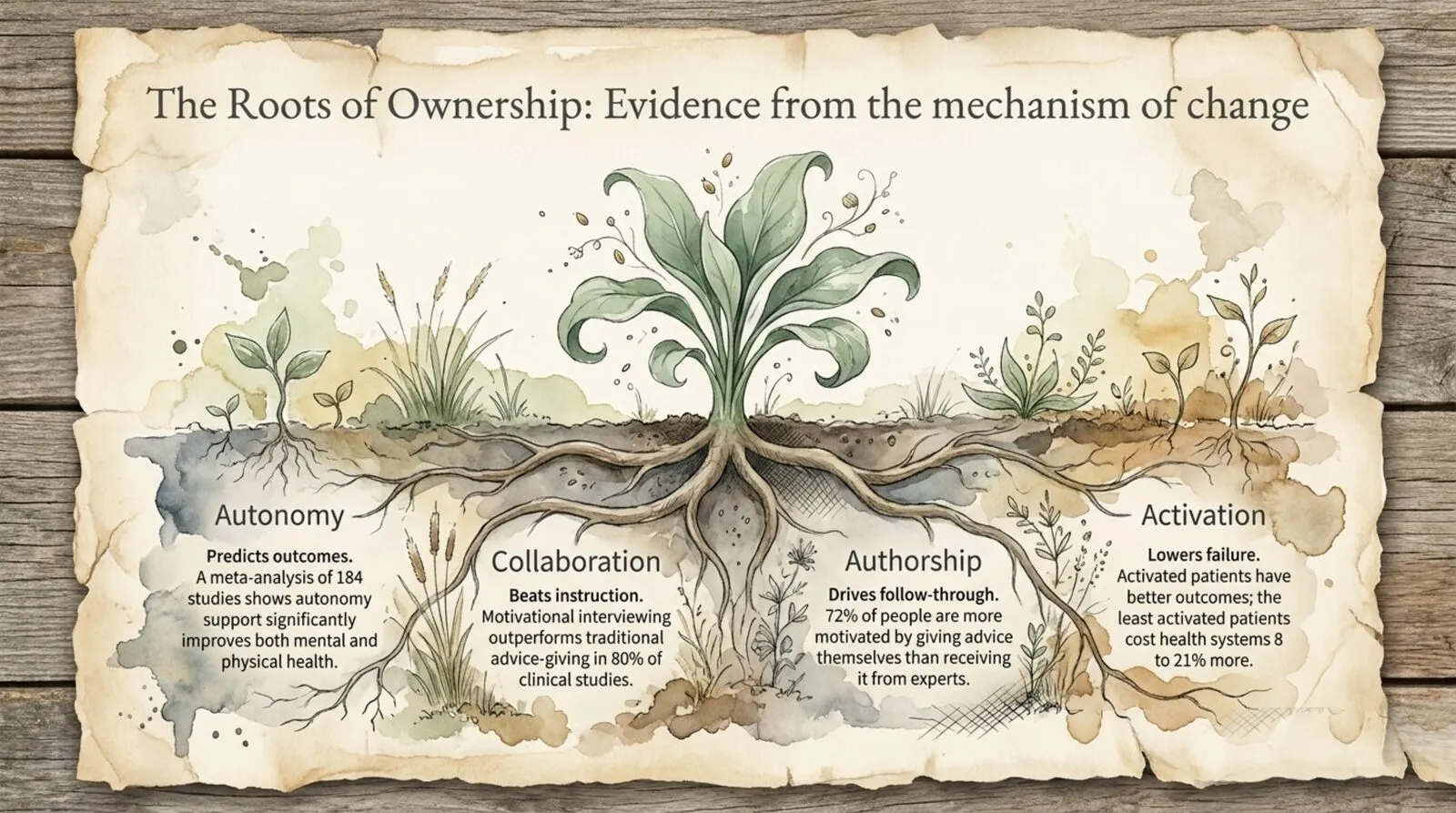
Autonomy predicts outcomes. A meta-analysis of 184 studies applying self-determination theory to health contexts found that when practitioners support a person’s autonomy, need satisfaction and autonomous motivation rise, and both mental and physical health outcomes improve. Autonomy support is not a courtesy. It is a treatment variable.
Collaboration beats instruction. Motivational interviewing, the collaborative style most health coaches train in, outperformed traditional advice-giving in roughly 80% of studies in a systematic review in the British Journal of General Practice. Of the trials that measured objective outcomes like weight, blood pressure, and cholesterol, three quarters found a significant effect. The method that treats the client as the author keeps winning against the method that treats them as the audience.
Ownership drives follow-through. In a series of studies by Lauren Eskreis-Winkler and Ayelet Fishbach, people struggling with a goal were more motivated by giving advice than by receiving it, including from experts. 72% of people trying to lose weight said giving advice motivated them more than tips from a Mayo Clinic nutritionist. In a field experiment with almost 2,000 students, the ones assigned to give advice earned better grades than the ones who got it. Articulating the plan yourself is not a nice-to-have on top of the plan. It is part of the mechanism.
Activated clients do better. In the healthcare literature this shows up as patient activation: the knowledge, skill, and confidence to manage your own health. Hibbard and Greene’s review in Health Affairs found that more activated patients have better outcomes and better care experiences, and in one health system the least activated patients cost 8 to 21% more than the most activated. Building a client’s sense of agency is the product, not a side effect.
Milkman’s flexibility study completes the set. Ownership is what makes flexibility safe. A client who owns their plan can bend it on a hard week. A client who was assigned their plan can only fail it.
What we built
So Grove now works the way the evidence says it should. Clients add, edit, pause, and cancel their own goals, habits, and actions, right from their app. No request queue. No waiting for the next session to make the plan match their life.
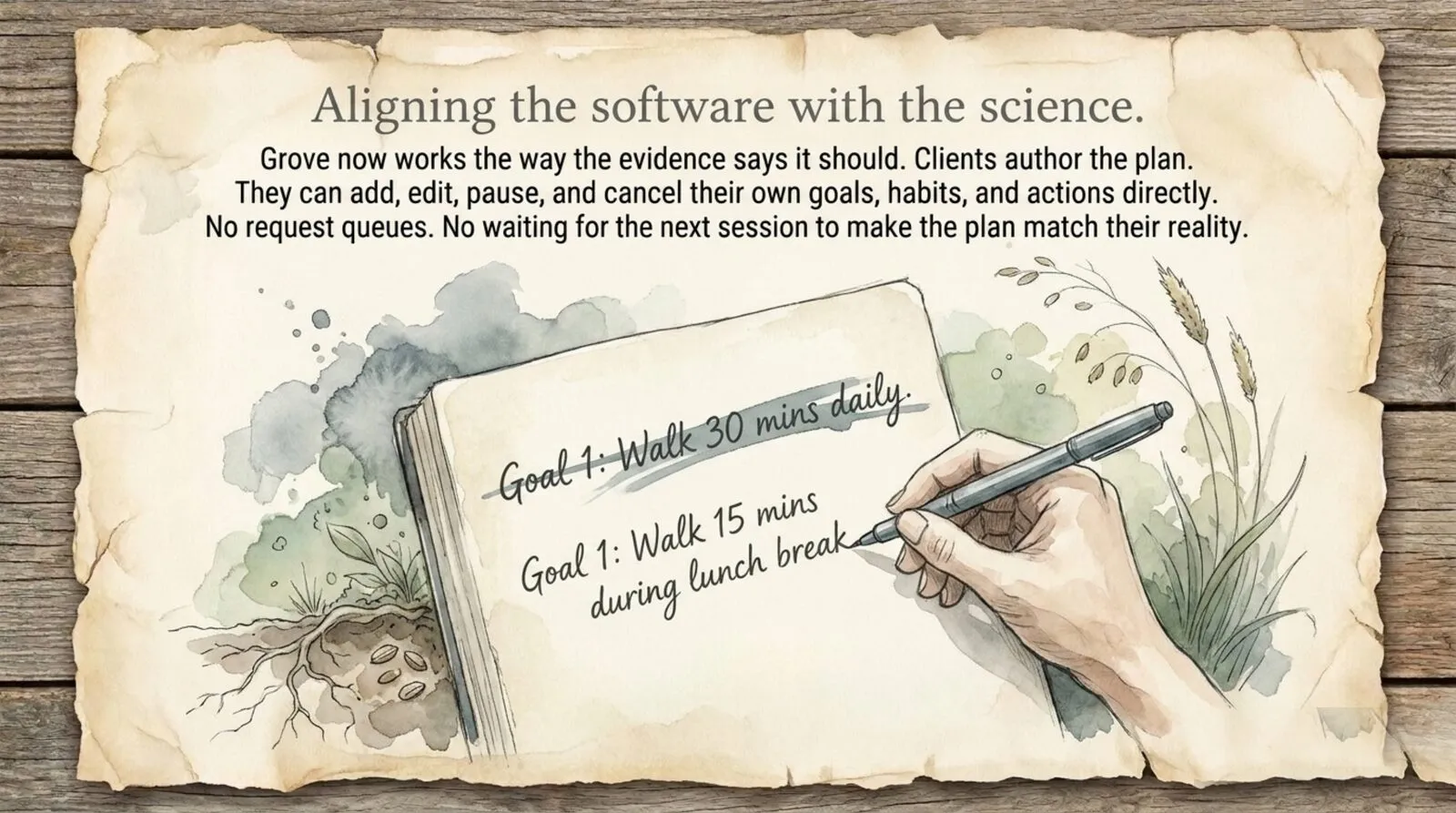
The coach’s side is visibility, not approval. Every change a client makes shows up for their coach as it happens: the new goal, the reworded habit, the pause. A coach opens a client’s card and sees the plan as it actually is today, plus how it got that way. The conversation in session starts from reality instead of from an artifact of what was agreed three weeks ago.
Two boundaries, on purpose. Measurements stay with the coach: a client can decline one, but the numbers a coach tracks with a client do not silently change underneath them. And pausing is a first-class move, not a failure state. A paused habit is a client saying “not right now” instead of vanishing. We wrote about that pattern before, in the graceful door. This is the same principle applied to the plan itself.
The objection, and what it misses
Every time I describe this to someone outside coaching, I get the same question: what if the client waters the plan down?
The honest answer is that sometimes they will, and that this is information. A client who pauses three habits in a row is telling their coach something a compliance dashboard never could. The coach sees it the day it happens and gets to be curious about it, which is the actual job. The alternative, a plan the client cannot touch, does not produce a client who keeps the hard plan. It produces a client who stops opening the app. The rigid gym group did not argue with their time slot. They just stopped going.
Coaching styles differ, and Grove does not take a side on how directive a coach should be in conversation. The coach still proposes, still challenges, still brings structure and playbooks and expertise. What changed is where the pen sits between sessions. It sits with the person whose life the plan has to survive.
The plan was never really the coach’s to keep. The software just used to say otherwise.

Founder of Grove. Twenty years building software for skilled professionals. Currently writes mostly on Tuesdays from a small studio in Austin.