
Before I settled on Grove’s pricing, I made myself answer a question most software pricing pages skip: what does a working health coach actually earn? A subscription that reads as pocket change inside a tech company can be a real decision for a coach billing a few sessions a week. I could not price for that coach without knowing her numbers.
The pages that rank for “how much do health coaches make” were no help. They are written by salary aggregators and certification programs. The aggregators say a health coach earns about $25 an hour. The certification programs say a good private practice bills $100 to $150 an hour. Both numbers are real. Neither is the story, and the people publishing the second one are selling the certification.
The story is in the primary data: the National Board for Health & Wellness Coaching surveys its own certified coaches every year, and the 2025 report answers the income question in the board’s own numbers. Here it is, with the arithmetic shown.
TL;DR, from the NBHWC 2025 Annual Survey of 2,328 certified coaches:
- 36% of certified health coaches earn less than $10,000 a year from coaching. 7% earn $100,000 or more.
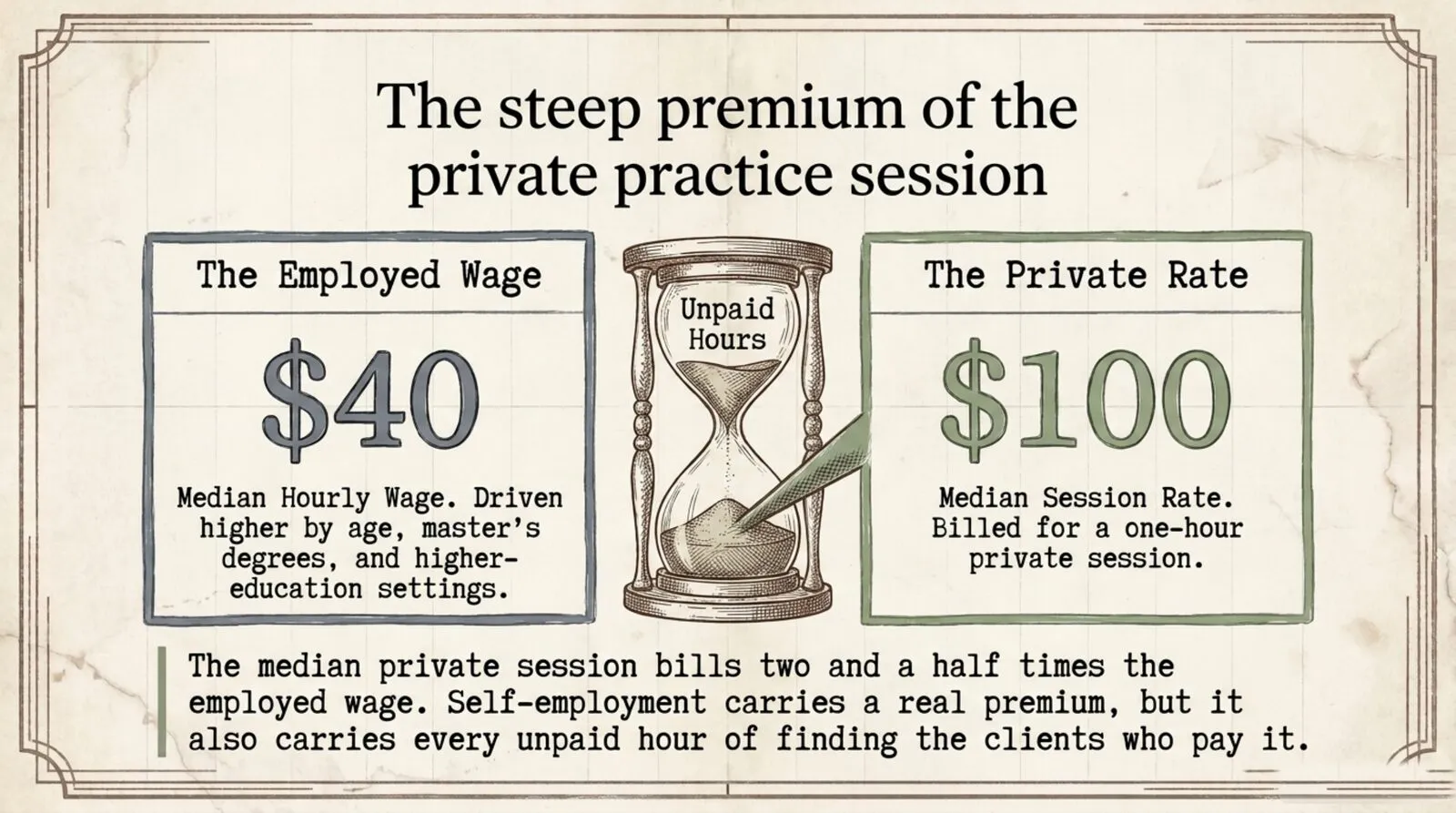
- The median hourly wage is $40. The median private-practice rate is $100 per session.
- 44% coach part-time, 28% full-time, and 58% are self-employed.
- Full-time changes everything: 67% of full-time coaches earn $50,000 to $99,999 a year, while 47% of part-time coaches earn under $10,000.
- Finding clients, not pay, is the most commonly cited professional challenge.
- 38% of coaches already use AI tools, mostly for notes, writing, and marketing.
Where these numbers come from
Every number in this post comes from the NBHWC 2025 Annual Survey Report, the credentialing board’s census of its own workforce. All 11,490 National Board Certified Health & Wellness Coaches (NBC-HWCs) were invited; 2,328 completed the survey in October 2025, a response rate around 20%, with methodology support from Dr. Jennifer Bleck at the University of South Florida.
Two honest caveats. The data is self-reported. And it covers certified coaches only: the many people practicing under the title “health coach” without board certification are not in this data, and their numbers are almost certainly lower. Where I do my own arithmetic on top of NBHWC’s figures, I say so. This analysis is Grove’s, and the survey is NBHWC’s.
How much do health coaches make a year?
Most certified health coaches earn very little from coaching, and a small group earns a lot. Among all NBC-HWCs, 36% earn less than $10,000 a year from coaching. Only 34% earn $50,000 or more. At the top, 7% clear $100,000.
The averages hide the real finding, which is that there are two professions in this data wearing one credential:
| Annual income from coaching | Full-time coaches | Part-time coaches |
|---|---|---|
| Under $10,000 | 4% | 47% |
| $10,000 to $24,999 | 3% | 22% |
| $25,000 to $49,999 | 13% | 17% |
| $50,000 to $74,999 | 45% | 6% |
| $75,000 to $99,999 | 22% | 2% |
| $100,000 to $149,999 | 10% | 2% |
| $150,000 or more | 2% | 1% |
Read the first row twice. A part-time coach is nearly twelve times as likely as a full-time coach to earn under $10,000. Meanwhile 67% of full-time coaches land between $50,000 and $99,999, which is a livable professional salary. The income question is really an hours question. “How much do health coaches make” has no single answer, because whether coaching is your job or your side practice matters more than anything else in the survey.
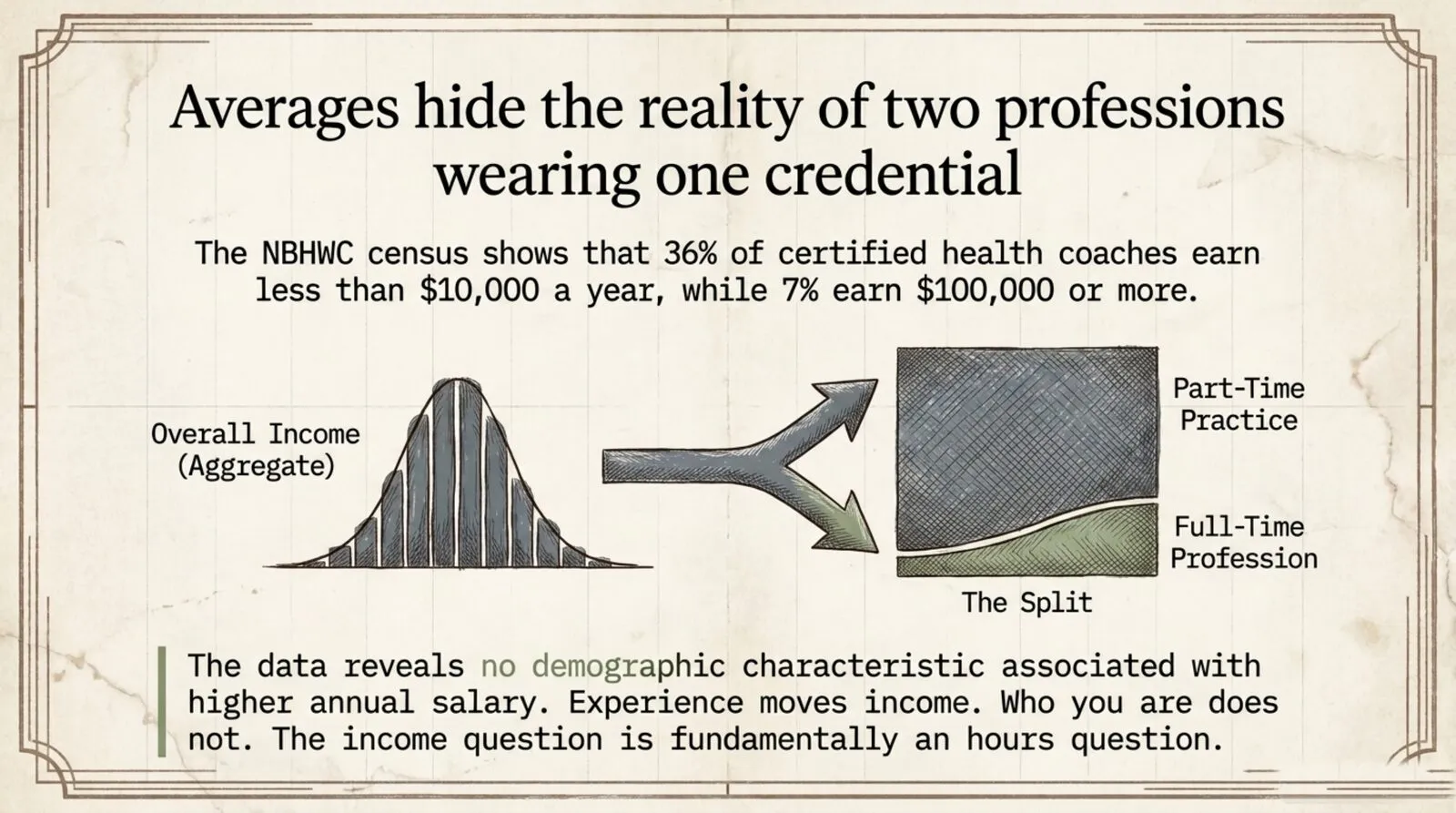
One more finding worth quoting exactly: the survey found no demographic characteristic associated with higher annual salary. Experience, hours, and employment setting move income. Who you are does not. And in the less comfortable direction, coaches serving teens, rural communities, veterans, employees, LGBTQIA+ individuals, and clients with chronic conditions or mental health needs were all less likely to earn $50,000 or more. The populations that need coaching most pay for it least.
What does a health coach charge per hour?
Two different numbers answer this, and confusing them is how the internet gets this question wrong.
The hourly wage across employed coaches has a median of $40 and an average of $54.42. Wages run higher with a master’s degree, with age, with practicing outside the U.S., and in higher-education settings.
The private-practice session rate is a different market. Coaches reported charging anywhere from $20 to $600 for a one-hour session, with a median of $100 and most rates clustered between $75 and $150. Those rates barely moved from 2024, when the median was also $100. Grove’s read of the two figures side by side: the median private-practice session bills two and a half times the median employed hourly wage. Self-employment carries a real premium, and it also carries every unpaid hour of finding the clients who pay it.
Is health coaching a full-time job?
For most certified coaches, no, or not yet. In the survey, 28% coach full-time (30 or more hours a week), 44% part-time, and 19% do contract or freelance work; coaches could select more than one arrangement. 58% are self-employed, 41% name private practice as their primary setting, and 22% work inside healthcare organizations. Another 11% are seeking a coaching job.
The certification itself is not usually the barrier to work. 70% of coaches were already employed in a coaching-related role when they passed the board exam, and among those who went looking afterward, most found coaching work within the first year. What the credential does not hand anyone is a roster. That part, the data suggests, stays hard long after the exam. If you are standing at that particular cliff, I have written about what to do after NBHWC certification.
What is the hardest part of being a health coach?
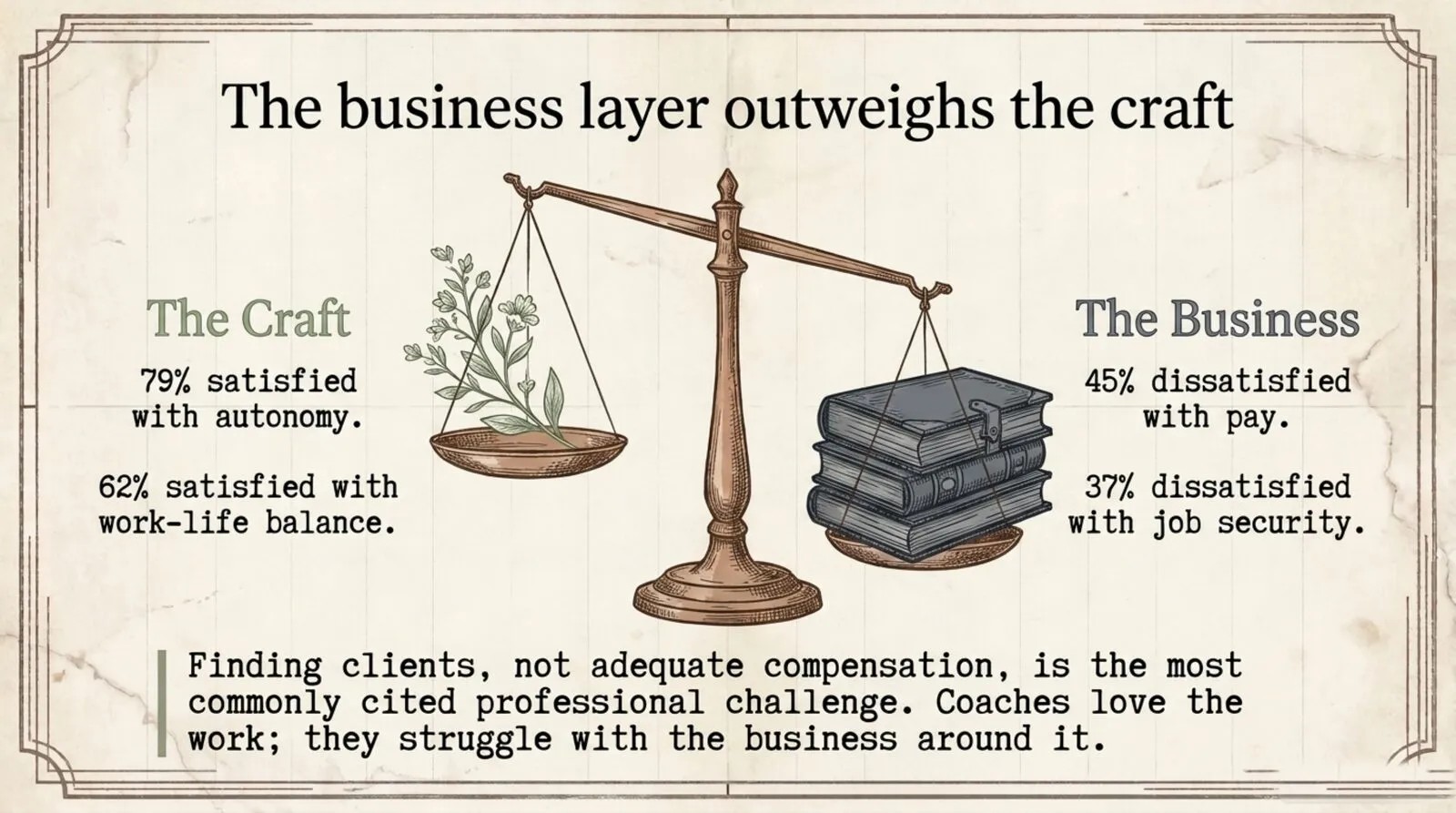
Not the coaching. The survey’s two most commonly cited professional challenges are client recruitment and adequate compensation, in that order. Finding people to coach outranks getting paid enough to coach them.
Satisfaction data tells the same story from the other side. 79% of coaches are satisfied with their autonomy and 62% with their work-life balance, while 45% are dissatisfied with their pay and 37% with their job security. Coaches love the work and struggle with the business around it. Every training program teaches the craft. Almost none of them teach the part the survey says is actually hardest, which is why so many new coaches end up buying sales software built for someone else’s problem.
How many health coaches use AI?
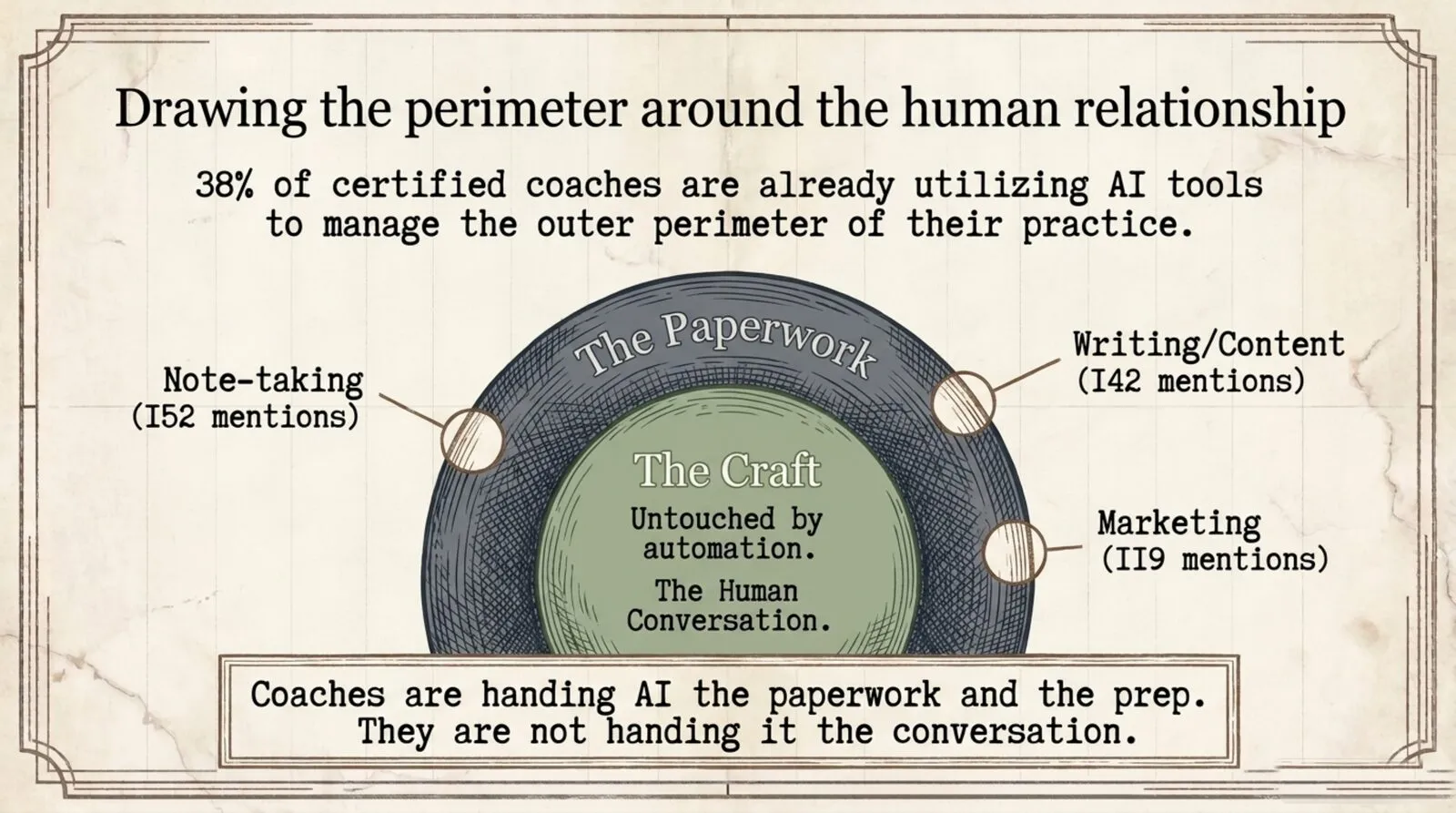
38% of certified health coaches already use AI in their practice, per the 2025 survey. The leading uses, by mention count in the survey’s free-text responses: note-taking and transcription (152 mentions), writing and content creation (142), marketing and website tasks (119), and research and program development (113).
Notice what is on that list and what is not. Coaches are handing AI the paperwork, the marketing, and the prep. They are not handing it the conversation. Even the training schools draw that line: the Institute for Integrative Nutrition’s 2026 guidance frames AI as a layer around the human conversation rather than a replacement for it, a principle I dug into in Will AI replace health coaches? That split matches every coach interview I have done while building Grove, and it is the split Grove is built around: AI carries the admin so the coach keeps the relationship. The profession is already virtual besides: 87% of coaches deliver sessions over video, and 62% coach clients in states other than where they live.
Who is the typical certified health coach?
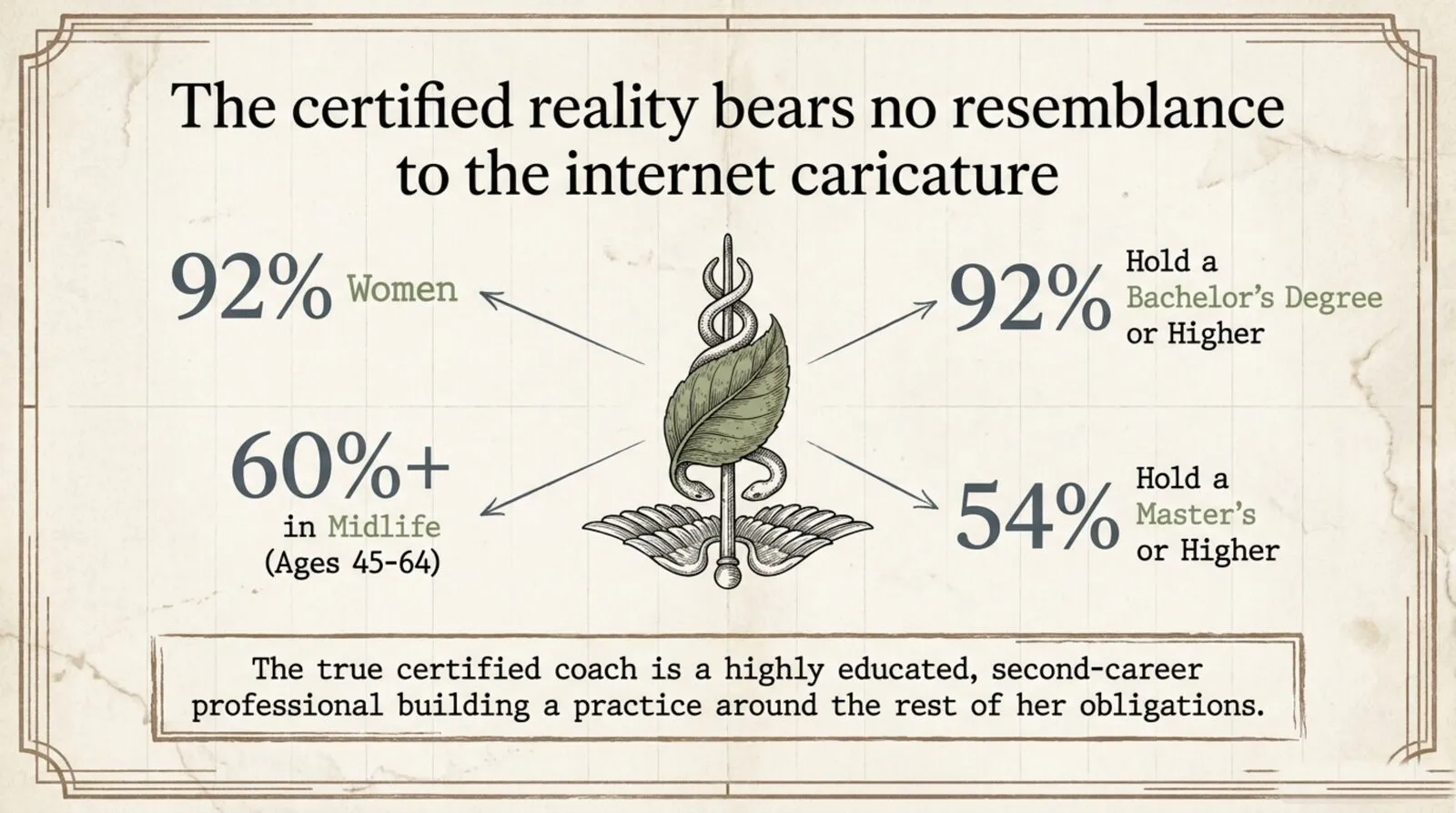
She is a woman (92% of the workforce), in midlife (over 60% are between 45 and 64), and heavily credentialed beyond the coaching board: 92% hold a bachelor’s degree or higher and 54% hold a master’s or higher. She is more likely than not self-employed, probably part-time, and reasonably early in her coaching career; the largest career-stage group, 39%, has been practicing two to five years.
This is worth sitting with, because the caricature of a health coach is a 24-year-old with a ring light. The certified reality is closer to a second-career professional with a graduate degree who came to coaching from healthcare, education, or corporate life, and who is building a practice deliberately, a few hours a week, around the rest of her obligations.
What the numbers add up to
Health coaching, as certified and surveyed, is a portfolio profession. Most of its practitioners are part-time and self-employed. Its income distribution is really two distributions, split by hours. Its rates are stable and its satisfaction is high everywhere except the two places that determine whether a practice survives: finding clients and getting paid.
I notice that the 36% earning under $10,000 are mostly not failing at coaching. Many of them built a practice this size on purpose. The survey is full of coaches combining coaching with another profession, a retirement, a business being built slowly, and for them a few $100 sessions a month is extra income wrapped around a life they already like. The satisfaction numbers say as much: even with the income distribution above, 79% of coaches are satisfied with their autonomy, 62% with their work-life balance, and fewer than half report dissatisfaction with pay. A small practice can be exactly the size its coach wants it to be.
The tension in the data belongs to the coaches who want more hours than they have. For them, what stands between here and there is rarely skill. It is the unpaid work of being found. The survey reads to me less like a report on a struggling profession and more like a report on a young one, still waiting for its business layer to get as good as its craft.

Founder of Grove. Twenty years building software for skilled professionals. Currently writes mostly on Tuesdays from a small studio in Austin.