
Earlier this year I sat down with a spreadsheet to work out what Grove could afford to give away. Every feature on the free plan has a cost per coach that we cover, and the exercise forces a blunt question: what do we want back? We settled on an answer we could say out loud, and I will, later in this piece. But the lasting effect was on how I read other companies’ pricing pages. Every free tier you have ever signed up for came out of someone’s version of that spreadsheet. Free is never the whole sentence. Free, because.
So when a listicle promises twelve free AI tools that will save you ten hours a week, I read it the way I read my own spreadsheet: what does each of these companies want back, and does the free part cover what a coach would actually use it for? Most roundups skip both questions. This one is organized around them.
The three kinds of free
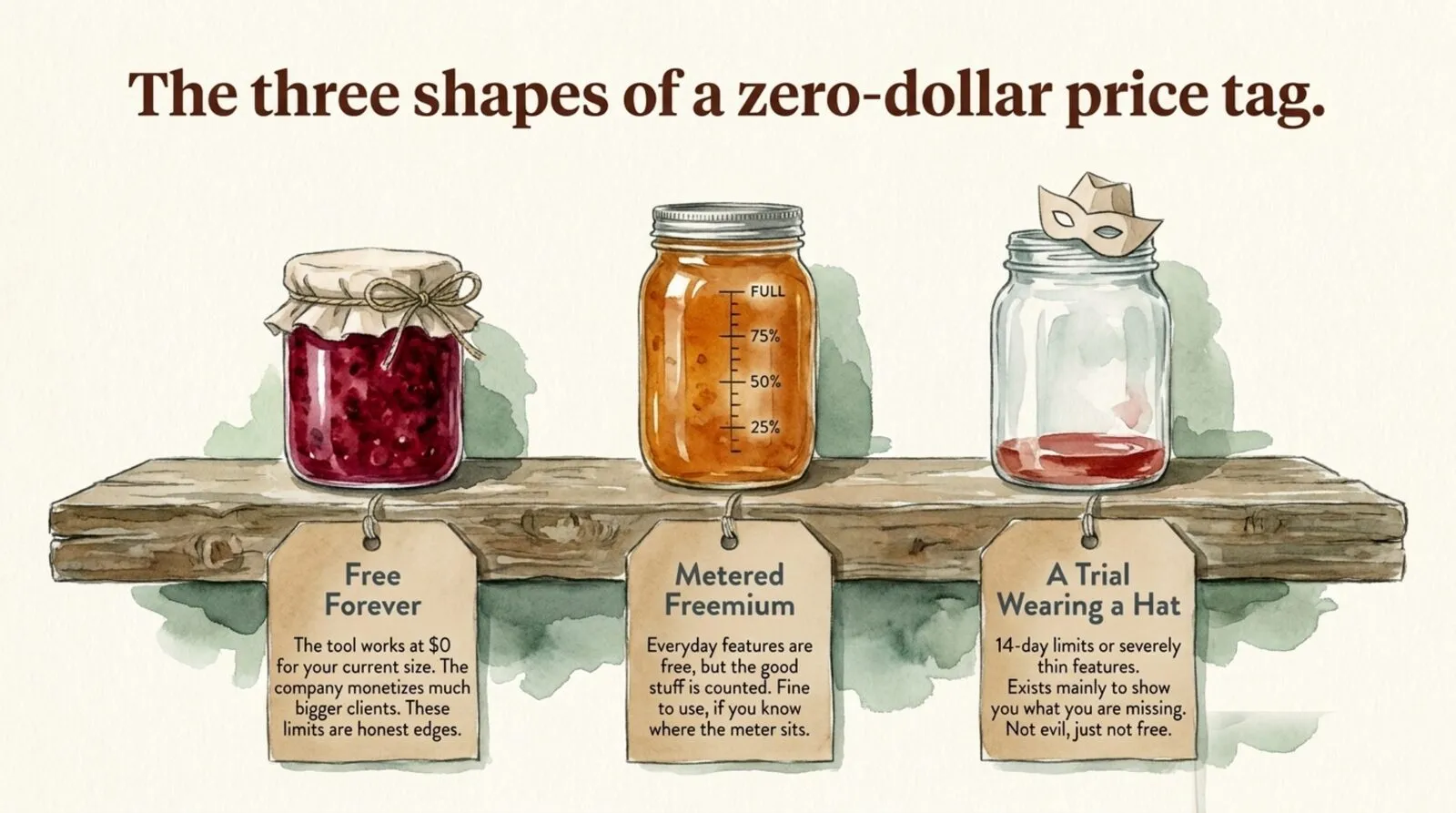
Free forever, within limits that fit you. The tool works at $0 for a practice your size, and the company makes its money on customers much bigger than you. This is the best kind. The limits are the product’s honest edges, and if you never cross them, you are not the customer they are monetizing, and that is fine with everyone.
Metered freemium. The everyday features are free and the good stuff is counted: so many AI generations, so many minutes, so many exports. Fine to use, as long as you check where the meter sits before you build a weekly routine on it.
A trial wearing a free hat. The page says free, the fine print says 14 days, or the free plan is so thin it exists mainly to show you what you are missing. Not evil, just not free. A surprising share of the tools on those twelve-free-tools lists live here.
The health coaching schools are right that AI literacy is becoming part of the job, FMCA’s guide to AI for health coaches makes that case well. Literacy includes reading the meter.
Thinking and drafting: the free assistants
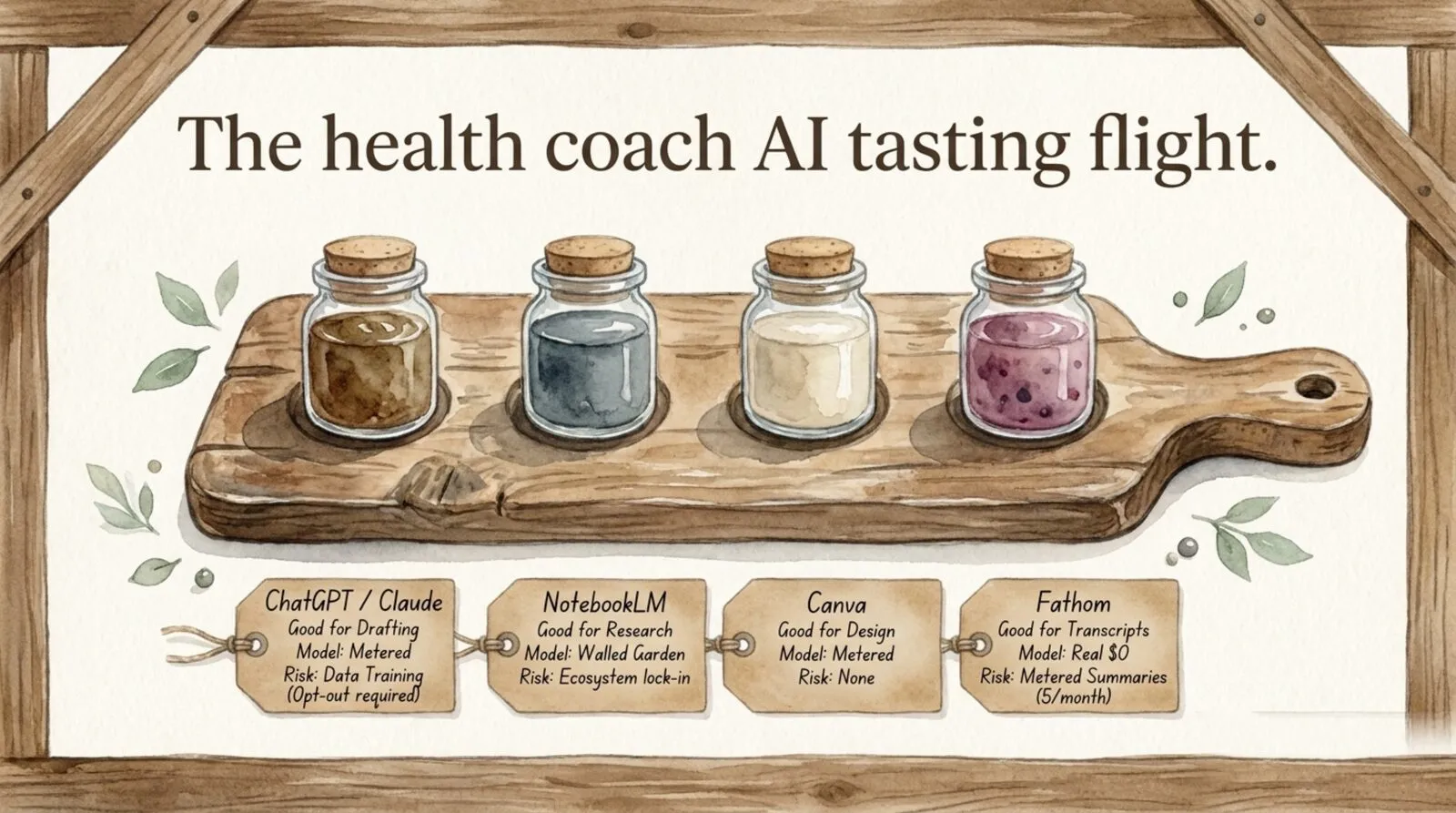
ChatGPT and Claude both have genuinely free plans, and for the writing side of a coaching business, the newsletter, the welcome packet, the workshop outline, the bio in three lengths, they are the strongest $0 tools on any list. The free plans cap how much you can do in a day and can slow down at busy hours, but a solo coach drafting a newsletter and a handful of documents each week fits inside the caps most weeks.
What do they want back? Two things. They want you to hit the ceiling and upgrade, which is transparent enough. And on the consumer plans, both have a setting that decides whether your conversations can be used to train future models. Go find that setting and choose it on purpose. It matters less for a blog draft, and much more for anything resembling a client’s story.
One thing this piece will not do is teach you to use them well, because I already wrote that up separately: AI Tools for Health Coaches: A Working System covers the fifteen-minute setup that makes a general assistant write like you instead of like the internet, and the five business surfaces to point it at. The short version: an assistant that knows your practice beats a clever prompt, every time.
Research: the quiet standout
Gemini Notebook, the tool Google renamed from NotebookLM in July 2026, is Google’s free research tool, and it is the one I recommend to coaches most often, because it fixes the thing coaches distrust about chatbots. You load it with sources you choose, the studies behind a protocol, your certification materials, your own program documents, and it answers only from those sources, with citations back to the exact passage. Ask a general chatbot about protein timing and you get the internet’s average opinion. Ask a notebook loaded with the three papers you trust and you get those papers, footnoted.
For evidence-based client education inside your scope, that difference is the whole game. What does Google want back? You, inside Google’s ecosystem, and eventually the paid tier with higher limits. At a solo coach’s volume, the free tier is roomy.
Design and video: metered, and fine
Canva’s free plan remains the default answer for social graphics, client workbooks, and slide decks, and it belongs on this list because it is the first kind of free: a real product at $0, with the pro features (brand kits, background removal, most of the AI generation credits) behind the meter. Use it freely; just notice when a favorite button starts asking for an upgrade, because that is the meter talking, not your design skills.
Transcription: read the fine print twice
This is the category where the free tiers most often fail a coach’s actual shape of work. Otter’s free plan gives you 300 minutes a month, which sounds like plenty, but each conversation caps at 30 minutes, which cuts a fifty-minute session off mid-thought, and only your 25 most recent conversations are kept. Older transcripts are deleted. A tool that quietly discards session records is not a small caveat for a coach; it is the difference between a system and a leak.
Fathom is the stronger free plan in this category, and the one I use for my own discovery calls with coaches. Recording, transcription, and storage are unlimited at $0 across Zoom, Meet, and Teams; the meter sits on the fancy AI summaries instead, five a month before you drop to the basic template. That is the honest shape of free: the company says where the meter is, and a coach who mainly wants the recording and the searchable transcript may never hit it.
And transcription is where the money question stops being the important one.
The line that is not about money
Whatever tools you pick, one rule does not flex: identifiable client information does not go into a general-purpose free AI tool. Not a recording with a client’s voice on it, not session notes with a name, not “let me tell you about my client and her labs.” A board-certified health coach signs up to a confidentiality standard that applies to what you paste into a chat window exactly as it applies to a filing cabinet, and consumer free tiers, with their training settings and their auto-deleting histories, were not built to hold that kind of material.
The practical version: use the free assistants for the business around the coaching, strip names and identifying details if a task genuinely needs a client situation, and keep client records in tools that were built to hold them and say so in writing.
Where Sage fits, and what we want back
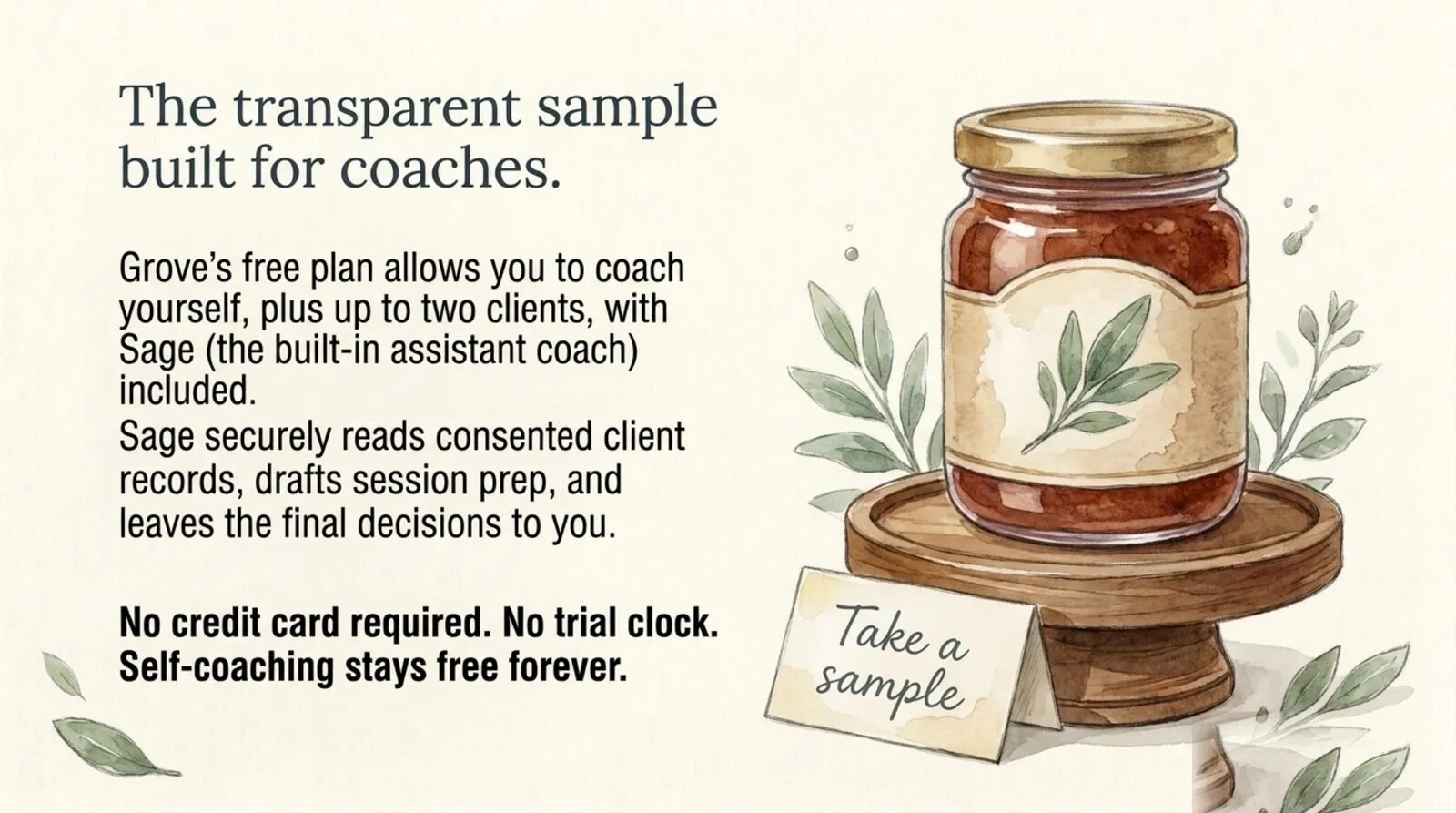
That last category is the one Grove lives in, so here is our spreadsheet answer, stated plainly. Grove’s free plan is coaching yourself, plus up to two clients when you are ready, with Sage, the assistant coach built into Grove, included. Sage reads each client’s consented record, drafts your session prep and your notes, and leaves the decisions with you. No card, no trial clock; self-coaching stays free forever.
What we want back: coaches who practice on themselves first, bring their first client or two, and grow. A coach with a full roster outgrows the free plan and pays for a bigger one, and because she helped shape Grove along the way, we think she will want to. That is the whole model. It only works if the free tier is genuinely useful at $0, which is the same test I would hold any tool on this page to.
The honest checklist
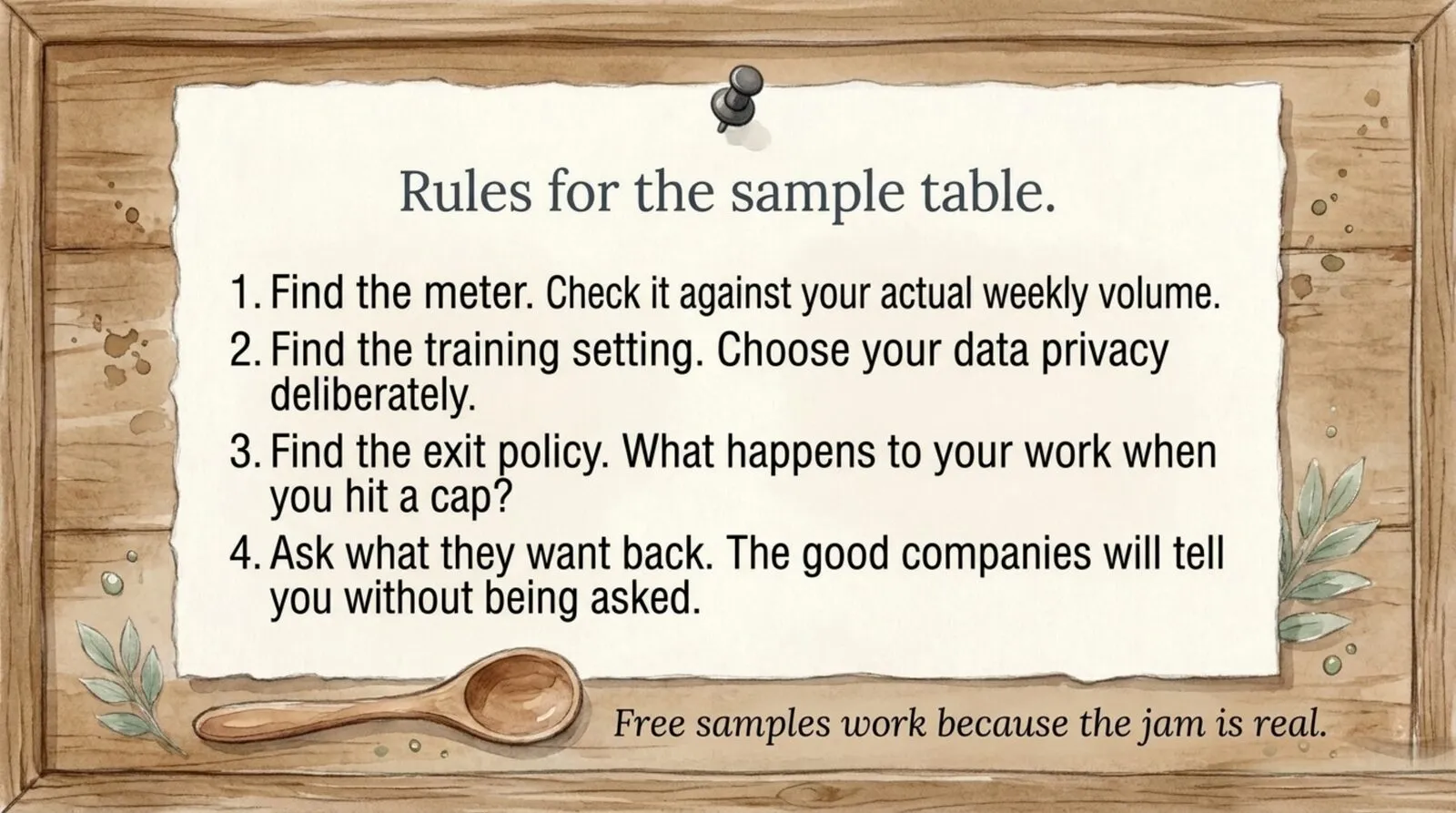
Before a free tool earns a place in your week: find the meter and check it against your real volume. Find the training setting and choose it deliberately. Find out what happens to your data when you hit a cap or leave. And ask what the company wants back; the good ones will tell you without being asked.
Free samples work because the jam is real. The tools worth keeping are the ones where the free tier is a true taste of the product, offered by a company that can say what it hopes you do next. The ones to walk past are the ones that cannot answer the question. Free, because.

Founder of Grove. Twenty years building software for skilled professionals. Currently writes mostly on Tuesdays from a small studio in Austin.