

Spend a few years helping people change their lives, and a strange chore eventually appears: proving those hours happened. Which sessions were held? Which were paid? How many hours, with how many clients? Somewhere there is a spreadsheet that was supposed to be keeping track. It is probably a few months behind.
More than one coach has told me about that spreadsheet. It is where the proof of a coaching practice lives: hours coached, who paid, who was pro bono, all copied in by hand so that a credentialing body can one day see a number it believes. Nobody has complained to me about earning the hours. The complaint is always the keeping of them: scroll back through months of calendar, copy one session at a time, and hope that what the calendar says matches what memory says.
Staying credentialed is two counts, not one. The first is the coaching you have done: hours, clients, paid versus pro bono. The second is the learning you have kept up: continuing education, in whatever unit your credentialing body uses. The International Coaching Federation (ICF) and the National Board for Health and Wellness Coaching (NBHWC) each ask for both, on different forms, in different units, with different rules about who ever sees the record.
Neither count is difficult. Both are tedious. Tedious is how a record falls a season behind.
Why CEUs exist at all
My dad was a family practitioner, and his continuing education used to happen in Hawaii. The conference was there, the credits counted the same, and the reasoning was hard to argue with: if the hours have to be collected, they can be collected somewhere pleasant. The hours were real. So was the beach.
The habit he was keeping up is older than coaching. For most of history, a medical license was a one-time event: prove yourself once, practice for life. Urology put the first crack in that idea when it made continuing education mandatory for its members in 1934; by the early 1970s, continuing education was wired into licensure across the health professions, and in 1970 the unit itself was standardized: one CEU, ten contact hours. Whether the counting makes better doctors is a question researchers have asked from the beginning, and the honest reading is: not much, on its own. A conference in Hawaii is many good things; a guarantee of learning is not one of them.
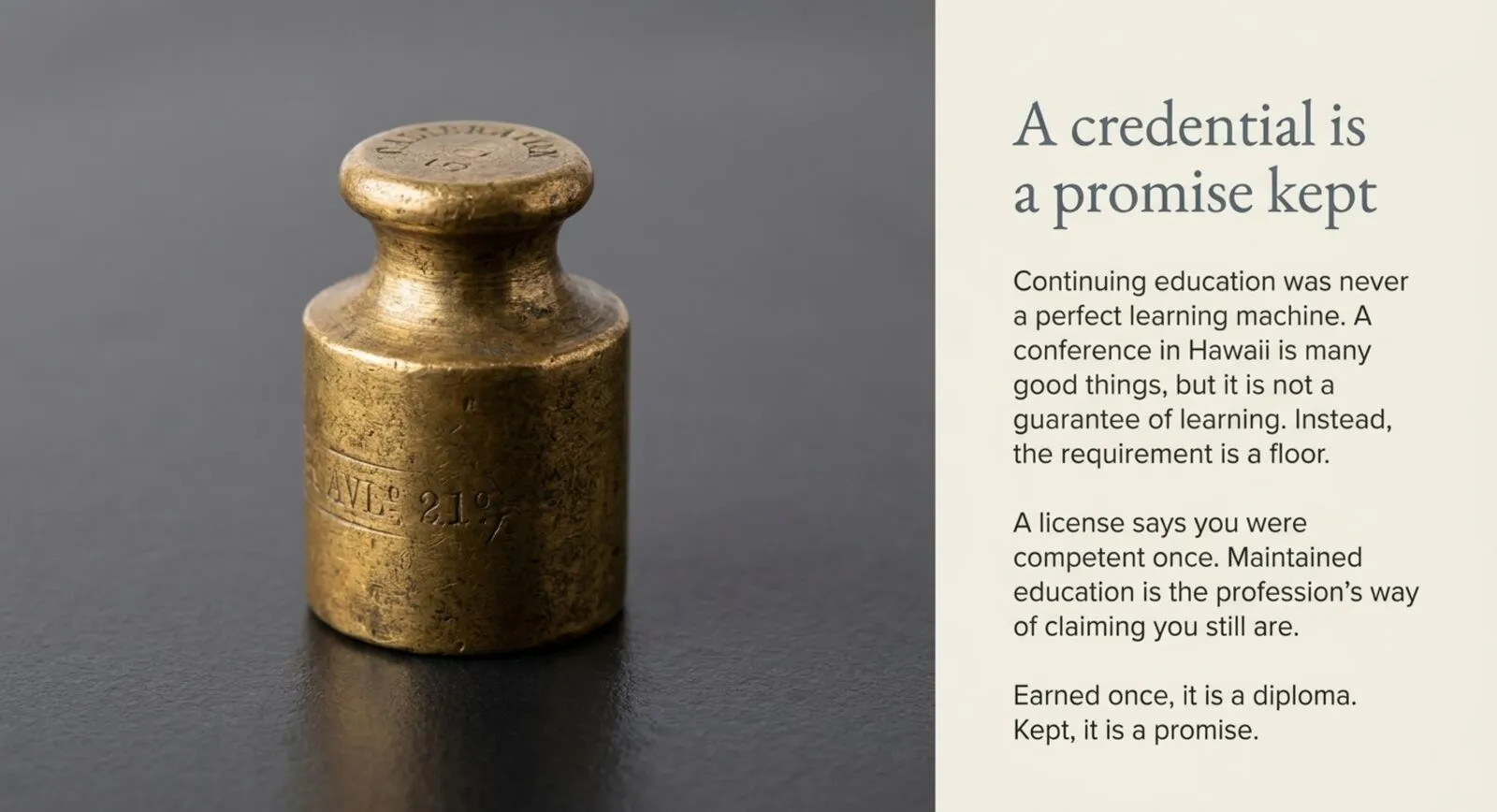
My read is that the requirement was never primarily a learning machine. It is a floor. A license says you were competent once; maintained education is the profession’s way of claiming you still are.
Coaching has the same need and none of medicine’s legal scaffolding. There is no coaching license; anyone can print the business cards tomorrow. So the field built voluntary standards instead. The International Coaching Federation, founded in 1995, had core competencies, an ethics code, and a credential that must be renewed rather than framed by the late 1990s. Health coaching took a different route: a consortium of schools and practitioners spent years agreeing on one national standard, became the National Board for Health and Wellness Coaching, and built its board exam with the National Board of Medical Examiners, the same organization behind physicians’ licensing exams. The first coaches sat for it in 2017. The point of all of it is the stranger deciding whether to trust you: a credential that is hard to get, means one agreed thing, and lapses if you stop tending it. Earned once, it is a diploma. Kept, it is a promise.
So here is what keeping each one takes.
NBHWC continuing education requirements
Board-certified health and wellness coaches renew every three years. As of NBHWC’s 2025 recertification handbook, the renewal math is:
- 36 CE hours per three-year cycle. One CE is one instructor-led hour, and surplus hours do not roll over into the next cycle.
- A $75 annual fee, paid every year, not just at renewal.
- No required category split. NBHWC strongly recommends that 18 of the 36 relate to its content outline, but there is no ethics floor the way ICF has one.
- Approved courses count directly. NBHWC’s own sponsored events, like the free Quarterly Connects, count for 1 CE each, up to 12 per cycle. A course NBHWC has not approved needs a CE petition, at $35 a course.
You document everything on NBHWC’s CE tracker and upload the tracker when you renew. A percentage of trackers are audited, and an audited coach has 30 days to prove all 36 hours. That last sentence is the one that matters. The hours do not just have to happen. They have to be provable, with the certificate findable three years after the webinar.
ICF CCE requirements
ICF credentials renew on the same three-year rhythm, with a bigger number and more structure. Per ICF’s credential renewal page and its renewal guide:
- 40 CCE units per cycle, at every credential level.
- At least 24 in Core Competencies, and 3 of those 24 in Coaching Ethics. ICF’s free online ethics course satisfies the 3.
- The remaining 16 can be Core Competencies or Resource Development.
- ACC coaches also need 10 hours of mentor coaching, spread across at least three months, in every cycle. The 10 count inside the 24 core.
One date to write down now: from January 1, 2027, the mentor coaching an ACC submits for renewal must come from a coach who holds ICF’s Mentor Coach Specialization. If your mentor hours will land next year, ask about your mentor’s credential before you book the engagement, not after.
ICF does not collect certificates when you renew. You report your units and it believes you, except when it audits, and it audits at random. ICF’s own advice is to keep CCE records for at least six months after you submit. Mine would be stronger: keep them for the whole cycle, in one place, filed the day you earn them. Future you will not remember which inbox the certificate went to.
What a coaching session log needs to hold
Search for a coaching session log template and most of what comes back is a practice journal: goals, breakthroughs, homework, how the client seemed that day. Those are good notes. They are not what your credentialing body asks for. The log that protects a credential is smaller than the templates suggest, and the two bodies want nearly opposite things from it.
NBHWC coaching log requirements
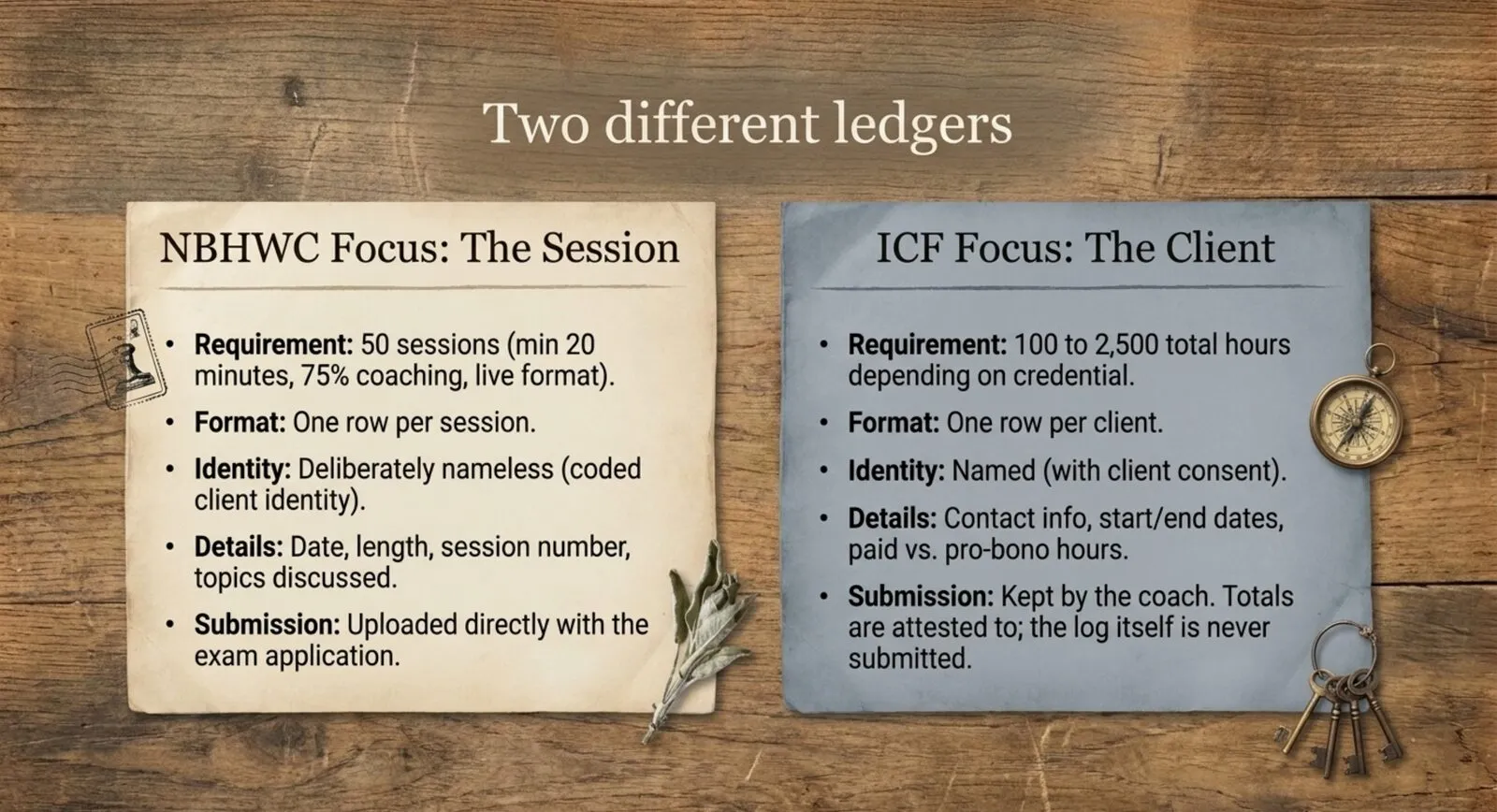
For NBHWC, the log is a gate in front of the board exam. Per the exam application packet, you need 50 coaching sessions, and each one must be:
- At least 20 minutes long, with at least 75% of the time spent coaching rather than educating.
- Held after you pass your training program’s Practical Skills Assessment. Earlier sessions do not count.
- Live: in person, by phone, or by interactive video. Text-based coaching does not count, however real the work was.
- With a real client who is not a friend, family member, or classmate. Paid and pro bono both count.
The official log is one row per session, seven columns, and deliberately nameless: a coded client identity instead of a name, the date, the length, the session number with that client, and a short note of topics discussed. You sign an attestation at the bottom and upload the whole log with your exam application. There is no minimum number of distinct clients; fifty sessions with a handful of committed clients qualifies.
ICF coaching hours log
Here is something I didn’t expect when we built Grove’s credential exports: ICF does not actually want your coaching log. You keep it, you report your totals, and you sign an attestation, and ICF says that even during an audit you will not be asked to submit the log itself. Falsifying the number is an ethics violation that can cost the credential and bar you from reapplying for up to five years, but the record stays with you.
What the record has to support is the totals for the level you are applying for, per ICF’s experience requirements:
| Credential | Total hours | Paid hours | Clients | Recent hours |
|---|---|---|---|---|
| ACC | 100 | 75 | 8 | 25 in the last 18 months |
| PCC | 500 | 450 | 25 | 50 in the last 18 months |
| MCC | 2,500 | 2,250 | 35 | no recency rule |
ICF’s coaching log template runs the other way from NBHWC’s: one row per client, not per session, and names required. Client name, contact information, individual or group, number in the group, start and end dates of the relationship, paid hours, pro bono hours. ICF asks you to get each client’s consent before their name goes in. Group coaching has its own arithmetic: each participant counts as a client, the hour is never multiplied, and a group larger than 15 does not count at all without a co-coach.
So the two logs answer different questions. NBHWC wants the receipts. ICF wants your signature. Either way, the log has to exist long before anyone asks, because a number you attest to is only as strong as the record behind it.
A coaching session tracker that counts itself
The engineer in me sees one absurdity in all of this, and it is not the credentialing bodies’ fault. The information already exists. The session was booked on a page. The client showed up. The call happened. The coach marked it complete afterward. Software witnessed nearly every part of that hour, and then we ask the coach to retype it into a spreadsheet. The spreadsheet exists because none of those places keep count.
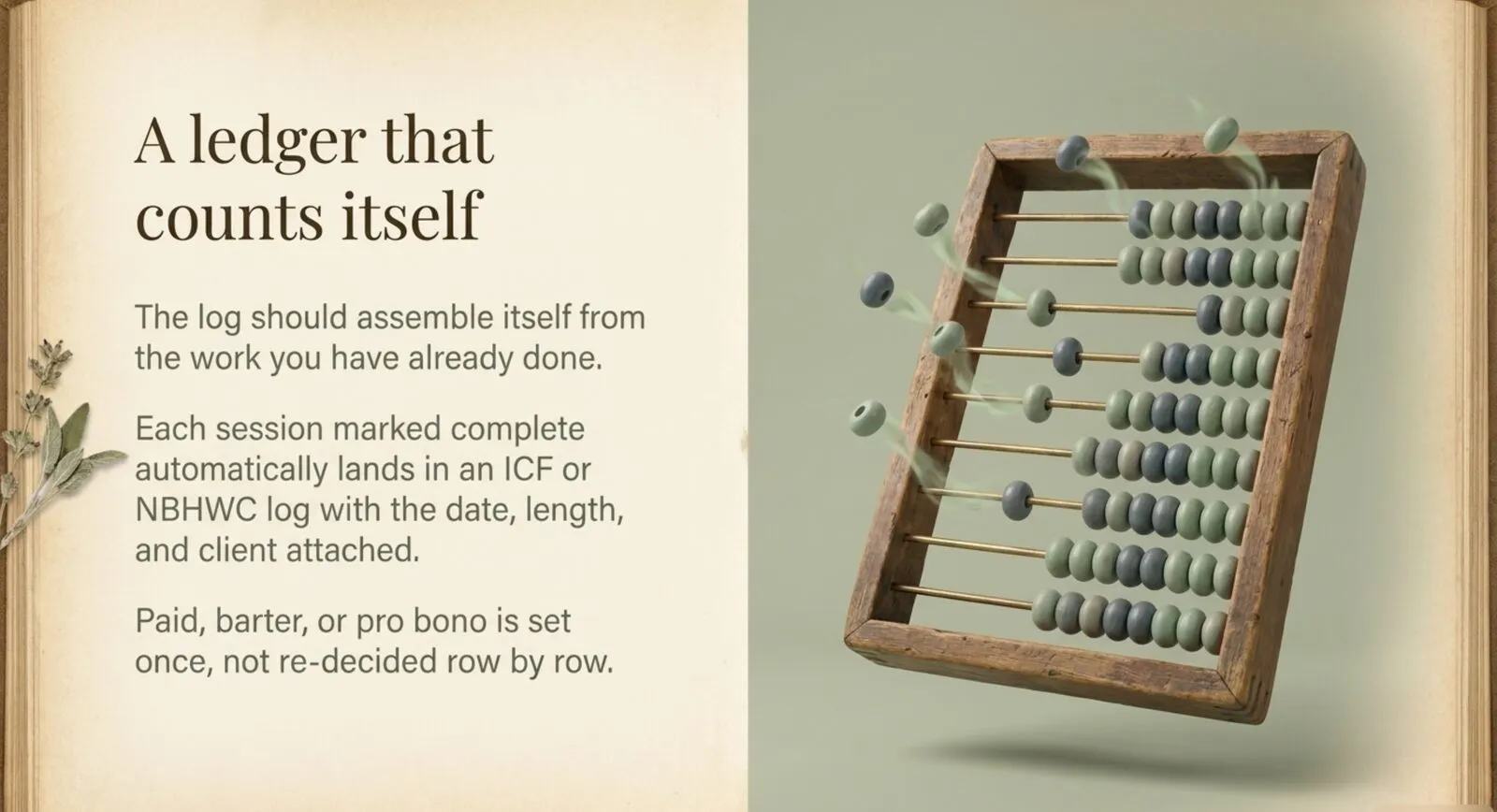
That was the design brief for the coaching hours log we built in Grove, which opens to every Grove coach on October 30. The log assembles itself from work you have already done: each session you mark complete lands in an ICF or NBHWC log with the date, length, and client attached, including clients who never open the app. Whether a client is paid, barter, or pro bono is set once, on the client, not re-decided row by row.
The hours a tool cannot see still have a place. Sessions from before Grove go in by hand, one row per client, so the log starts whole instead of starting over. And when it is time to apply or renew, Grove flags what is missing and exports the shape your body expects: an ICF-style client log, NBHWC’s seven-column session log with coded identities, or a plain CSV.
The second ledger lives beside the first. CE hours log against your renewal rules, certificates are stored next to the hours they prove, and reminders arrive six months and three months before a renewal comes due. Before the scramble, not during it.
It is worth being plain about what it does not do. It does not verify your hours or submit anything to ICF or NBHWC; the attestation stays yours to sign. It will not import your old spreadsheet. And it is not accounting software: payments and invoices run through your own Stripe account, and nothing syncs to QuickBooks or Xero. It keeps the count. The claims stay yours.
Credentialing bodies count hours because hours are what can be counted. The reps that made the hours good, the reflection that finally landed, the question you managed not to answer for someone: no ledger holds those, and no auditor will ever ask about them. The number is the smallest true thing about the work. It’s just the only part anyone will ever ask you to prove.

Founder of Grove. Twenty years building software for skilled professionals. Currently writes mostly on Tuesdays from a small studio in Austin.