Early access·Applications open for the first cohort of coaches → Apply
← The Grove Journal
Coach craft 9 min read April 28, 2026

Habit stacking for behavior-change coaching: a working playbook

The version of habit stacking that survives a real client roster. Less James Clear, more what your Tuesday afternoon clients actually do between sessions.

Beth Richardson
Founder of Grove
A smooth green river stone with a single fern leaf imprint resting on weathered wood. Headline reads 'The Working Playbook for Habit Stacking. What actually survives a real client roster.'

Habit stacking, as written, sounds clean. Anchor a new habit to an existing one. Brush your teeth, then floss. Pour coffee, then meditate. The science is good. The execution, with real clients, is rarely that tidy.

A two-panel diagram. Left panel, "The Textbook Theory," shows four neat green rectangles stacked vertically with the caption "Brush your teeth, then floss. Pour coffee, then meditate. Clean, logical, and fragile." Right panel, "The Tuesday Afternoon Reality," shows a coffee cup, an old key, and a battered notebook with scribbled notes, caption "Exhausted clients, fluctuating motivation, and messy environments." Footer: "The science is good. The execution is rarely that tidy."

This is the version that holds up across the coach rosters I’ve watched, with the parts that actually translate into Tuesday-afternoon practice.

The anchor needs to be boring.
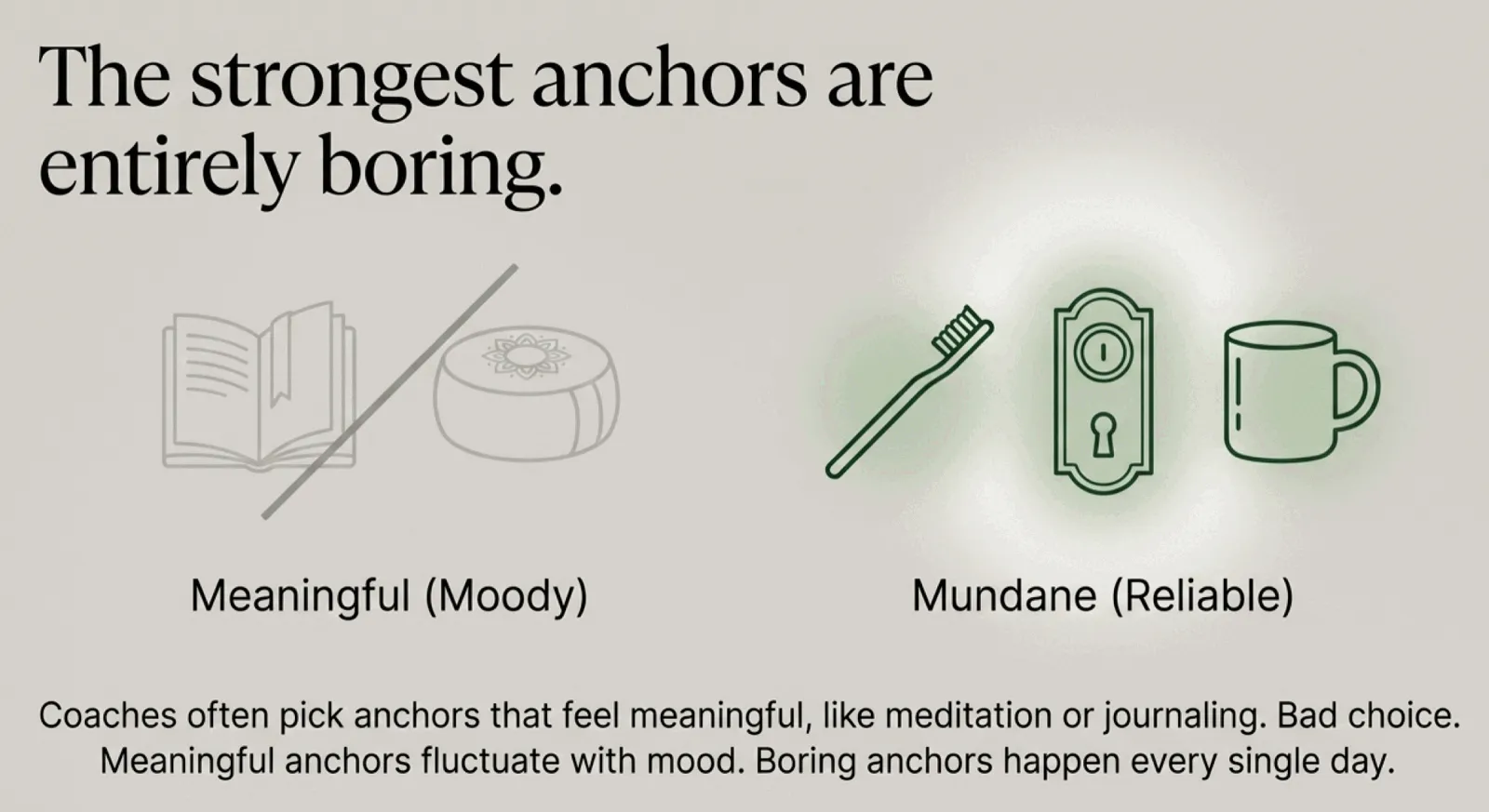
A two-panel comparison titled "The strongest anchors are entirely boring." Left side, "Meaningful (Moody)," shows faded icons of an open book and a meditation cushion. Right side, "Mundane (Reliable)," shows brighter icons of a toothbrush, a door lock, and a coffee mug with a green glow around them. Footer: "Coaches often pick anchors that feel meaningful, like meditation or journaling. Bad choice. Meaningful anchors fluctuate with mood. Boring anchors happen every single day."

Coaches sometimes pick anchors that feel meaningful, like meditation or journaling. Bad choice. The strongest anchors are mundane: brushing teeth, locking the front door, the first sip of morning coffee. Boring anchors are reliable. Meaningful anchors are moody.

The new habit has to be smaller than you think.
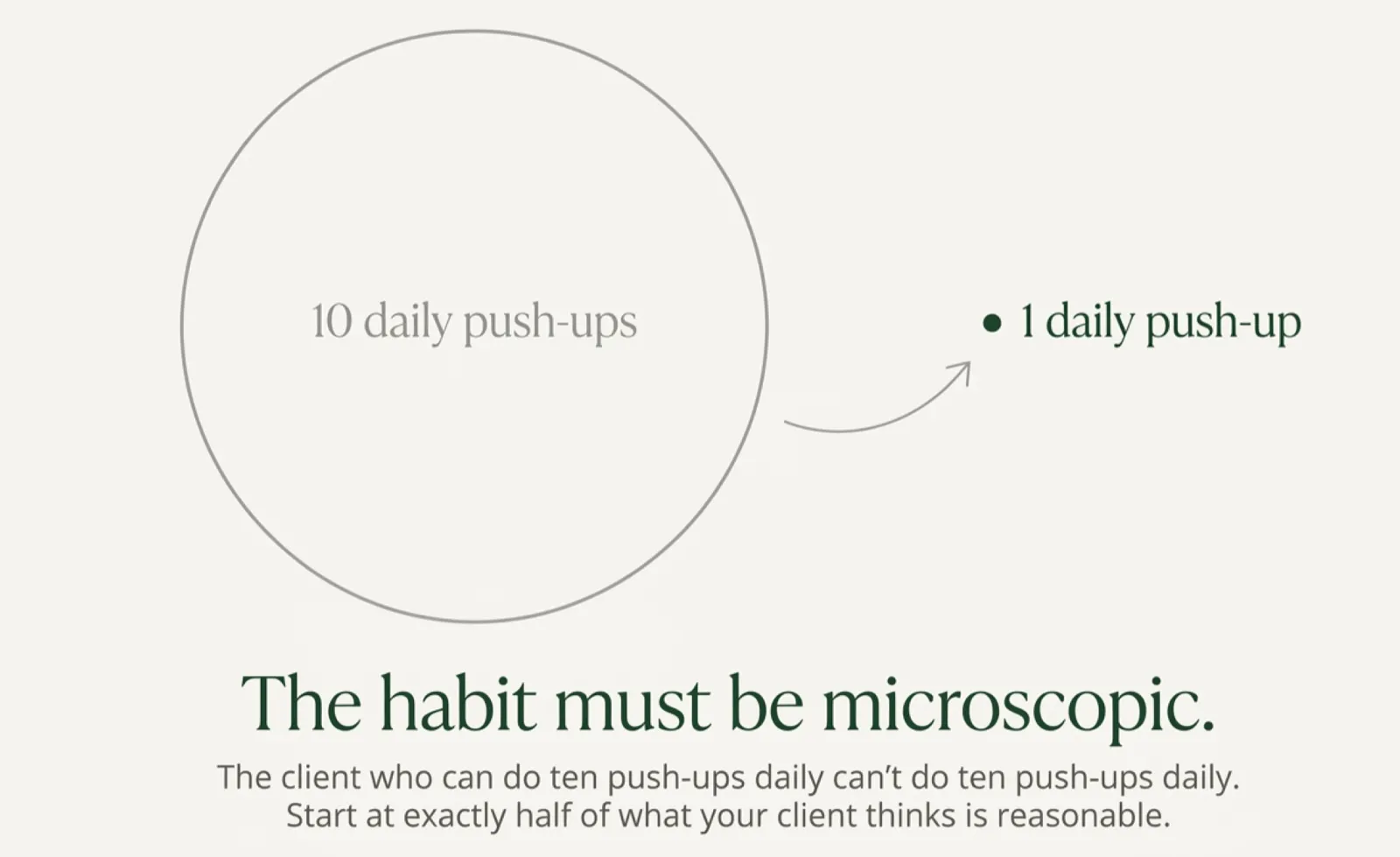
A simple diagram titled "The habit must be microscopic." A large pale circle labeled "10 daily push-ups" sits next to a tiny dot labeled "1 daily push-up," connected by a small arrow. Footer: "The client who can do ten push-ups daily can't do ten push-ups daily. The client who can do one will do one for a year. Start at exactly half of what your client thinks is reasonable."

The client who can do ten push-ups daily can’t do ten push-ups daily. The client who can do one will do one for a year and quietly drift to three. Start at half of what your client thinks is reasonable.

One stack per phase.
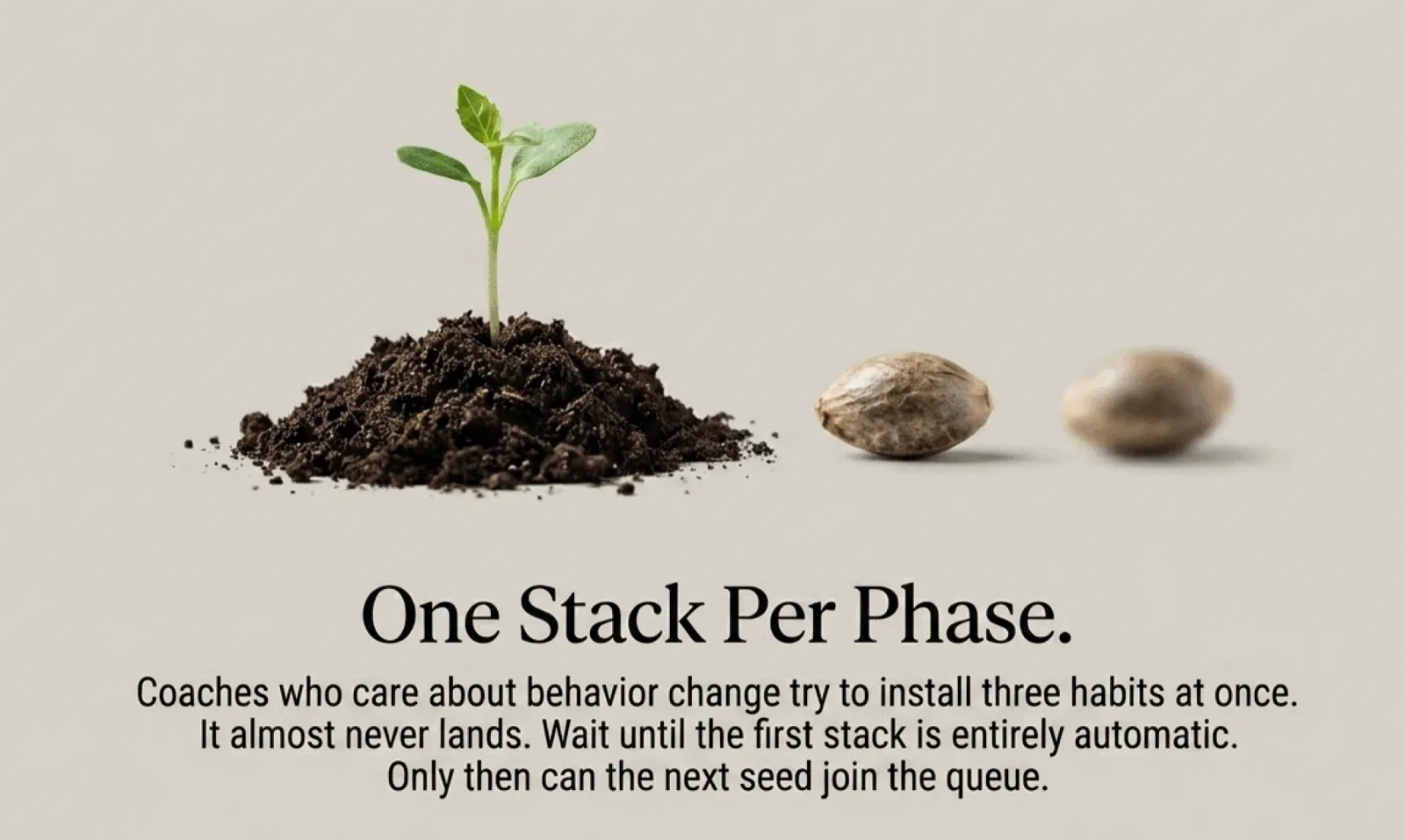
A photo composition titled "One Stack Per Phase." On the left, a healthy green seedling growing from a small mound of dark soil. On the right, two dormant seeds resting on a neutral surface, waiting. Footer: "Coaches who care about behavior change try to install three habits at once. It almost never lands. Wait until the first stack is entirely automatic. Only then can the next seed join the queue."

Coaches who care about behavior change try to install three habits at once. It almost never lands. One stack per phase of the work. When that one is automatic, the next one can join the queue.

Track the stack, not the habit. A tracker that asks about the new habit alone measures willpower. A tracker that asks “did the stack happen?” measures the design. The simplest way to get there: have the client log the anchor and the new habit as a single check, so they’re confirming the whole ritual happened, not just the part that takes effort.

The session check is whether it still feels like one thing.
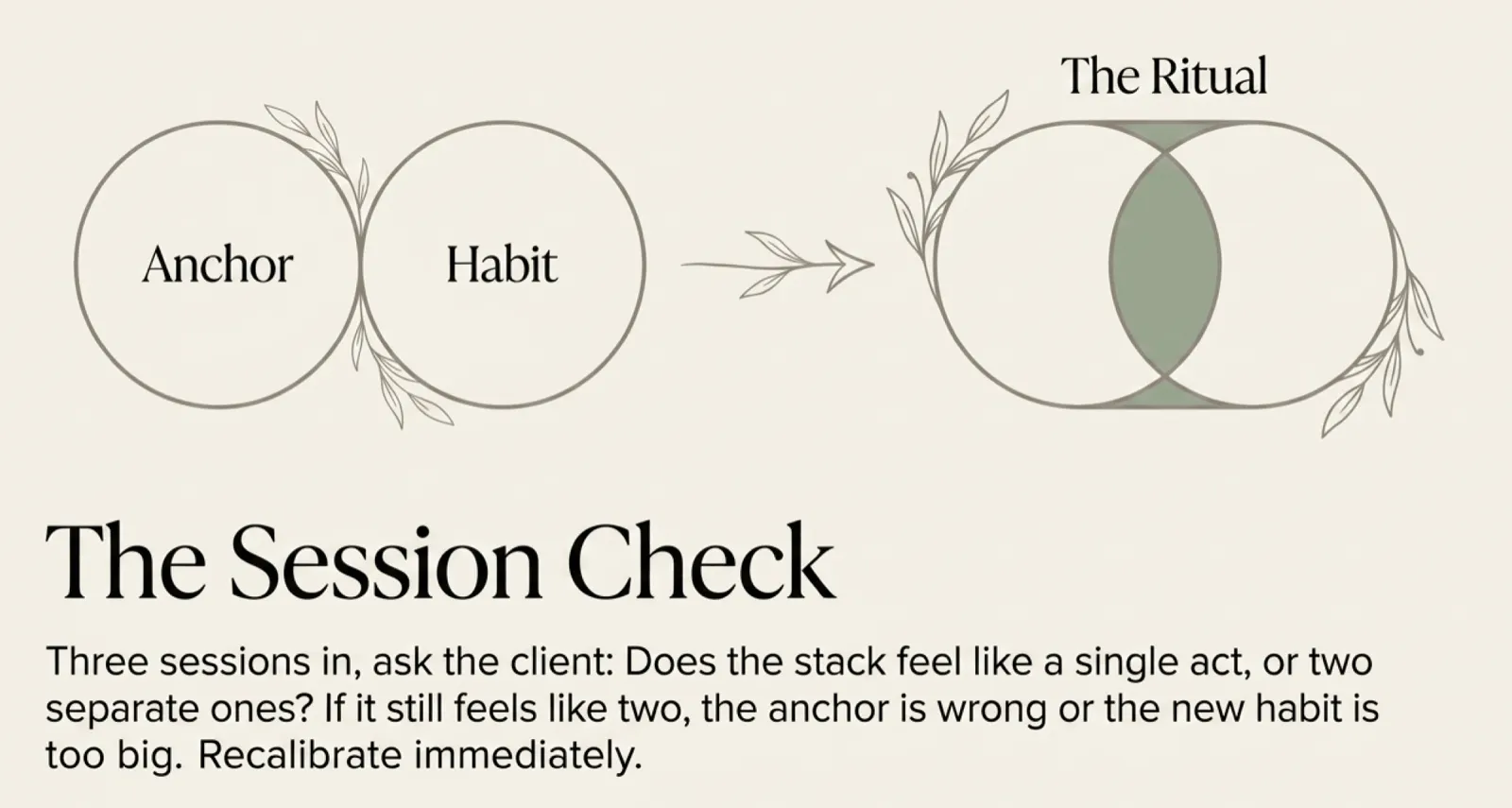
A diagram titled "The Session Check." Two overlapping circles labeled "Anchor" and "Habit" sit on the left. An arrow points right to a single fused shape labeled "The Ritual," surrounded by a soft leafy border. Footer: "Three sessions in, ask the client: does the stack feel like a single act, or two separate ones? If it still feels like two, the anchor is wrong or the new habit is too big. Recalibrate immediately."

Three sessions in, ask the client if the stack still feels like a single act or two separate ones. If it still feels like two, the anchor is wrong or the new habit is too big.

The exit ramp is on purpose.
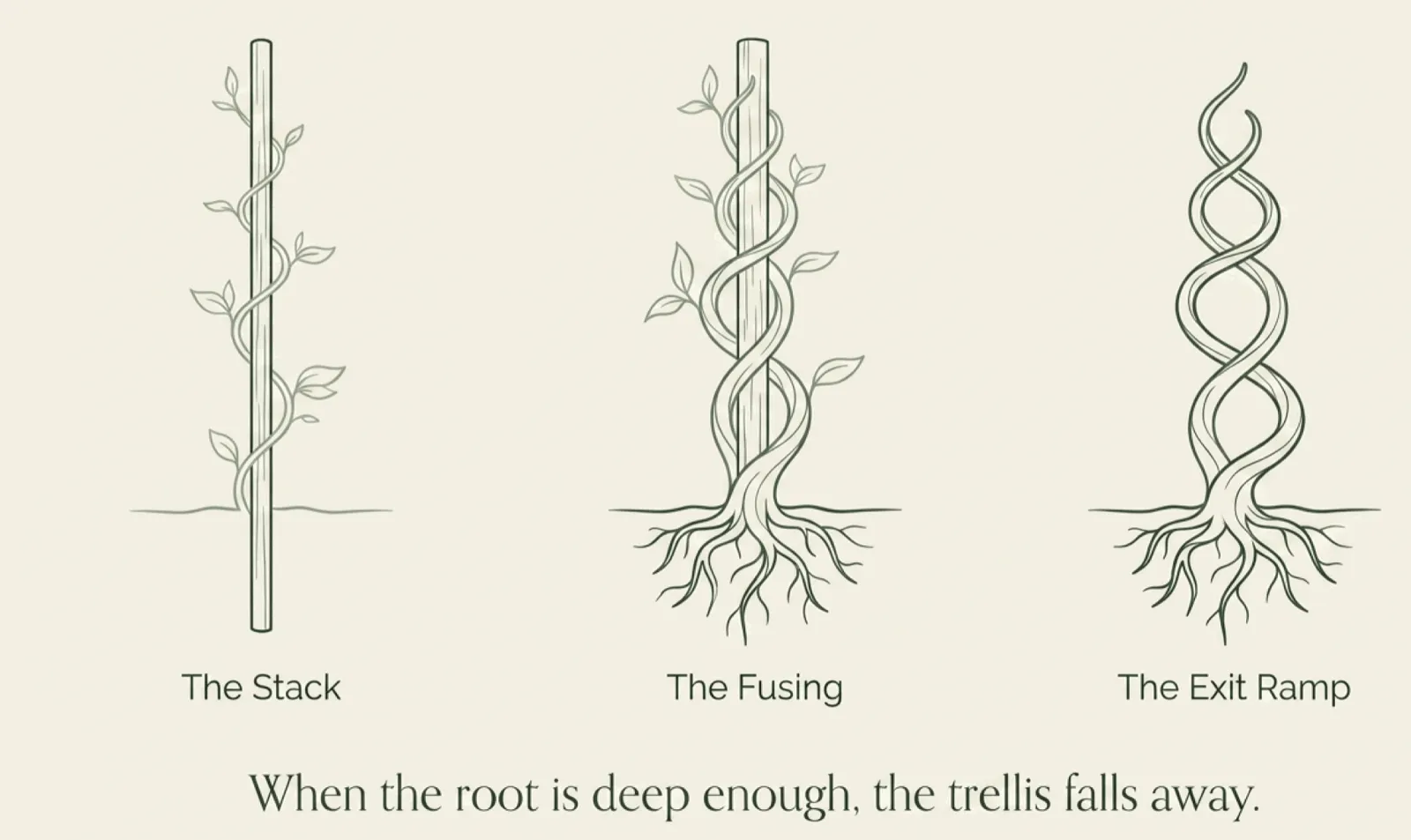
A three-panel botanical illustration showing the same trellis at three stages. Panel one, "The Stack," shows a young vine climbing a slender wooden trellis. Panel two, "The Fusing," shows the vine thickening, with roots reaching into the ground. Panel three, "The Exit Ramp," shows a mature, self-supporting vine in the shape of the original trellis, with no trellis visible. Footer: "When the root is deep enough, the trellis falls away."

Eventually the new habit doesn’t need the anchor. That’s success, and it surprises clients. Tell them it will happen.

The shape of the work, with all of that applied, looks less like a stack and more like a small ritual that grows in place. Most of the science is the same. The translation into coaching is where the real craft lives.

Written by
Beth Richardson

Founder of Grove. Twenty years building software for skilled professionals. Currently writes mostly on Tuesdays from a small studio in Austin.

Try the thing the essay is about.

Grove is the coaching layer for health and wellness practitioners. Daily touchpoints, prep that writes itself, sessions that land.