Every coach’s first Grove client is themselves. When you create an account, Grove’s guided setup doesn’t hand you an empty dashboard and wish you luck. It walks you through a real intake, a real check-in, and your first AI-written Daily Pulse, all on your own coaching record. About five minutes in, you’re not reading about the product. You’re using it the way your clients will.
This guide walks the whole first session: creating your free account, completing the guided setup (including the outcome areas and goals that shape everything after), meeting Sage (your assistant coach) and Riley (your sample client), and settling into the daily check-in rhythm that makes session prep work. Run it for a few days before you invite a real client and you’ll walk into that relationship with muscle memory instead of guesses, and because coaching yourself first practices real coaching competencies rather than just familiarizing you with buttons, there’s a section at the end mapping the two.
The terms you’ll see
A few words carry precise meanings in this flow. Here’s the map:
| Term | What it means |
|---|---|
| Guided setup | The five-minute flow right after sign-up that builds your intake, adopts your first playbook, and ends with your first Daily Pulse. |
| Outcome areas and goals | The library of focus areas (Sleep and recovery, Movement and fitness, and more) and the plain-language goals under each. You pick your own here; your future clients pick theirs the same way during their own onboarding. |
| Sample client | Riley, a fully populated practice client Grove creates for every account (demo goals, habits, and check-ins already in place) so you can explore real product behavior without a real person. Doesn’t count against your client limit. |
| Self-coaching | Using Grove on yourself, the same way your clients use it, from your own seat in the practice instead of theirs. |
| Daily Pulse | The short, Sage-written read of what changed and what matters, generated from your (or a client’s) recent check-ins and carrying an “Authored by Sage” badge. |
Before you start
- All you need is an email address. There’s no credit card and no application for the free tier.
- The guided setup takes about five minutes. Budget another ten to explore your dashboard and meet your sample client.
- Plan to check in once a day for a few days afterward. That’s where the real learning is.
Steps
-
Create your free account. Go to Grove’s early access page and click Start free. That takes you straight to sign-up with nothing to apply for and nothing to pay.
Tip: The same page describes an optional Early Access cohort with extra perks and founder office hours. You can apply for that later; you don’t need it to get started.
-
Start the guided setup. After sign-up Grove greets you with “Welcome. Your first client is you.” Click Let’s begin. The setup runs about five minutes, start to finish, and ends with your first Daily Pulse.
-
Name who you’re becoming. The first intake screen (“Who are you becoming?”) asks you to pick an identity to grow into, like being an active person or someone who handles life with calm, or to write your own. This is Grove’s identity-first coaching model applied to you: change sticks when it’s anchored to who you’re becoming, not just what you’re doing this week.
Heads up: The identity and goals screens are the required part of your intake; the practice-lens screen after them is optional. And nothing you type here is read by AI at this point. Sage asks for your consent separately, a few screens later, and you decide.
-
Pick your outcome areas and goals. The second screen (“What are you working toward?”) lets you choose up to 3 areas to focus on, like Sleep and recovery, Movement and fitness, or Stress and mental load. Each area you pick opens a set of plain-language goals (“I want to wake up rested,” “I want a consistent workout routine”) to select from. These aren’t decorative. They come from Grove’s coaching taxonomy, the same library of outcome areas and goals your clients will choose from during their own onboarding, and they do real work: they become your self-coaching intake, they shape which starter playbooks Grove offers you next, and once you enable Sage they’re the context your Daily Pulse draws on.
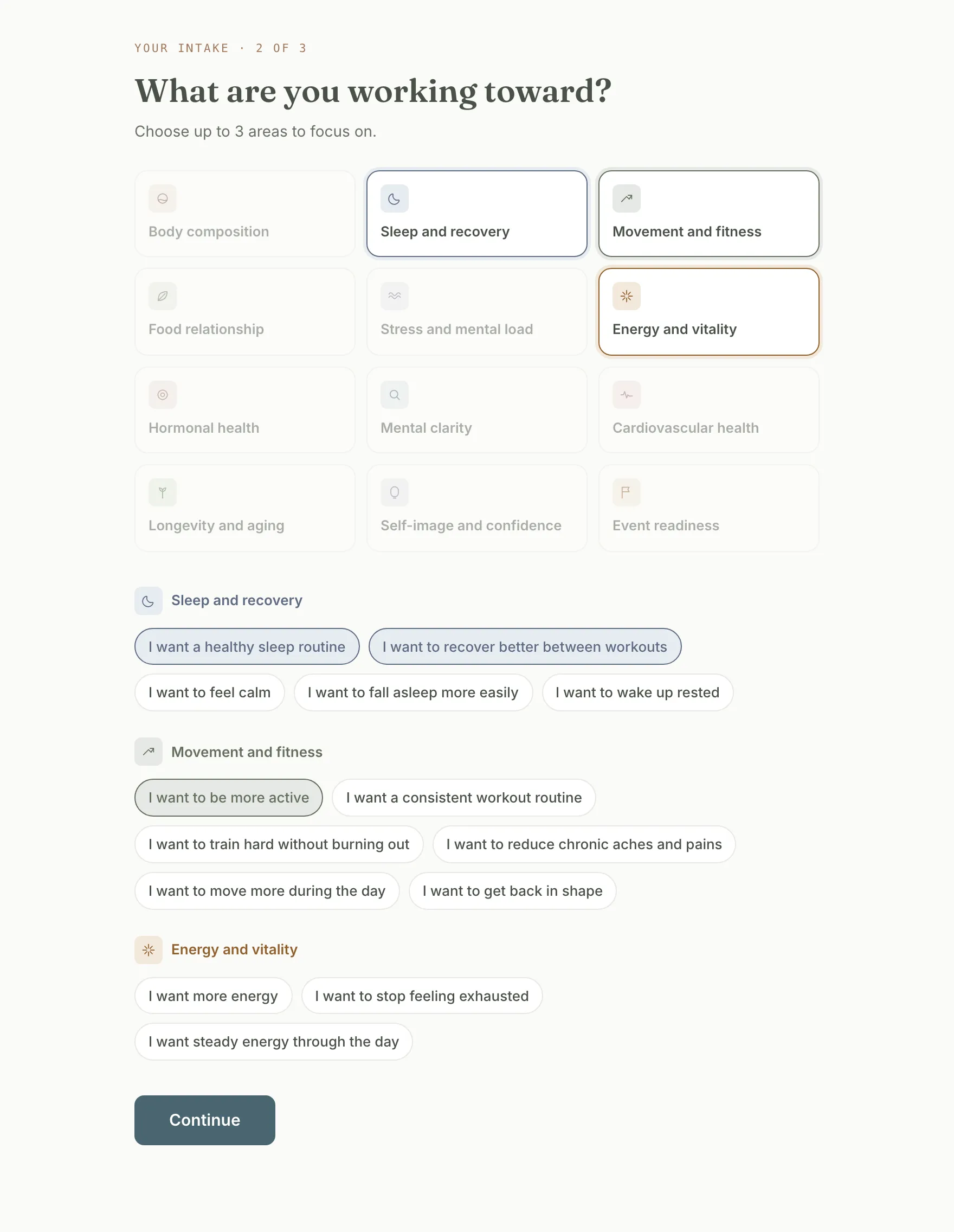
Tip: Pick what’s true for you, not what sounds coach-like. You’re about to experience how it feels when a client hands a coach their real goals, and that empathy is the point of this whole exercise.
-
Add an optional lens on your practice, then save. The third screen asks who you hope to coach and what you want your practice to feel like in a year. It’s optional (click Skip for now if you’d rather move on) and private to you. Then Grove reads your whole intake back on the “Read it back.” screen; click Save my intake when it looks right. Saving is the moment self-coaching activates: Grove creates your own client record, separate from your future roster.
-
Adopt a starter playbook. On the “Pick your first playbook” screen, choose one; the options follow from the goals you just picked. Grove adds its foundation habit to your record as an active habit, so your first check-in has something real to check off.
-
Do your first check-in. On the “Now, check in” screen, pick how you’re feeling (from Rough to Great), mark your new habit, and click Complete check-in. This is the exact daily motion your clients will do.
-
Meet Sage and read your first Daily Pulse. Sage is Grove’s assistant coach, and this is the consent moment: the setup shows you exactly what Sage reads (your check-ins and reflection forms, session notes and talking points, your intake answers) and what it never touches (your payment information, messages you send to clients, anything you mark private) before you decide. Click Enable Sage & see my Pulse, and Grove writes a Daily Pulse from the check-in you submitted a moment ago. Not a demo, not boilerplate.
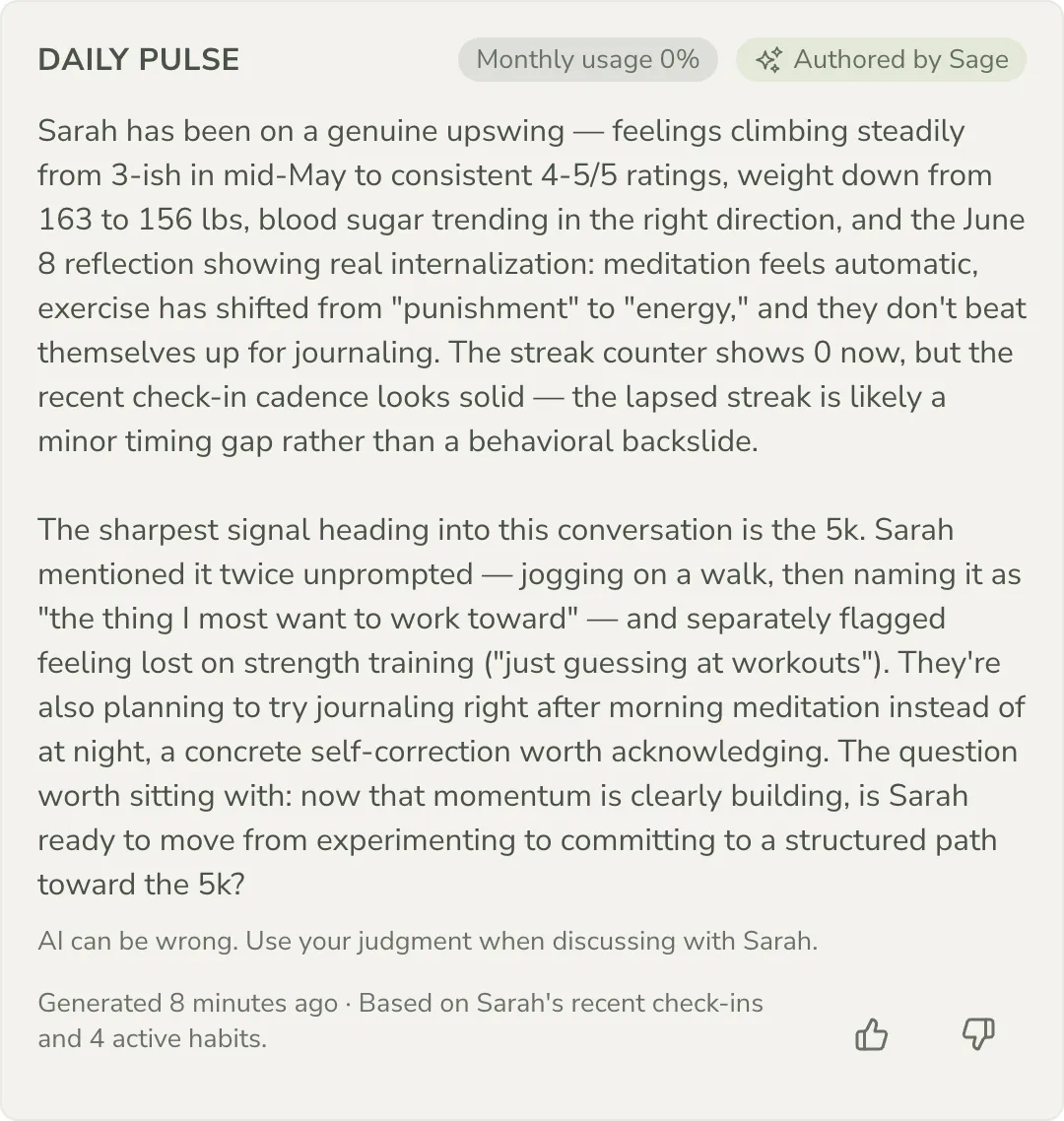
Heads up: You can click Skip, show me around first instead. Nothing else changes, and you can meet Sage again from your dashboard whenever you’re ready. Your clients get the same deal later: Sage reads a client’s data only after that client opts in themselves.
-
Say hello to Riley, your sample client. Click Finish setup, then Go to dashboard. Waiting for you is Riley, a fully populated practice client with goals in motion, habits being hit and missed, and a month of check-ins. Her welcome message in your messages drawer names concrete things to try. Poke at her client page, her briefing, and her session prep. She’s there so nothing you learn later has to be learned on a real person.
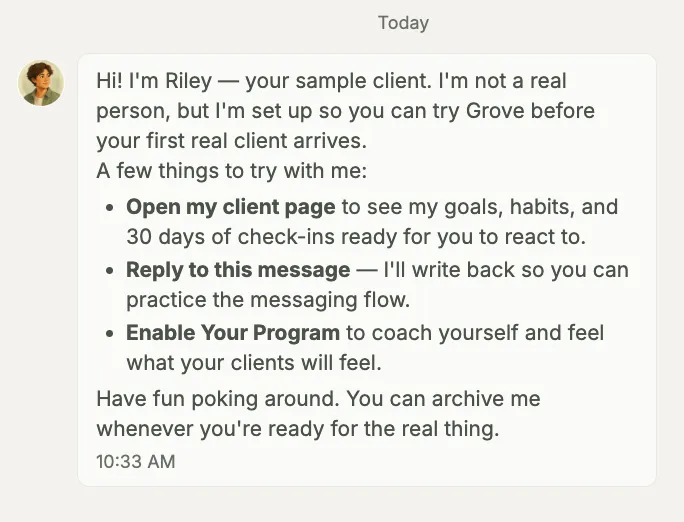
Tip: Riley and your own self-coaching record are both part of the free tier. Neither counts against your client limit.
-
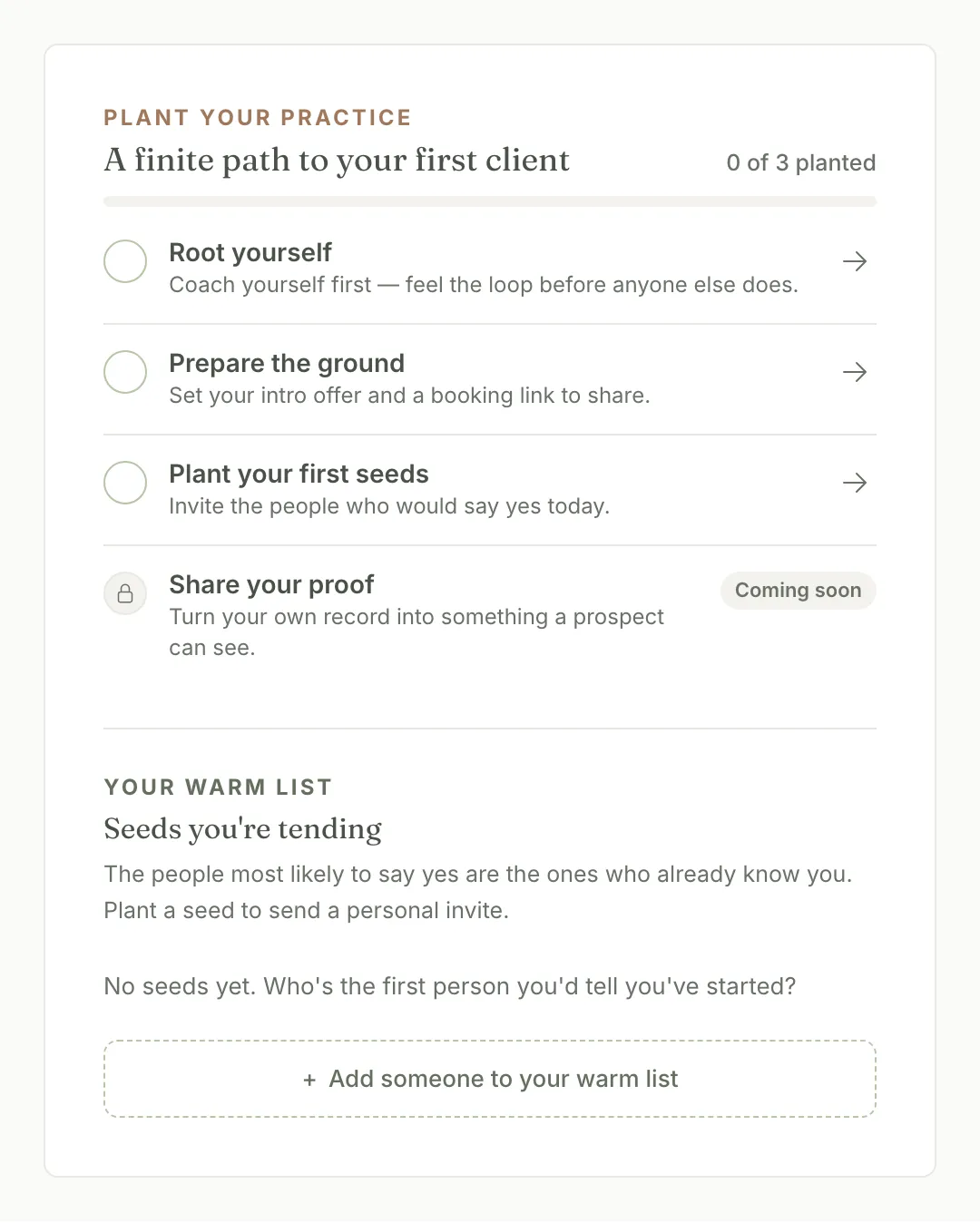
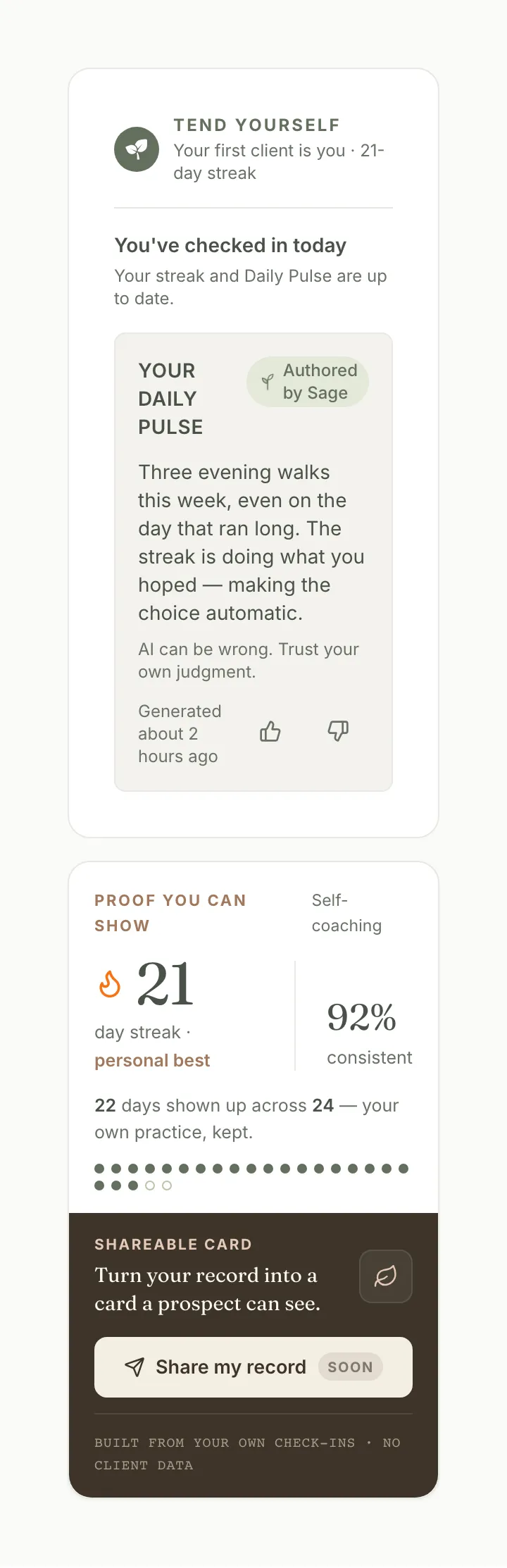
Learn your dashboard’s two halves. As a new coach your home screen is built around two panels. On the left, “Plant your practice” lays out a finite path to your first client: Root yourself (this guide), Prepare the ground, Plant your first seeds, and Share your proof, plus a warm list for the people you’d invite first. On the right, the “Tend yourself” rail carries your own daily check-in, your Daily Pulse, and a “Proof you can show” card that turns your streak into something a prospect can see.
-
Keep the rhythm going for a few days. Check in once a day from the Tend yourself rail: how you’re feeling, today’s habits, an optional note, then Check in. One check-in per day builds your streak and sharpens each morning’s Pulse. This daily loop, felt from the client’s side, is the whole point of coaching yourself first.
Tip: Want the full client’s-seat view? Sign in to the Grove client app with the same email you use as a coach. That’s the experience your clients get on their phones.
-
Decide when to invite your first real client. A few days of your own check-ins is usually enough to feel the rhythm. When you’re ready, follow Invite and onboard your first client. You’ll be setting up a flow you’ve already lived, down to the outcome-goals picker your client will meet on their first day.
How coaching yourself first supports NBHWC best practices
Running the guided setup on yourself can look like a warm-up before the real work starts with clients. It’s closer to the opposite: several of the moments in this walkthrough are named competencies in the NBHWC Content Outline (2026-2030), practiced from the client’s seat before you ever coach someone else through them.
-
You practice self-awareness and self-regulation (1.2). The outline names ongoing self-awareness and self-regulation as a coach competency in its own right, not a byproduct of coaching others. Setting your own outcome goals, checking in daily, and reading your own Daily Pulse gives you a structured place to build exactly that, on a rhythm you keep for yourself.
-
You set outcome goals in your own words first (3.9.1). The outline’s goal-setting competencies start with the client defining goals in their own language, not the coach’s. The guided setup’s “Who are you becoming?” and “What are you working toward?” screens put you through that same authoring step before you ever guide a client through it.
-
You experience the AI-consent moment before a client does (Domain 4). Ethics and professional practice covers how a coach handles AI-assisted tools with a client. Sage’s setup screen shows you exactly what it reads and never touches, then waits for your explicit choice, the identical disclosure-and-consent pattern your future clients get before Sage ever looks at their data.
None of this replaces your own judgment about what a real client needs. It means the empathy and the standards both arrive before your first real session, not after.
What’s next
The invite guide picks up exactly where this one ends: adding a client, preparing their space while they’re still a draft, and responding to their first check-in. If you want to understand the surfaces you just met, the self-coaching mode and Sage feature pages go deeper on what you saw during setup.