
When I first met with my health coach, I came in like a study subject. I could quote the research. I knew the difference between resistance training adaptations and aerobic ones. I had read Atomic Habits twice. I had a clean tracker. I had set the bar at the finish line.
My daily steps told a different story.
In every coach conversation I have had since starting to build Grove, some version of this client comes up. The educated one. The articulate one. The one who shows up on Tuesday with a thoughtful plan and a thoughtful question and a quietly mounting pile of red days. The most informed clients are often the most stuck. That is not a paradox. That is what happens when information is the only tool.
The deficit-of-knowledge story coaches are taught
The coaching textbook story is clean. A client comes in. Something is not working. The coach assesses. The coach finds the gap in their knowledge or skill and fills it. Better information, better skill, better outcomes. The arrow is supposed to run one way.
Most coaching curricula are built around this story. Most coach-tool dashboards are too. The default surface is a tracker with red and green and a tally. The default coaching response to a red day is to explain why the green day matters.
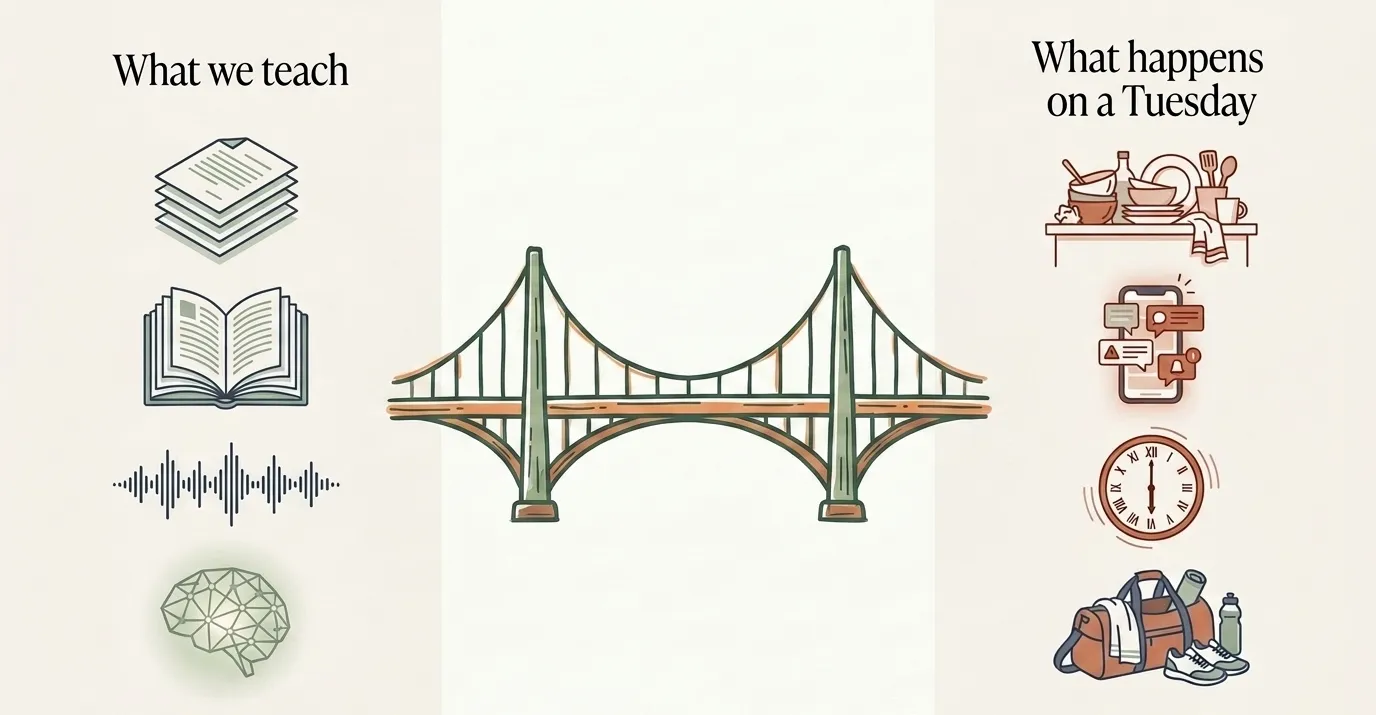
The Tuesday-afternoon reality is different. The clients I keep hearing about from coaches are not lacking the explanation. They are lacking the bridge between intent on Monday morning and the actual decision at 6pm on a Tuesday when work has been bad and someone is in a meeting that ran late and dinner is not planned and the gym bag is upstairs.
The explanation is not what is missing. The bridge is.
What the research actually shows
The intention-behavior gap is one of the most replicated findings in behavior science. The 2016 meta-analysis by Sheeran and Webb pulled together studies across health behavior, exercise, diet, and substance use, and found that intentions explain roughly half of variance in subsequent behavior. Half. The other half is something else.
Wendy Wood’s work at USC sharpens the number. About forty-three percent of what people do on a given day is habit-driven, which means it does not pass through conscious intention at all. It is cued by environment, time of day, social context, and prior behavior. You do not decide to drive home the same way you decided yesterday. You drive.
BJ Fogg’s behavior design model from the Stanford Behavior Design Lab makes the implication concrete. Behavior happens at the intersection of motivation, ability, and a trigger. Of those three, the field systematically over-invests in motivation, which is the input most easily addressed through explanation. The real lever is usually ability (lowering friction) and trigger (designing when and where the behavior happens). Both of those live outside the coaching session.
A coach who only works on motivation is working on a third of the system.
The coaching response that worked on me
My coach did not try to explain things better. She did the opposite. Progress over perfection, she said, the first time we talked. She scaled me back to four habits matched to my current focus, and she set the bar low enough that I could guarantee compliance for a week. The bar was almost embarrassingly low.
That worked, and the reason it worked is the reason I am writing this. The conversation she had with me was not about whether I understood the science. The conversation was about where in my week the behavior was actually going to happen, and what was going to stop it. She moved the work from explanation to design.
The design questions are not new. Coaches who have worked with messy, real clients already know them. They sound like:
- What is the boring, reliable thing that happens before this should happen?
- What does the environment look like in the moment of decision?
- What is the smallest version of this that you can guarantee?
- Who else is in the picture, and what are they doing?
- What is the version of this that survives a bad day?
These questions move the coaching work into the 167 hours between sessions, which is where the behavior actually lives. They also do something quieter for the relationship. They communicate that the coach is not trying to make the client more disciplined. The coach is trying to make the next decision easier. That is a different posture, and I felt the difference.
What this looks like in practice
Three concrete moves coaches I have watched use this week, on existing clients, without changing anything else.
Anchor pairing. Instead of “I will go for a walk this week,” design “I will walk after I put the dishes in the dishwasher on weekdays.” The boring anchor matters. It needs to be something that already happens every single day, regardless of mood. Meditation as an anchor is a moody choice. Loading the dishwasher is a reliable one.
Time-of-day specificity. Replace any goal containing “more” with a goal containing a time. “Drink more water” becomes “fill the bottle before the first meeting.” “Eat better” becomes “decide on dinner at 2pm.” The specificity is not a constraint. It is the trigger that the behavior was missing.
Friction reduction. Clothes laid out, app on the home screen, snacks pre-portioned, gym bag by the door, the meditation cushion left on the floor where the client will see it. None of these are clever. All of them work because the dominant variable in a moment of decision is how much effort it takes.
There is a fourth move that lives in the product layer of a coaching practice. The daily touchpoint between sessions matters as much as the session itself. A morning surface that opens to the client’s current focus, not to a tally of how they did yesterday, keeps the question alive: what is the version of this that I can do today? That is the question the coaching relationship is trying to keep at the top of the client’s mind. Grove builds for this on purpose. Most coaching products are built around the tally because the tally is easier to ship.
What changes for the coach
There is a quieter benefit on the coach side. The session prep gets easier because the in-between hours have become visible. The conversation in session gets richer because the friction is named, not abstract. The coach stops carrying the weight of “did I explain it well enough” and starts carrying the weight of “did we design it well enough,” which is the weight the work actually deserves.
The client also stops feeling lectured. That mattered more to me than I expected when I was on the receiving end. The version of me who showed up with the plan and the reading list did not want to be re-taught the thing I already knew. I wanted to be helped to do it. The shift from explanation to design is the shift I had been quietly waiting for.
A note on what this is not
This is not a rejection of education in coaching. There are clients who genuinely lack a piece of information, and the right move is to give it to them clearly. The point is narrower: when the knowledge is already there and the behavior is still not, the next coaching move is rarely more knowledge. It is design. Treating information as the universal lever produces clients who are highly literate and chronically stuck, which is a real shape the coaching field keeps producing and rarely names.
The other thing this is not is a willpower argument in disguise. The whole point of designing the in-between is to make willpower the smallest variable, not the largest. If the design is good, the Tuesday afternoon decision does not require willpower at all. It requires walking past the dishwasher.
A coach’s job is not to teach the right thing. It is to make sure the right thing happens on a Tuesday afternoon.
Sources & further reading
- Sheeran, P. & Webb, T.L. (2016). The Intention-Behavior Gap. Social and Personality Psychology Compass, 10(9), 503–518.
- Wood, W. (2019). Good Habits, Bad Habits and the 43% finding on habit-driven daily behavior.
- Fogg, B.J. The Fogg Behavior Model. Stanford Behavior Design Lab.
- Greater Good Science Center, “How to Help Your Students Develop Positive Habits” — on intentions, willpower, and why habit planning matters more than motivation.
- NBHWC scope of practice — the coach’s role as accountability partner, not director, with “consult and advise” explicitly outside a coach’s scope.

Founder of Grove. Twenty years building software for skilled professionals. Currently writes mostly on Tuesdays from a small studio in Austin.