

Every time I create a fresh coach account to test Grove, I land on the same page a brand-new coach lands on. For most of this year, that page was a triage board with nothing to triage. An empty roster, an empty calendar, a chart with no line in it. I built the thing, and it still managed to make me feel behind.
I want to be honest about where this feature came from, because it was not coach interviews. It came from building, and from a cold start I know personally: Grove itself began as a product with zero customers, a home screen full of frames around things that did not exist yet. A triage board is genuinely useful once check-ins are flowing in. Six clients, three of them waiting on you, one going quiet: the board tells you where the next thirty minutes go. With zero clients it is a blank canvas with your name on it. Useful later, mute now. And starting a coaching practice has the same shape as starting anything solo: the tools all assume you already have the thing you are trying to get.
The textbook answer is an empty state. A friendly illustration, a line of copy, a button. But an empty state is an apology, not a plan. It admits the page was built for someone else and offers you a doorknob. The question that actually matters on day one is not “how do I use this dashboard,” it is “how do I get my first client, and what do I do until then?”
So we rebuilt the home to answer that question. We shipped it this week, to every coach on Grove.
One home that knows your season
Grove Home reads your practice stage and reshapes around it.
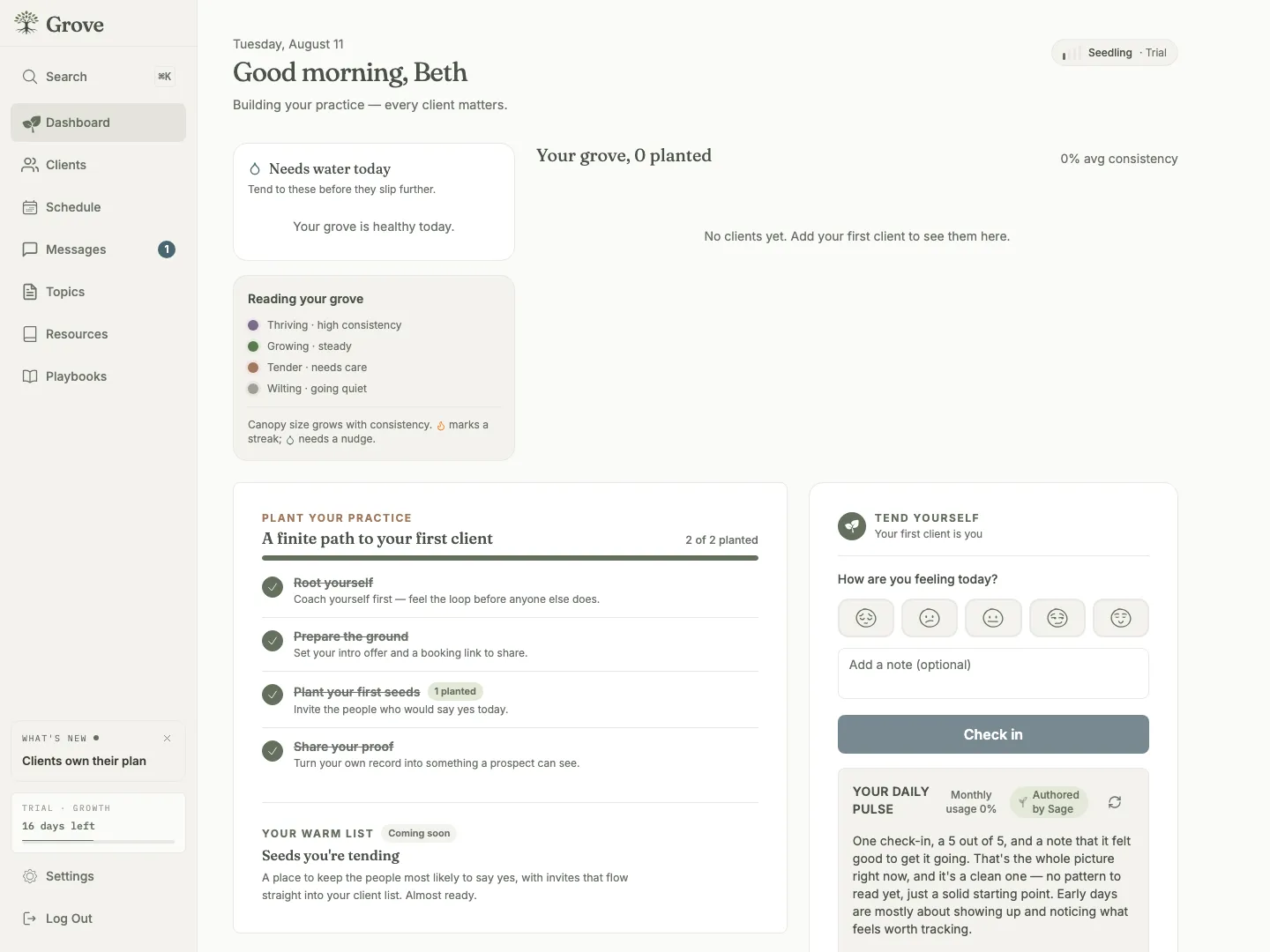
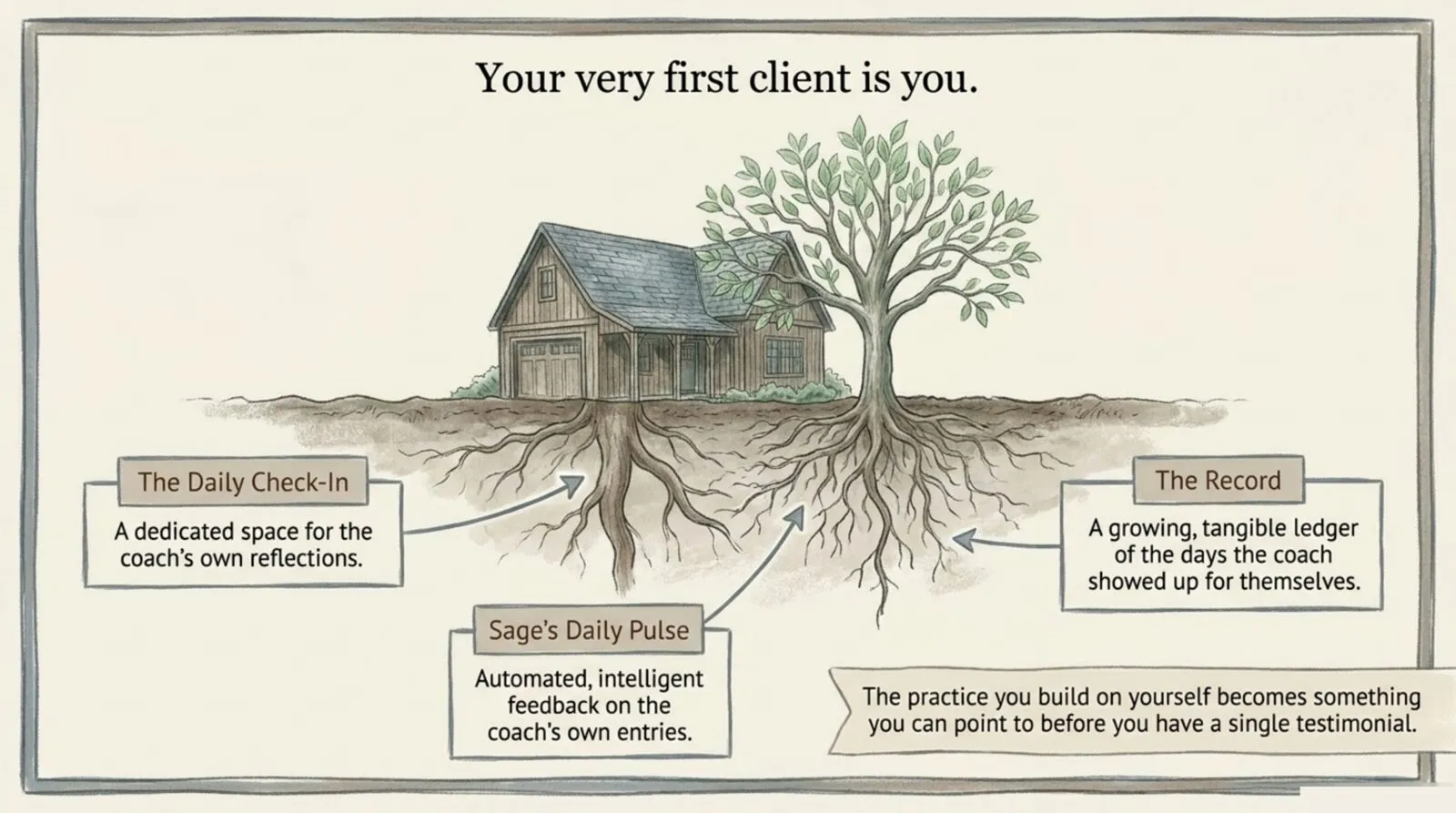
Starting out, before your roster fills, the home leads with two things. “Plant your practice” is a short, finite path toward your first client: root yourself, prepare the ground, and the steps that follow as we finish them (a couple are labeled coming soon, because they are coming soon, not because we want a longer checklist). “Tend yourself” is the other half, and it is the part I care about most: you coach yourself first. A daily check-in of your own, a Daily Pulse from Sage on your own entries, and a growing record of days you showed up. Your first client is you, and the practice you build on yourself becomes something you can point to before you have a single testimonial.
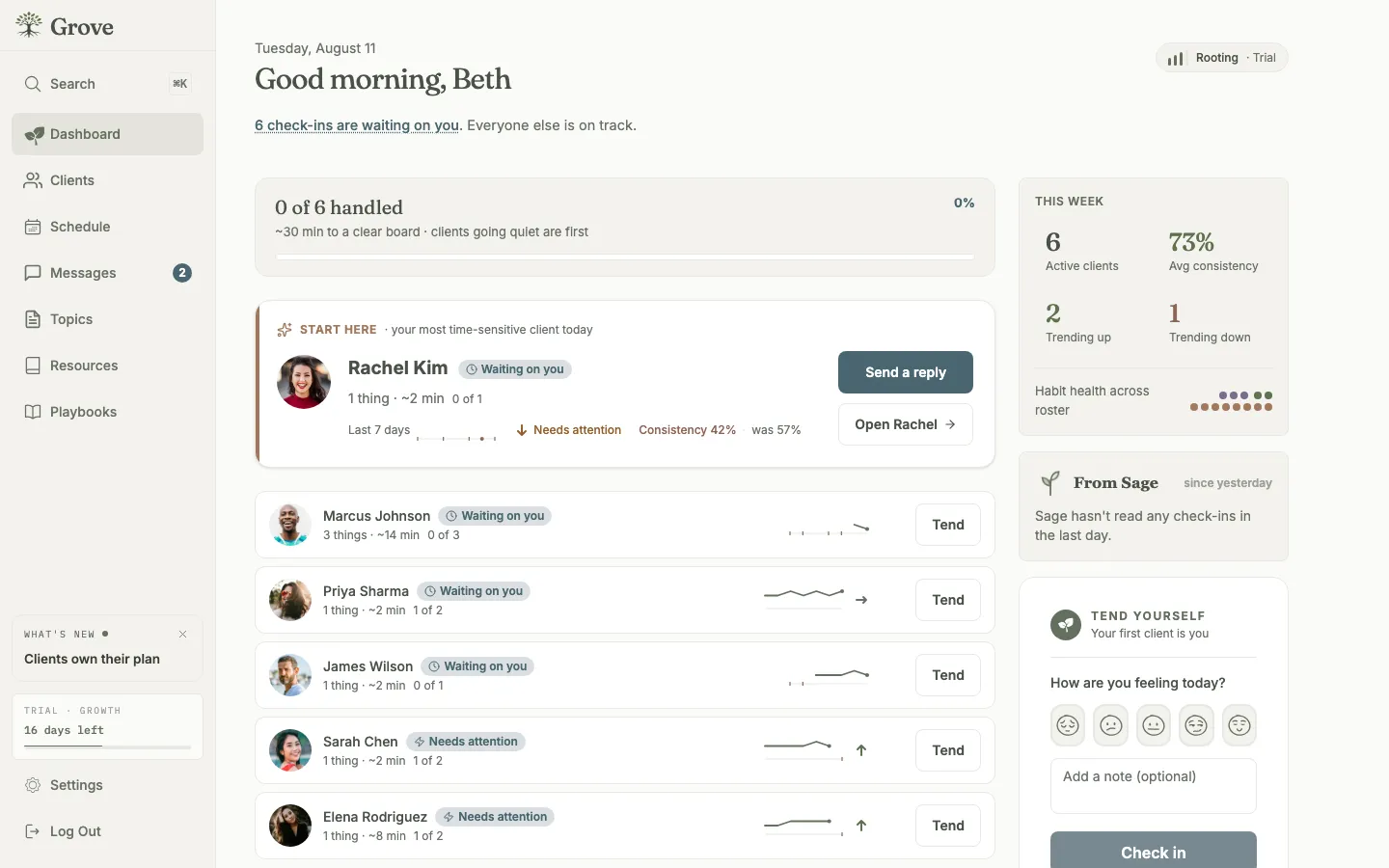
Once clients arrive, the center of gravity shifts. The triage board becomes the hero: a handled count for the day, the one client to start with, and a Tend row for everyone waiting. Around it, the rails carry the week: today’s sessions, what is coming up, a digest from Sage, onboarding follow-ups, your capacity, and your own self-coaching, now in a compact corner because your mornings belong to clients now.
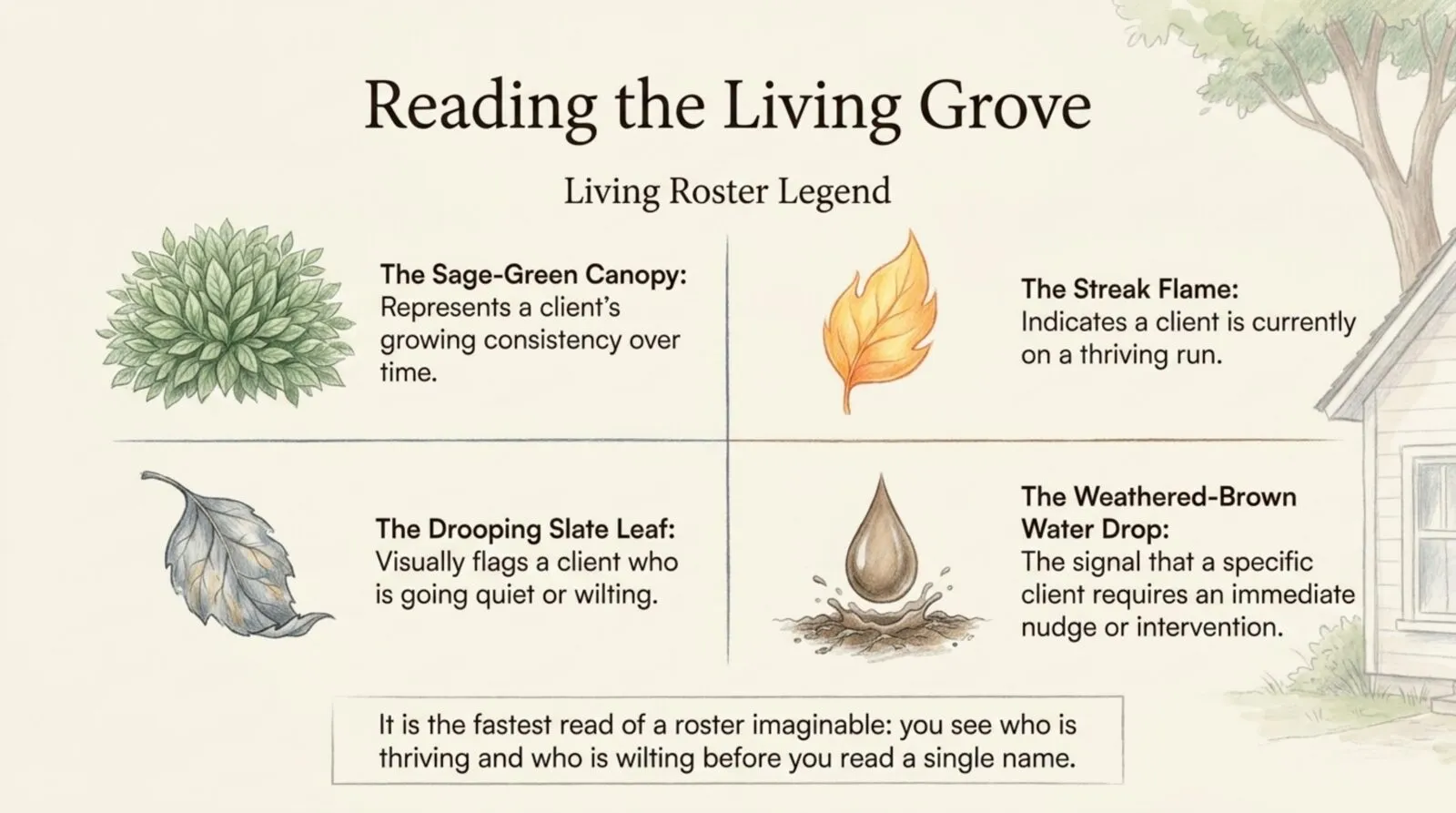
The living grove runs through both. Every client is a plant whose canopy grows with their consistency, a streak flame when they are on a run, a water drop when they need a nudge. It sounds decorative. It is the fastest read of a roster I know: you see who is thriving and who is wilting before you read a single name.
The threshold is the interesting part
The engineering was mostly ordinary. The design question was not: when exactly does a home stop being about growing and start being about tending? We draw the line at three active clients, and the handoff is deliberately undramatic. Nothing is taken away from you. The board you saw hints of earlier simply takes the center, and the growing tools step to the side rather than disappearing.
I do not know yet if three is the right number. It is the kind of decision that looks precise in code and is really a hypothesis about how a practice feels at different sizes. If yours felt different at two, or at seven, that is exactly the kind of thing I want to hear.
What I keep noticing, watching this ship, is how much of building for coaches is really building for seasons. A tool that only works in summer teaches you to dread the spring. The home you see on day one should already believe you will get there.

Founder of Grove. Twenty years building software for skilled professionals. Currently writes mostly on Tuesdays from a small studio in Austin.