
The last time I had bloodwork done, the results reached my phone before my doctor had seen them. Since 2021, federal information-blocking rules have required that patients get results without delay, so the PDF arrived the way they all arrive now: at night, unannounced, with one value in bold. I did what I suspect many of your clients do. I opened an AI chat and asked what it meant. I had theories within seconds. Confident theories, with follow-up questions and a supplement to consider.
What I did not have was a person attached to any of it.
The data was mine, and I am glad I can see it. But somewhere in that system, a decision got made about who a result speaks to first. It used to be addressed to the clinician, who would read it against everything else she knew about you before it ever reached your ears. Now it is addressed to you, and the first read happens alone, at 9pm, with a chatbot. Nobody exactly chose that outcome. It fell out of the design.
The sixty seconds after the answer appears
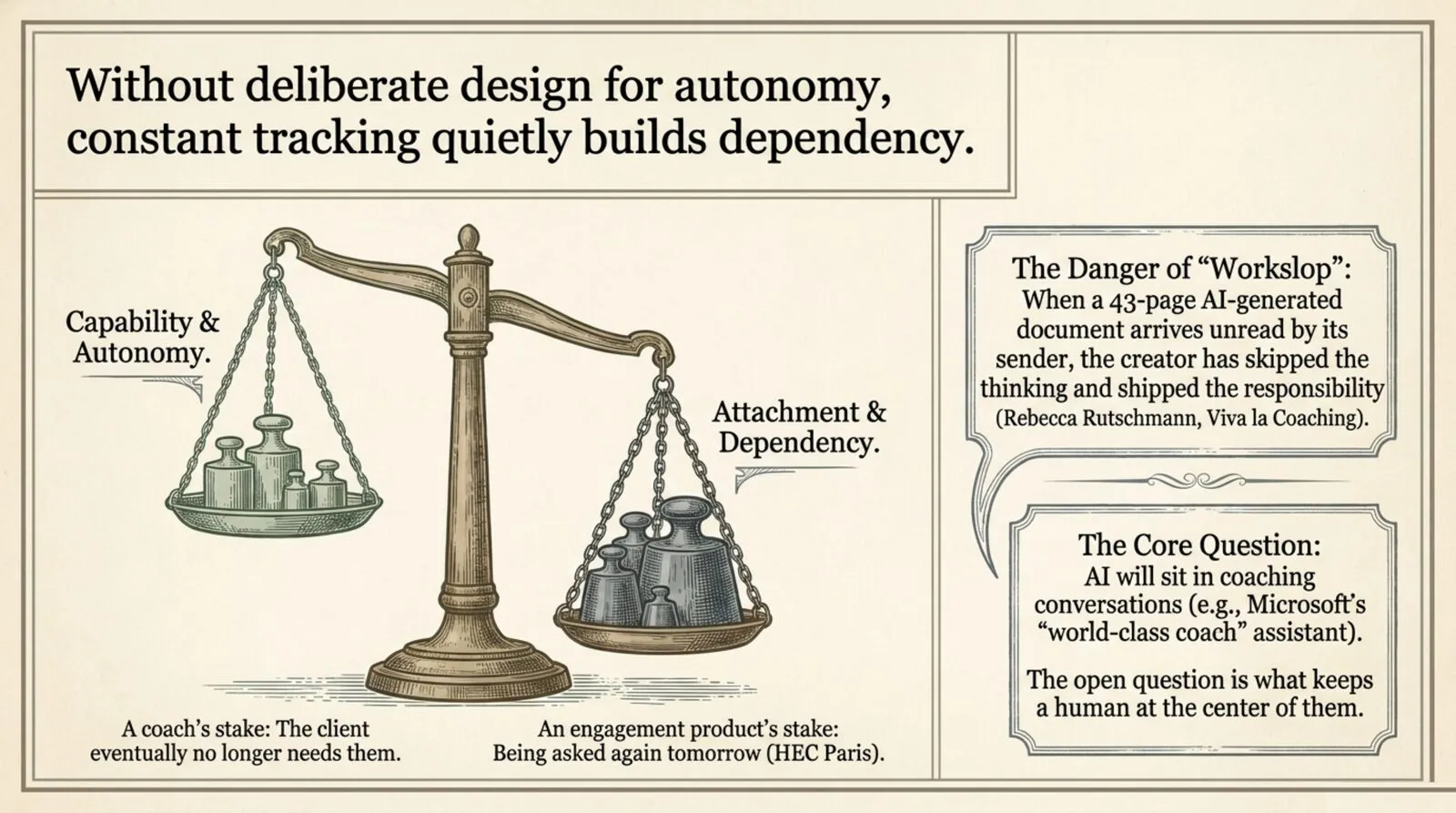
Coaches are arriving at a version of the same worry from the other side. In August, Rebecca Rutschmann, who has spent years teaching coaches AI literacy at Viva la Coaching, published an essay called “From AI Literacy to Cognitive Stewardship” that names it precisely. Her scene is one every knowledge worker will recognize: a 43-page AI-generated document, well prompted, clearly never read by the person who sent it, arriving with a note asking for her feedback. The sender skipped the thinking and shipped the responsibility.
Literacy, she writes, asks whether you can use the tool. Stewardship asks whether you take responsibility for what the tool produces before it becomes someone else’s problem. Her line for it is the best one I have read this year: it is less about the prompt and more about what you do in the sixty seconds after the answer appears.
For coaches the stakes are not a bloated strategy deck. They are a client’s autonomy. On Rutschmann’s podcast, the coaching psychologist Dr. Laura Rees-Davies, who is partway through interviewing coaches across the whole AI-adoption spectrum, puts it plainly:
Algorithms can track your goals 24/7. But without deliberate design for autonomy, that same tracking quietly builds dependency instead of capability.
And the drift toward dependency is not a character flaw in your clients or a diligence failure in you. A coach has a stake in a client eventually not needing her. An engagement product has a stake in being asked again tomorrow. Researchers at HEC Paris make the same point about AI coaching tools: their incentives bend toward attachment, because attachment is what their business models measure. Meanwhile Microsoft markets its assistant as a “world-class coach,” OpenAI opened ChatGPT Health to every US adult this July, wired to Apple Health and hospital medical records, and Google now sells a Gemini-powered personal health coach for $9.99 a month. The question of whether AI will sit in coaching conversations is settled. The open question is what keeps a person at the center of them.
Virtue becomes protocol
Rutschmann’s own essay holds the observation that points past discipline. Workslop, she writes, is an organizational failure dressed up as an individual one. I want to take that sentence seriously, because if the failure is structural, the remedy can be structural too.
Every safety discipline in history has followed the same arc: it starts as a personal virtue and matures into infrastructure. Hand-washing was a surgeon’s discipline before sterile protocol made it the room’s property. Careful pilots became checklists and interlocks. Privacy was a policy document until privacy-by-design made it an architecture requirement. The virtue does not disappear in that transition. It gets compiled in, so it no longer depends on the best day of the most conscientious practitioner.
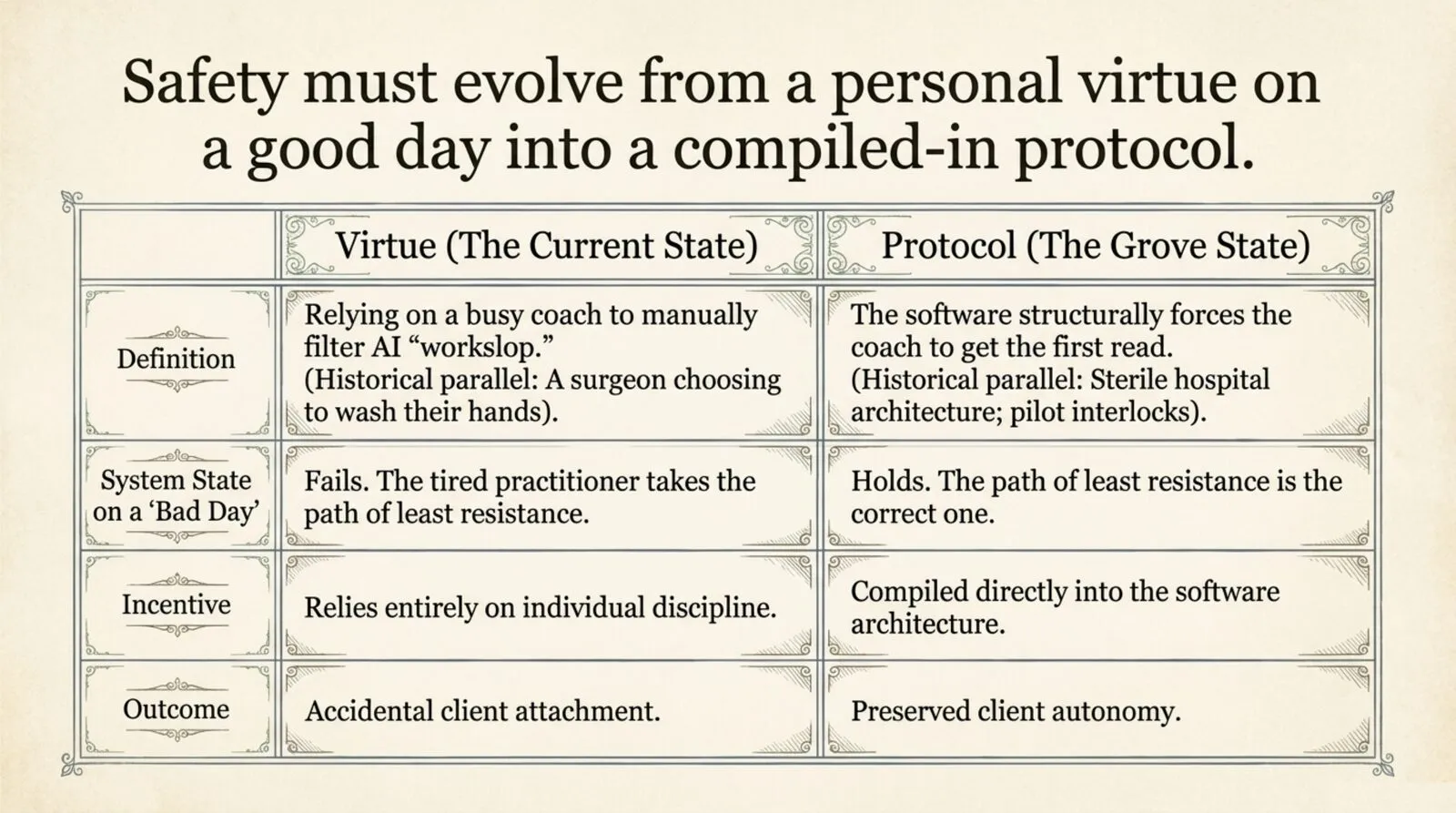
I spent twenty years in software before Grove, and much of it building internal tools for other engineers. That job has a design principle you learn early or not at all: assume the person using your tool is tired. Assume brain fog, a full pager, a Tuesday that started badly. Then do the hard work under the covers so that the path of least resistance is the correct one, and the tool gets someone’s best work out of them on their worst day. You do not fix an overworked engineer by telling her to be more careful. You fix the tool.
Swap engineer for coach and that is the design brief for AI in coaching. Rutschmann closes her essay with the right personal rule: read it first, cut what does not sound like you, decide what you actually think. That rule is stewardship as a virtue. The builder’s job is to make it a protocol: to build the product so the reading-it-first is not something a coach remembers to do, but the only way the product works at all.
The coach gets first pass
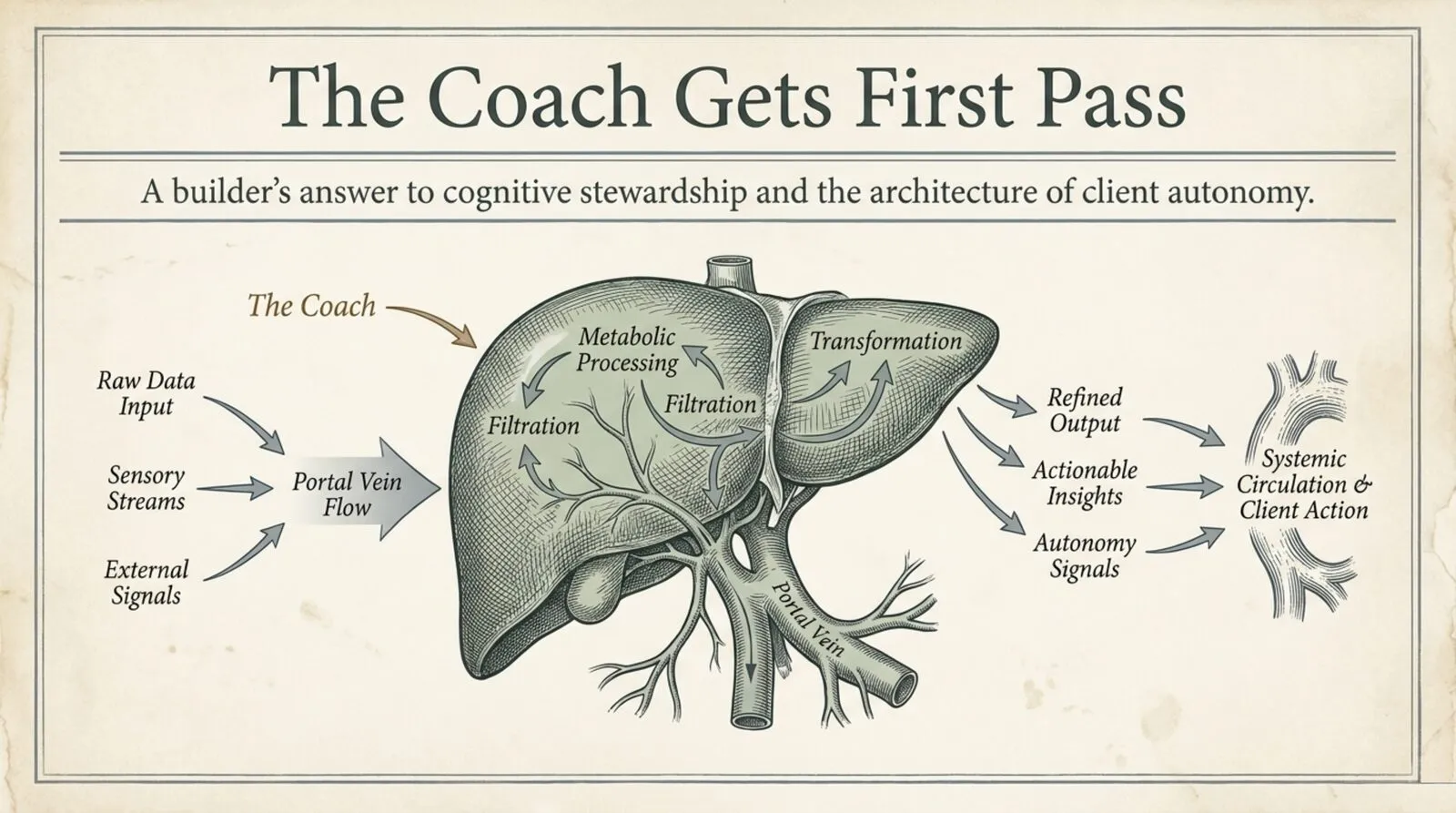
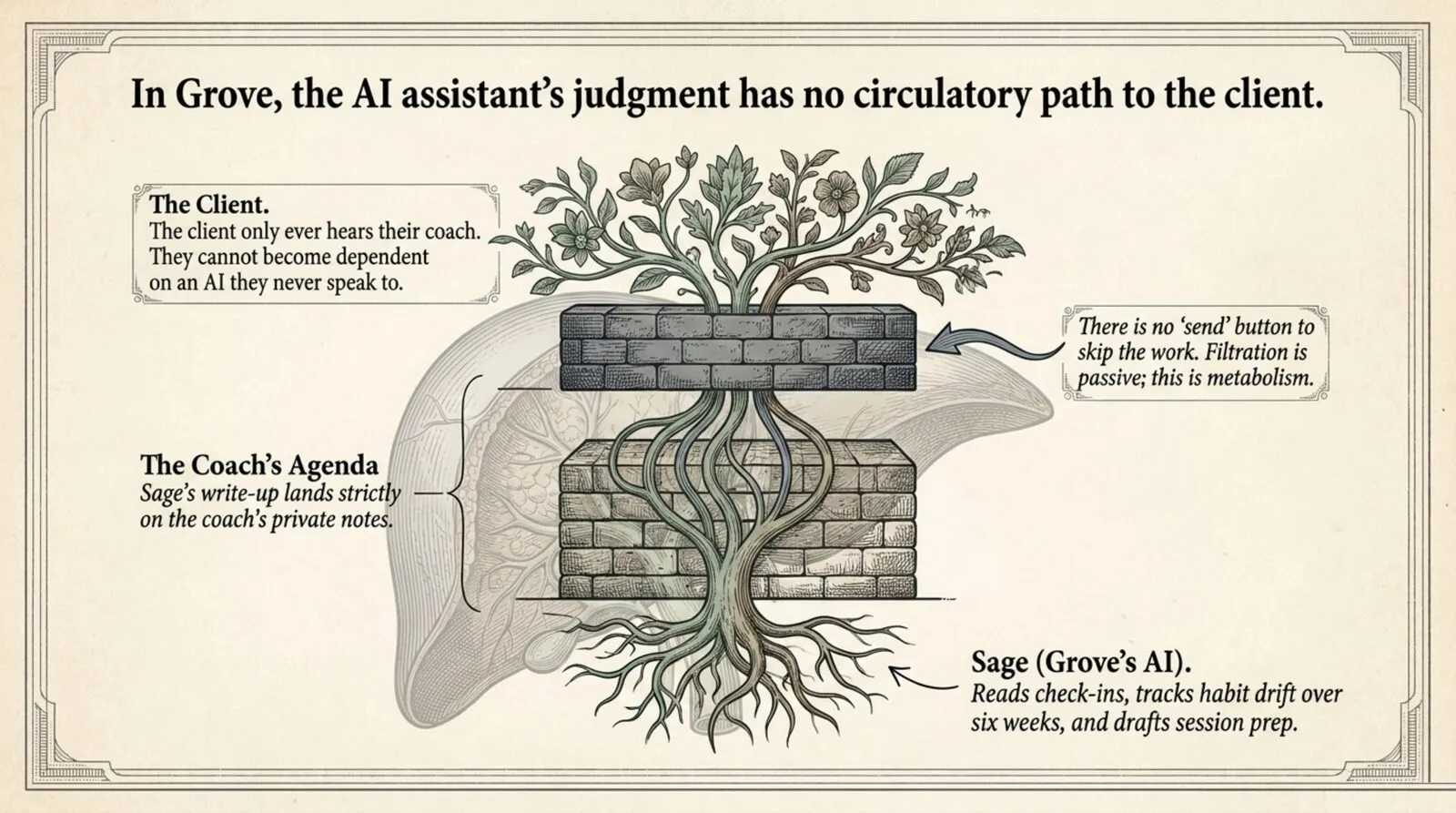
So here is the decision we made building Grove. Sage, the assistant coach built into Grove, does a lot of reading. Check-ins, reflections, the slow drift of a habit over six weeks. Before a session, it writes up what it noticed: a pattern worth asking about, a habit that might need resizing, a conversation worth having. That write-up is never delivered to the client. It is addressed to the coach, and it lands on the coach’s session agenda, next to her own notes. There is no send button to skip, because the write-up has no path to the client at all.
Pharmacology solved this exact problem long before software existed. Almost nothing you swallow reaches your bloodstream in raw form. It is absorbed into a vein that runs straight to the liver, which gets the first read, and only what the liver makes of it reaches general circulation. The name for this is first-pass metabolism, and the liver does all three things a coach does with what Sage hands her:
Clears. Some compounds never reach circulation at all. Some talking points get dismissed, and the client never knows they existed.
Transforms. Most of what passes is a metabolite, not the original substance. The assessment becomes a conversation. Sage’s paragraph becomes one good question, asked at the right moment.
Passes through. A few things go by unchanged. Occasionally a suggestion really is applied as-is, but even then the decision was the coach’s.
The client almost never receives Sage’s sentence. They receive what the coach made of it, in session, timed and framed by everything she knows that the model does not. That is not filtration. Filtration is passive, and this is the most skilled work in the building. It is metabolism.
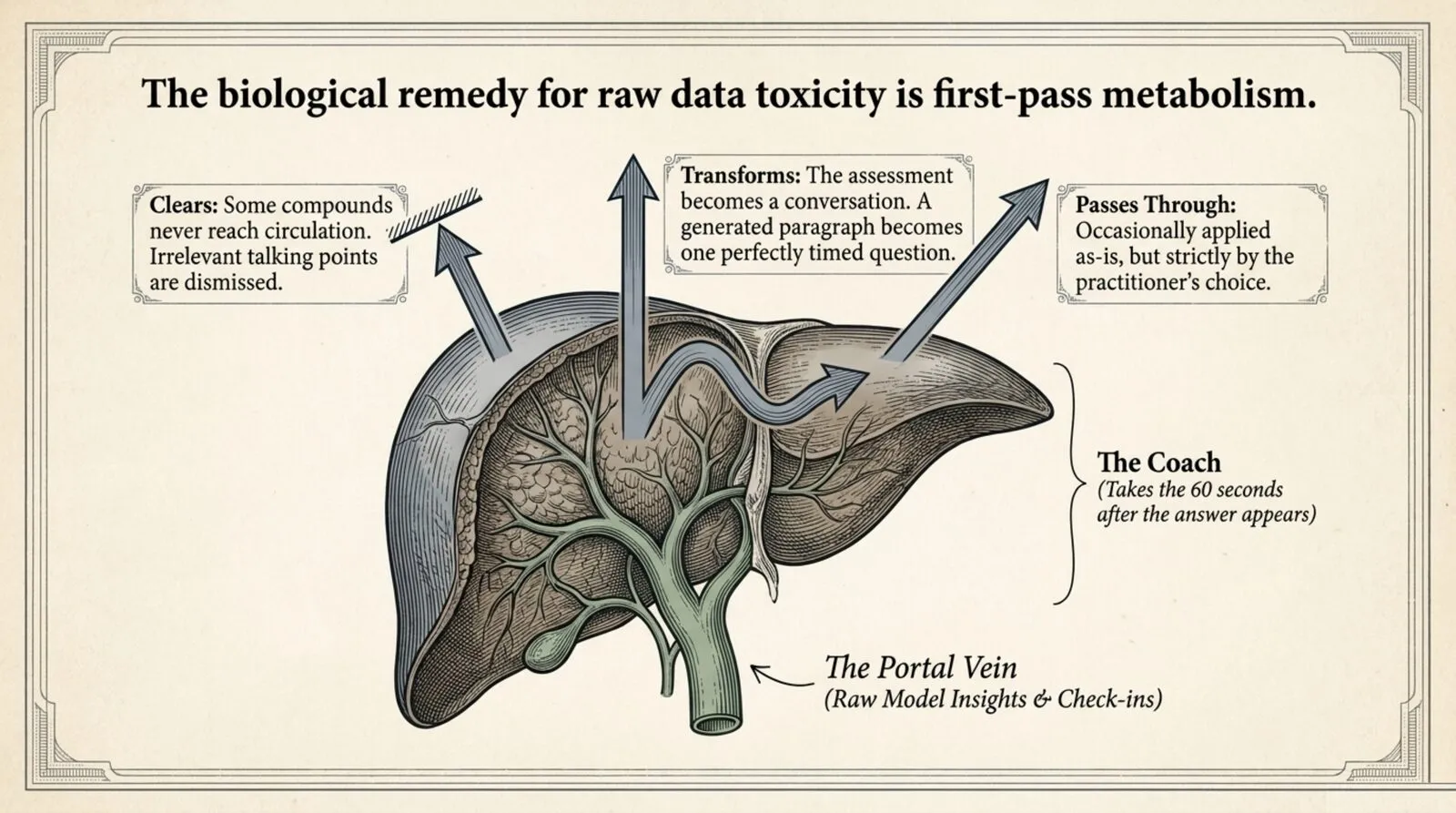
Which is why, in Grove, we say the coach gets first pass. If you came to coaching from nursing or clinical work, you already know the term. If you did not, you know it anyway: taking first pass at something just means you read it before anyone else does. Rutschmann’s sixty seconds after the answer appears belong to the coach, structurally, every time.
Notice what this does to the dependency question. A client cannot become dependent on an AI they never talk to about themselves. There is no confident midnight theory-machine wearing a coaching interface in your client’s pocket, because the machine’s read on your client is pointed at you.
Three stewards, one practice
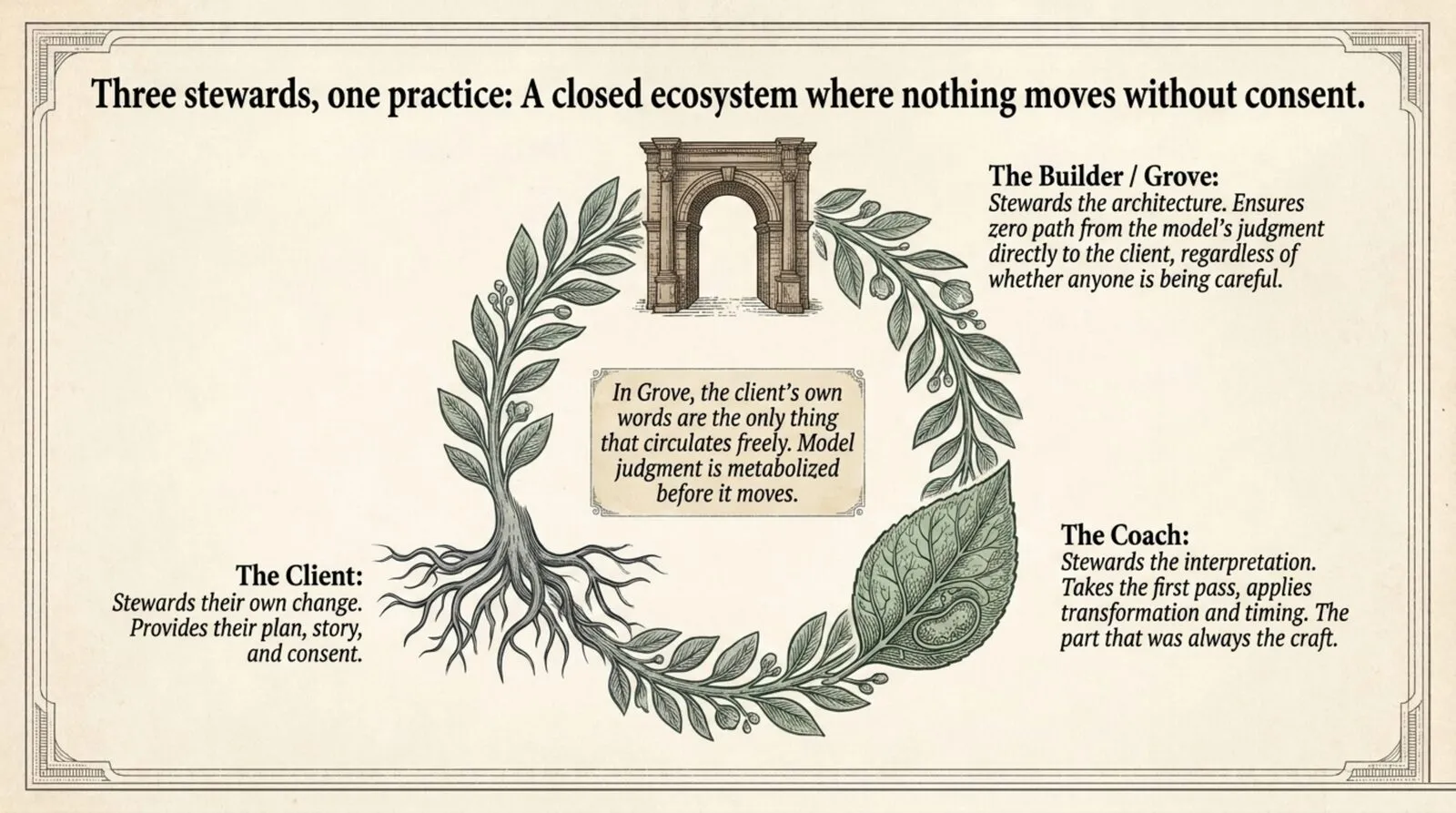
Stewardship framed this way stops being a weight the coach carries alone and becomes a collaboration with a role for each party:
The builder stewards the architecture. The model’s assessment of a client never reaches them raw. That is my share, and it holds whether or not anyone is being careful.
The coach stewards the interpretation. First pass, transformation, timing. The part that was always the craft.
The client stewards their own change. Their plan, their story, their consent. In Grove the client’s own words are the one thing that circulates freely: the story of their weeks, drawn from their own check-ins, reaches them directly, and the coach sees the identical page. Judgment about a client is metabolized before it moves. A client’s own words come back to them whole. Nothing moves anywhere without their consent.
There is one narrow register where Sage does speak to a client directly, and the exception is what proves the rule is about content, not silence. When a client finishes a check-in, Sage can reply, if that client has said yes to replies at all. The contract for those replies is noticing, not telling. Sage can reflect what the client themselves wrote, mark a win, or ask one open question that hands the thinking back. It cannot assess, and it cannot advise. The moment a reply would cross from “you named the afternoon slump three times this week” into “you should try moving your workout,” that sentence stops being a reply and becomes part of the coach’s first pass. Rutschmann quotes a line educators use, whoever does the thinking gets the learning, and the reply is built to leave the thinking with the client.
That split is also a test we can hold our own roadmap against: any new surface that would carry the model’s judgment about a client straight to that client fails it, no matter how good the writing is. And it is the closest I can get to a principle nobody at the table could reasonably reject, which is an old philosopher’s test for what we owe each other, and a decent test for software.
The client leads the coaching. That has been Grove’s spine from the start. The coach gets first pass, so the part of the work that was always human stays human, not because a busy coach resolves daily to hold a line, but because the line was poured into the foundation.
Rutschmann’s word for the duty is stewardship, and it is the right duty. The builder’s contribution is making it structural, and if that version of the duty needs a name of its own, call it metabolic stewardship: the same care she is asking for, moved out of the practitioner’s memory and into the organism’s design. The coach’s share of it is the first pass. The models will keep getting better at the reading, and none of that changes the question that actually decides whether all this tracking builds capability or dependency: who gets the first read. That should not be a habit anyone has to keep. It should be a protocol somebody builds, once, on purpose.

Founder of Grove. Twenty years building software for skilled professionals. Currently writes mostly on Tuesdays from a small studio in Austin.