
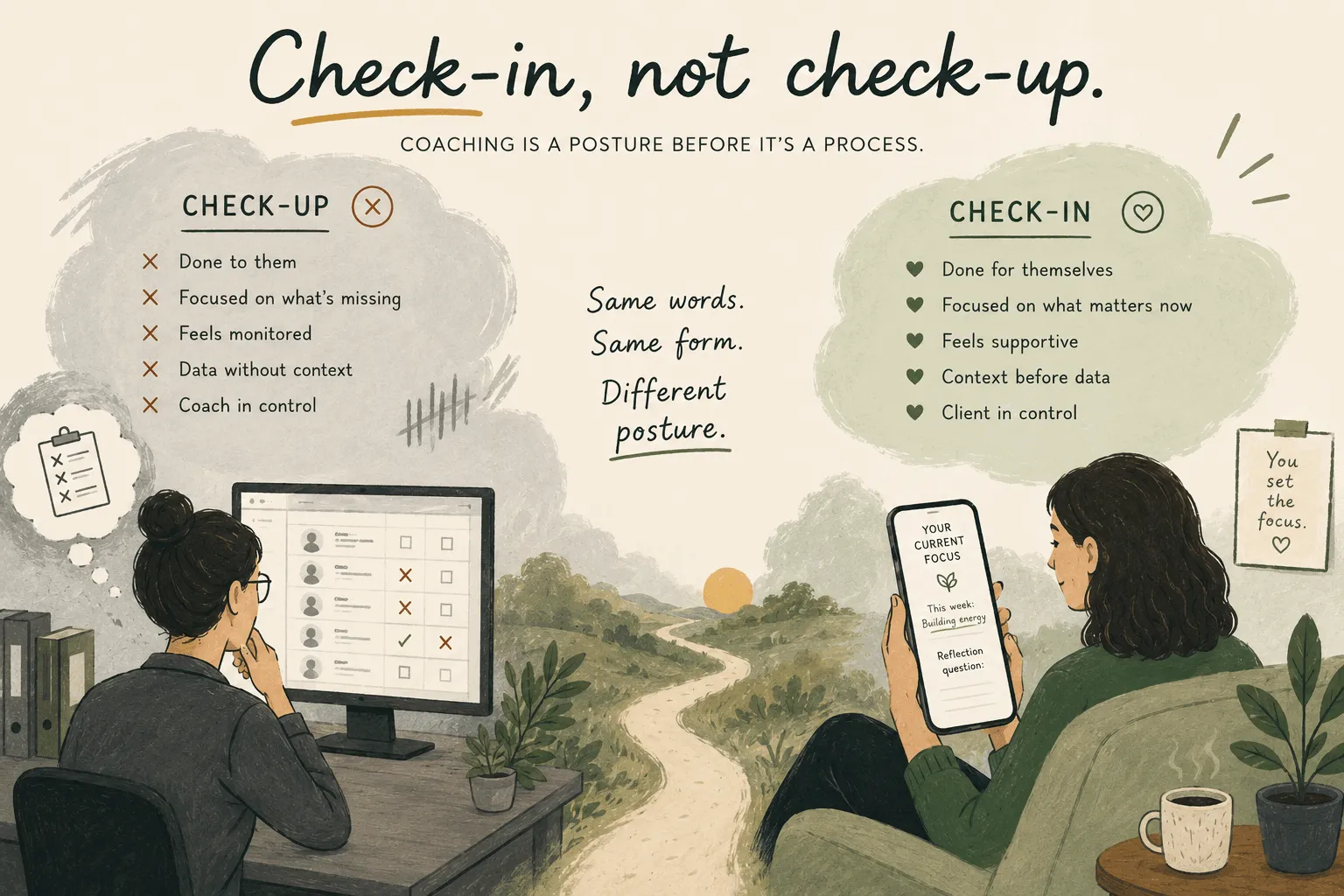
A line I keep coming back to when I think about coaching software:
Daily check-ins are great when they feel like checking in. They’re poison when they feel like checking up.
A check-in is something a client does for themselves, with you nearby. A check-up is something done to them, by you, for your benefit. Same words, same form, different posture. The form doesn’t know which one it is.
What does know: tone, timing, who chose what’s on the page, and what the coach does with the answer. If the morning prompt sounds clinical, it’s a check-up. If the items being logged were assigned top-down with no conversation, it’s a check-up. If you only reach out when the data looks off, it’s a check-up. If the dashboard turns the client into a row in a spreadsheet, it’s a check-up.
The fix isn’t to send fewer prompts or strip out the checklists. It’s to make sure the client’s voice is the loudest one at every step. Three product decisions in Grove came out of that distinction.
1. The items being tracked are co-authored, not assigned. Every Grove session ends in a lock-in: the coach and client agree together on the focus for the week, the habits to track, the actions to commit to, and which measurements matter. By the time the client opens the app on Tuesday morning, every checkbox traces back to something they helped name in conversation a few days earlier. The list still looks like a checklist. The contents are theirs.
2. The morning surface leads with the focus, not the tally. The client app opens to “Your Current Focus”: the topic from lock-in, with a reflection question shaped around it. Habits, actions, and measurements sit below that, in service to the focus, not in place of it. The same data fields a tracking app would show, in a different priority order. The point of the morning isn’t to count rows. It’s to think for sixty seconds about the part of the work that matters this week.
3. Reactions over reports, daily. When a client posts a check-in, what they want on the other side is a person, not a stat sheet. Grove nudges the coach toward a same-day reaction (a sentence, a heart, a question) rather than waiting for a weekly recap. Some coaches keep a different cadence and that’s fine, but the default rhythm we encourage is daily and human. The data still rolls up neatly when you sit down for session prep. The touchpoints in between are conversational, not analytical.
Coaching is a posture before it’s a process. The tools should be downstream of that, not the other way around.

Founder of Grove. Twenty years building software for skilled professionals. Currently writes mostly on Tuesdays from a small studio in Austin.