
A coach told me last week about clients who just drift away. Not a fight, not a final session, not even a cancelled appointment she could point to. They get a little quieter. The check-ins thin out. A reschedule turns into a longer gap. And then one day she realizes she has not heard from them in a month, and she is not sure what happened to them. That last part is the one that stuck with me. Not sure what happened to them. Not "they quit." Not "they finished." Just gone, with no ending she gets to read.
I have now had this conversation with every coach I have interviewed while building Grove. Every single one. It comes out differently each time, but it is the same loss underneath.
One coach has a name for the sharp version of it: the "Minnesota No." In a place too polite to say no out loud, the no just goes quiet. It is the client who nods along, agrees with the plan, and then, instead of telling you it is not working, simply never comes back. She reaches out. If you need something different, just let me know. Silence. She has been doing this long enough that she built a standing mid-engagement check-in for the sole purpose of catching the Minnesota No before it becomes a ghost. A coach so marked by the disappearing that she engineered a way to see it coming.
Another coach put a number on it that I have not been able to shake. A client paid for twelve sessions and showed up for one. Eleven sessions of intention, bought and abandoned.
The part nobody tells you about
Here is what surprised me, hearing it again and again: the dominant feeling is not sadness. At first it is anger and self-doubt.
You replay it. You get a little resentful. After everything, the prep, the care, the personalization, the hours you spent thinking about this person between sessions, they could not send one text? You start building the case against them in your head. You half-compose the message you will never send. You feel, honestly, a bit abandoned, and then you feel slightly ridiculous for feeling abandoned, because this was a business relationship and you are a professional and people leave services all the time.
It took me a while to understand what I was actually hearing in those conversations. The anger is not the real thing. The anger is grief that has not found its shape yet. It is the loss coming out sideways, because the front door is locked.
It is locked because nobody gives you permission to grieve a client. There is no language for it. You cannot really tell people you are heartbroken that a stranger stopped using your service. So the feeling has nowhere sanctioned to go, and it comes out as irritation, as resentment, as a story about how they were never that committed anyway. Underneath all of it is a simple, unglamorous fact: it is a hurt. It is a loss. It is an abandonment. And it is allowed to be, even inside a relationship you got paid for.
Why it cuts deeper than business should
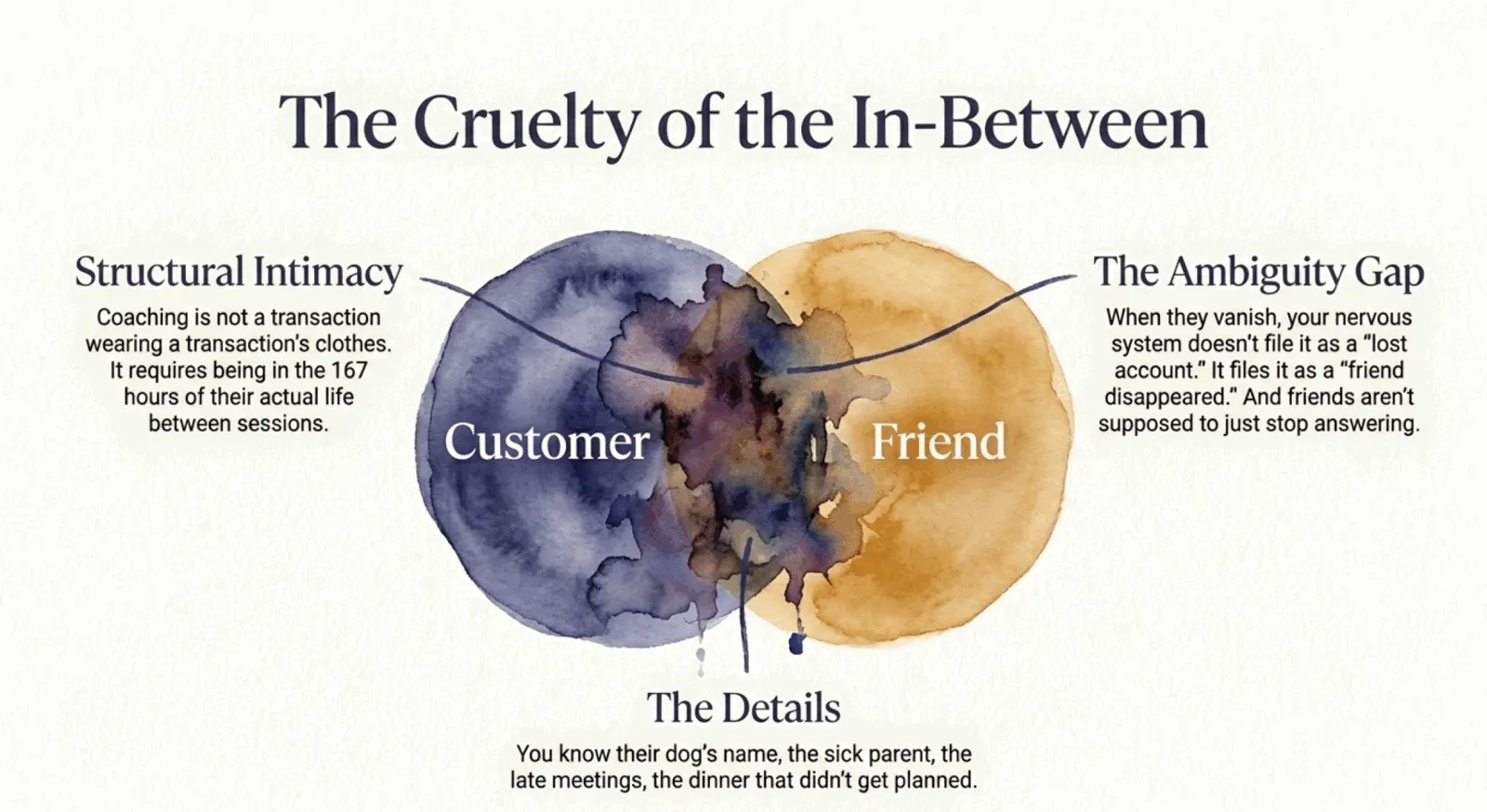
The reason it lands so hard is that coaching is not a transaction wearing a transaction's clothes. It is personal, structurally, by design.
You know about their father's heart attack. You know the dog's name and the vacation they were nervous about falling off track during. The good coaches I have talked to take those details down almost compulsively. One types them like a court reporter during every call, because the personalization is the coaching, not a nicety on top of it. You are not managing their macros. You are in the 167 hours of their actual life, the meetings that run late and the gym bag still upstairs and the dinner that did not get planned.
So when they vanish, your nervous system does not file it under "lost account." It files it under "a friend disappeared." Because in every way that your body keeps score, they were one. And friends are not supposed to do that. They are not supposed to just stop answering.
That is the cruelty of the in-between. They were not quite a customer and not quite a friend, and that exact ambiguity is why the disappearance hurts in a place a cancelled subscription never could.
What actually happened to them
Here is the turn, and it came from a coach too.
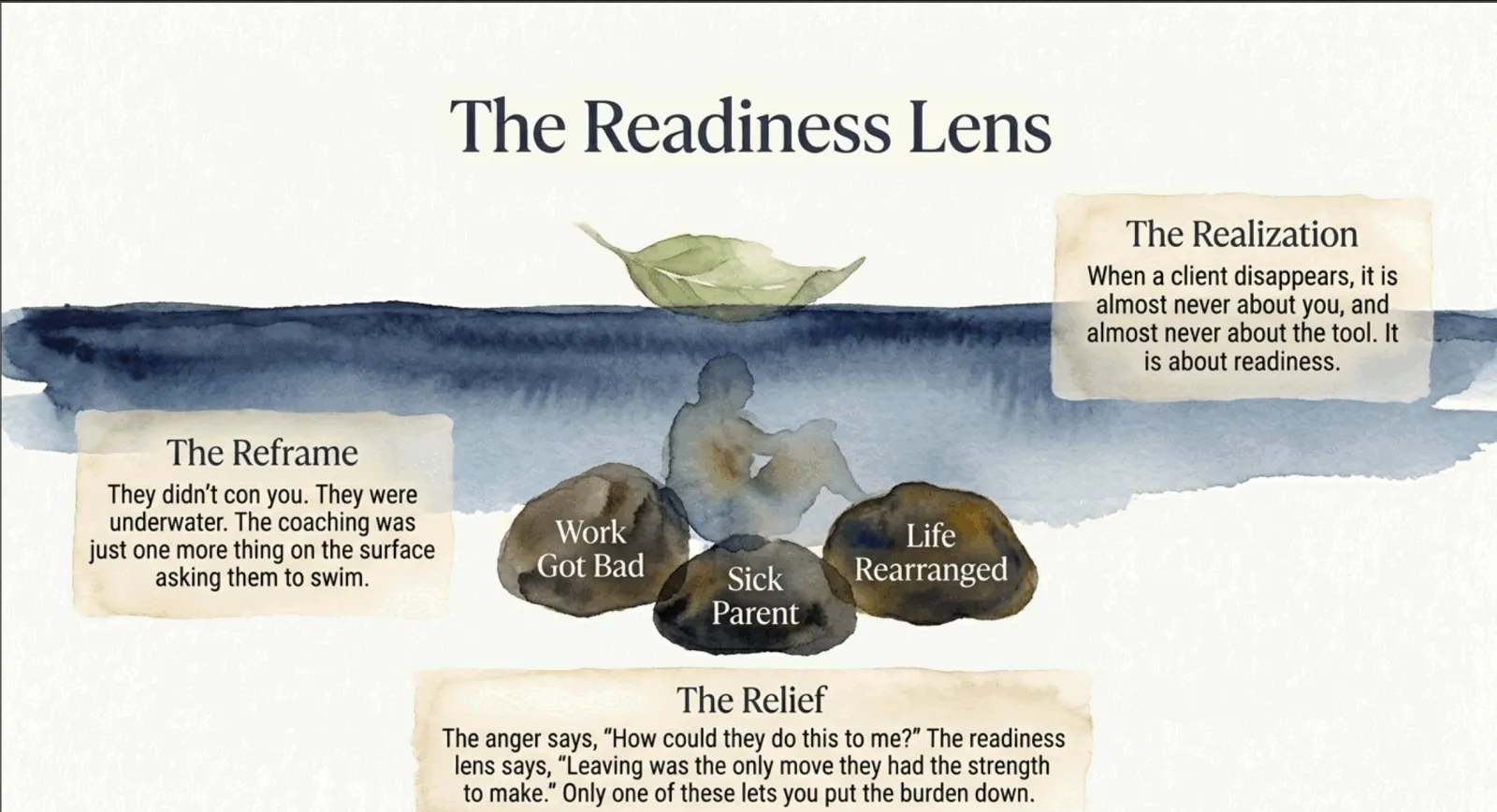
Her read, after years of it: when a client disappears, it is almost never about you, and almost never about the tool. It is readiness. The person was not ready for the size of what you were asking them to do, or life rearranged its priorities around them without asking permission first. Work got bad. A parent got sick. The change you were guiding them toward required a version of their life that did not exist yet.
The client who showed up for one of twelve sessions did not con anyone. She was, most likely, underwater. And you were one more thing on the surface asking her to swim.
This does not erase the loss. You are still allowed to grieve it. But it gives the grief somewhere kinder to rest than resentment. The anger says how could they do this to me. The readiness lens says they were drowning, and leaving was the only move they had the strength to make. Both can be true. Only one of them lets you put it down.
A door that is not disappearance
I want to be careful here, because the wrong response to all of this is to clutch tighter. To chase. To turn every quiet week into an alarm and every soft signal into a reason to pull someone back who is trying, gently, to step away. That is not coaching. That is checking up on someone, and people can feel the difference.
But there is a better response hiding inside the problem itself. People ghost when leaving feels like failure and the only available exit is silence. Nobody drifts away because drifting is pleasant. They drift because there is no graceful door, so they take the only one there is: they stop answering.
So we are building the graceful door.
One of these same coaches asked us for a way to put a client on hold. Not archive them, not end it, just pause. That request is the reason the feature exists. A pause says the thing a ghost cannot: you do not have to disappear to take a break. The relationship stays intact. The streak does not break for stepping back. The door stays open, with the light on, for whenever ready actually arrives. We started with coach-initiated pauses; we are building toward letting clients reach for that door themselves, so that "I need to step back for a while" is a button, not a vanishing.
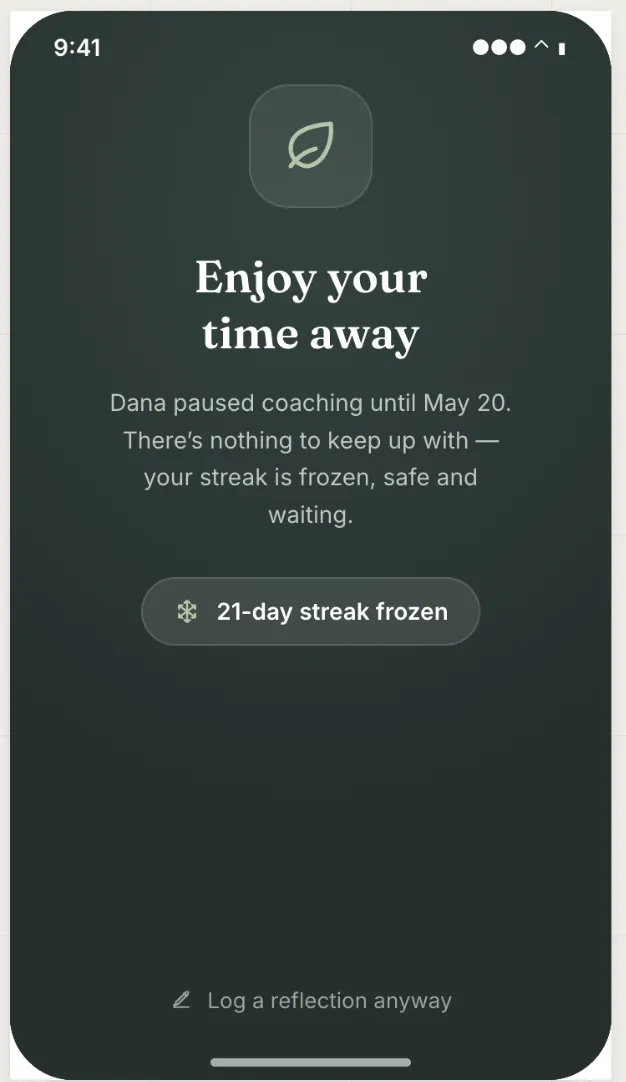
A door that isn't disappearance. Coaching paused, the streak frozen right where it was left, and the light still on: log a reflection anyway.
The other half is presence that does not pressure. When a client finishes a check-in, Grove offers a single next step, not a list, not a nagging push, just one small thing shaped around where they actually are. And when the signal is thin, when it genuinely does not know enough to suggest an action, it does not invent one to seem useful. It asks a gentle question instead. That restraint is the whole point. The goal is not to engineer retention. It is to be the kind of steady, low-pressure presence that makes staying loosely attached easier than disappearing.
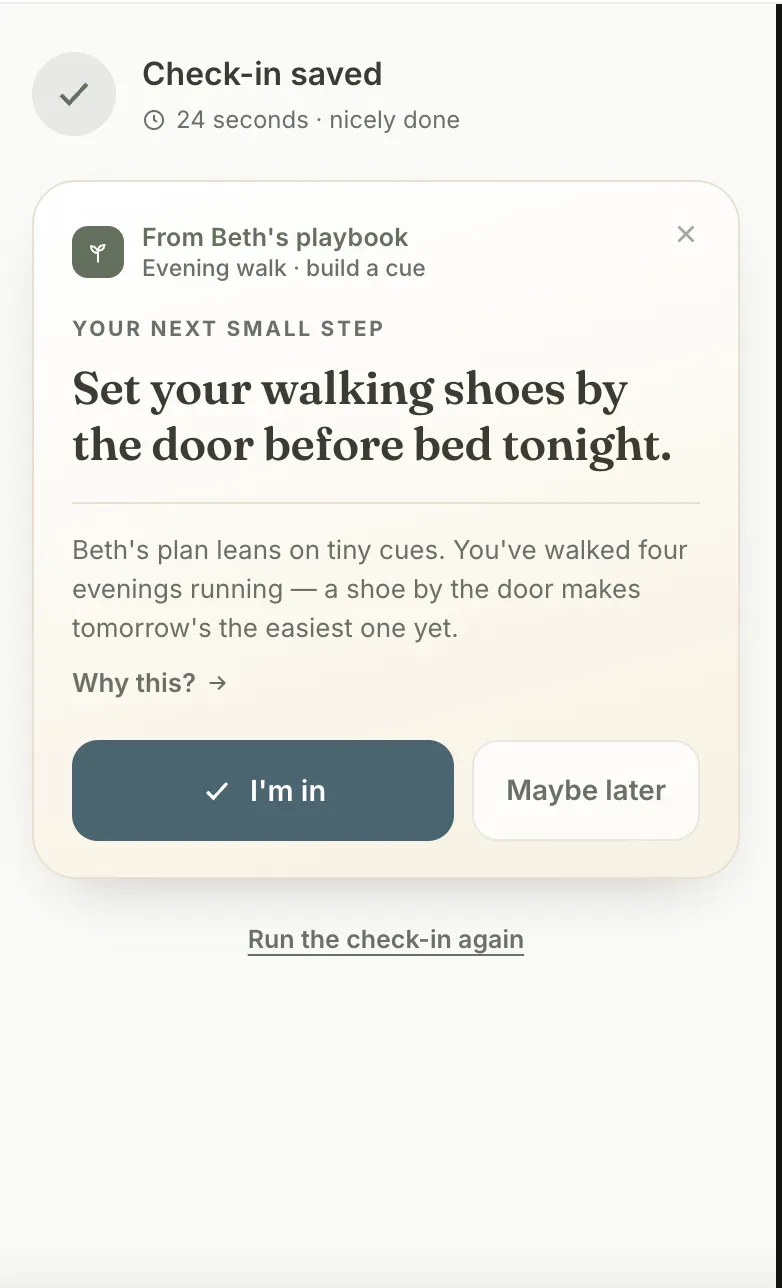
One small step, at the moment it lands, with "Maybe later" sitting right there. Presence, not pressure.
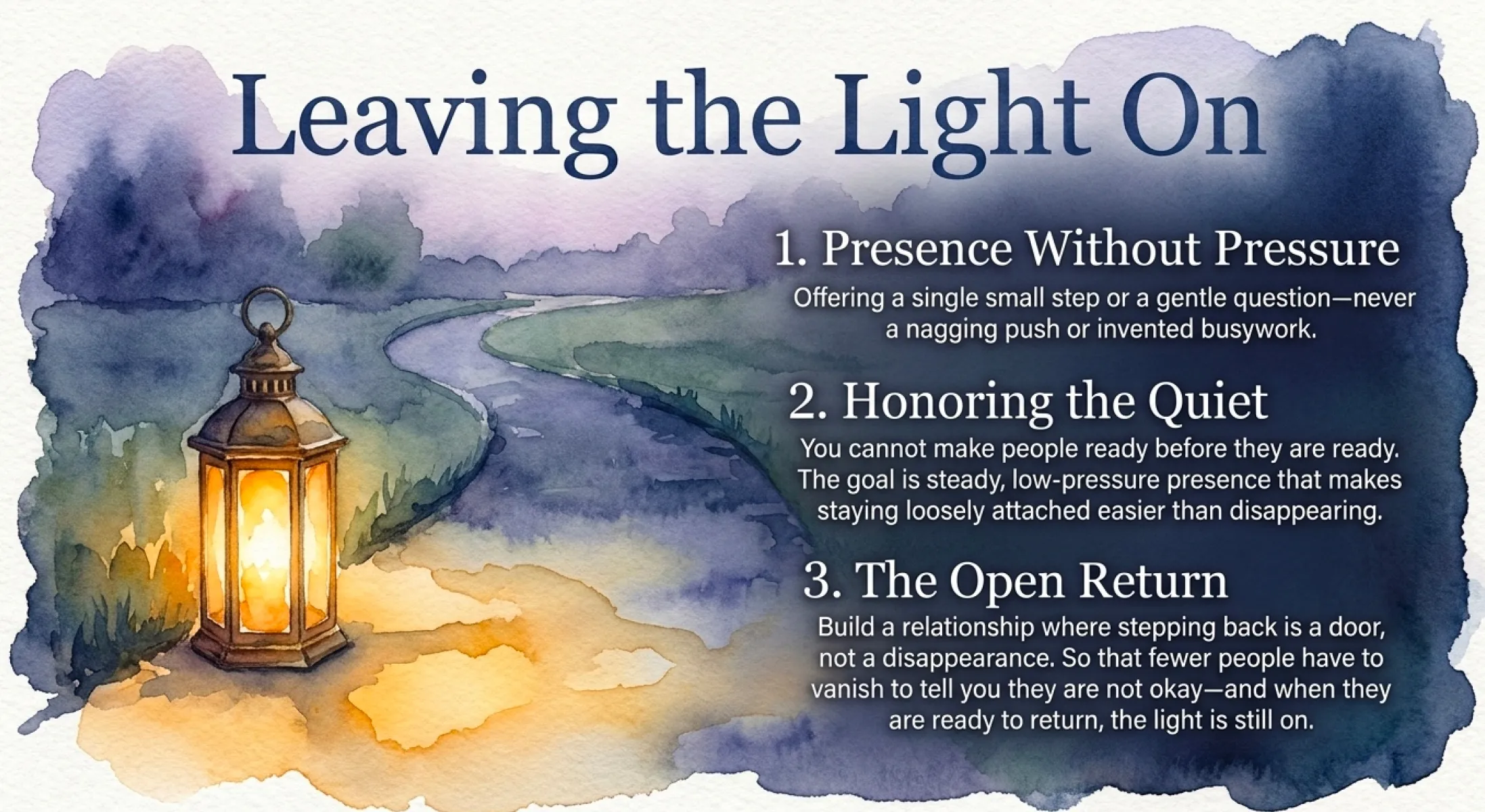
You cannot make people ready before they are ready. You cannot stop someone whose life has filled to the brim from setting your work down to free up their hands. That part is not yours to fix, and the grief when it happens is real and worth honoring rather than rushing past.
What you can do is build a relationship where leaving does not have to mean lying. Where stepping back is a door, not a disappearance. Where the quiet is met with a question, not a chase. So that fewer people have to vanish to tell you they are not okay, and so that when they come back, and a surprising number do, the light is still on.

Founder of Grove. Twenty years building software for skilled professionals. Currently writes mostly on Tuesdays from a small studio in Austin.